When the Shopper Says 'Too Expensive': How Price-Pack Architecture Can Save Your FMCG Brand in Indonesia
A practical and witty guide to price-pack architecture in Indonesia, showing how FMCG brands can stay affordable, protect margins and keep shoppers buying when demand is under pressure.
There is a sentence every FMCG salesperson in Indonesia eventually hears.
It usually comes from a warung owner, a minimarket buyer, a distributor, a supermarket category manager, or a consumer who is standing in front of the shelf doing mental mathematics with the seriousness of a finance director.
The sentence is simple:
"Sekarang agak mahal ya."
There it is.
Four words that can ruin a sales forecast.
The product is still good. The brand is still known. The packaging still looks nice. The marketing team still believes in the campaign. The sales manager still has a target that was built in a spreadsheet during happier times. But the shopper has spoken.
Too expensive.
Now, this does not always mean the shopper hates your brand. It does not always mean the product is wrongly priced. It does not even mean the consumer has stopped wanting it.
Sometimes the consumer is saying something more subtle.
"I still like this brand, but not at this pack size."
"I still want this product, but not in this channel."
"I still trust you, but I need a cheaper way in."
"I would buy more if the unit economics made sense."
"I need value, but I do not want to feel poor while buying it."
This is where price-pack architecture becomes one of the most important tools in FMCG.
Unfortunately, many companies treat it like packaging admin.
It is not.
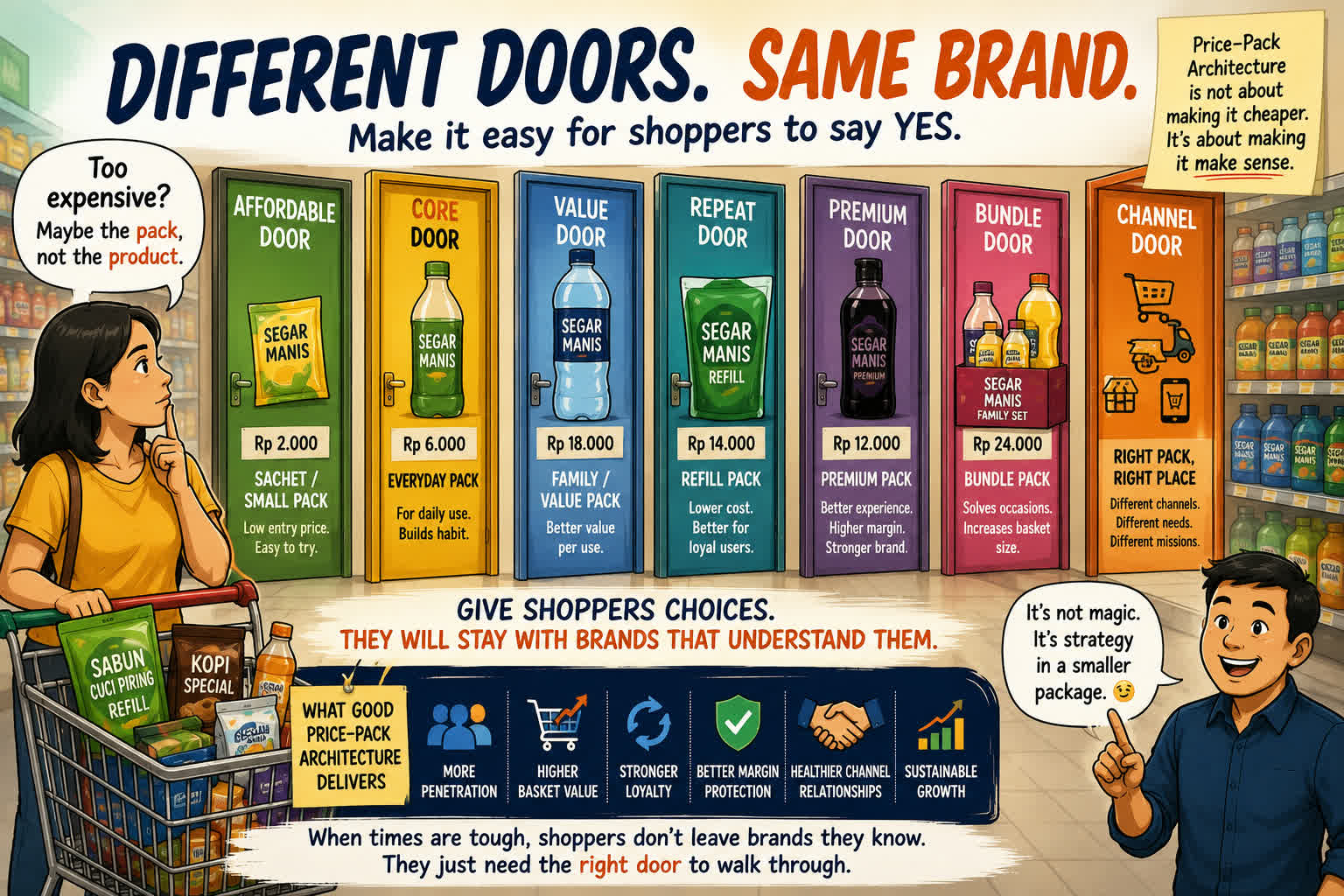
Price-pack architecture is not just deciding whether a pack should be 80ml, 100ml, 250ml or 1 litre. It is the art of designing different doors into the brand. Small doors for affordability. Bigger doors for value. Premium doors for aspiration. Refill doors for repeat. Trial doors for new users. Bundle doors for e-commerce. Fast-moving doors for traditional trade. Convenient doors for quick commerce.
A good price-pack architecture helps consumers stay with the brand when money becomes tighter.
A bad one forces consumers to choose between paying too much, switching down, or leaving the brand completely.
And in a market like Indonesia, where shoppers are practical, price-aware, channel-fluid and very good at comparing value, this can decide whether your brand survives a weak demand period or ends up in the tragic category of "good product, wrong pack, wrong price, wrong moment."
The Brand That Thought Discounting Was a Strategy
Let us imagine a fictional FMCG brand called SegarManis.
SegarManis sells a ready-to-drink beverage. The product tastes good. The brand has decent awareness in Jakarta and Bandung. It sells through minimarkets, some supermarkets, a few distributors, and online marketplaces.
For a while, the business looks healthy. The 350ml bottle is the hero SKU. It looks nice in the chiller. It photographs well. It has enough margin to make the finance team breathe normally. Consumers like it.
Then demand softens.
Not completely. People are still buying drinks. They are still thirsty. Indonesia has not suddenly become a country of camels. But shoppers become more cautious. They compare more. They reduce impulse buys. They choose cheaper alternatives. Some switch to larger value packs at home. Others buy smaller single-serve formats only when they really want them.
SegarManis starts missing its target.
The first reaction is predictable.
Promotion.
The team discounts the 350ml bottle in modern trade. Then online. Then at selected distributors. Then during payday campaigns. Then during double-date marketplace campaigns. Then during a random Tuesday campaign that nobody can explain but everyone supports because the number is behind.
Sales move.
For a while.
Then the same problem returns.
The shopper has learned that SegarManis is often available cheaper. Retailers ask for more support. Distributors wait for better deals. Online conversion drops when there is no voucher. Margin becomes thinner. The sales dashboard looks busy, but finance looks like it has seen a ghost.
This is the moment when the company realises the painful truth.
The problem was not only price.
The problem was architecture.
SegarManis had one main door into the brand: the 350ml bottle. When that door felt expensive, the company kept trying to lower the door instead of building other entrances.
That is not strategy.
That is carpentry with a discount sticker.
Consumers Do Not Always Trade Out. Sometimes They Trade Around.
When shoppers become more cautious, brands often fear they will lose consumers completely. Sometimes they do. But many consumers do not immediately leave a brand. They adjust how they buy.
A mother who used to buy a large pack may switch to a smaller pack to control cash outflow.
A young office worker may still buy a snack brand, but only in single-serve packs near payday.
A household may switch from a bottle to a refill pouch.
A beauty shopper may buy the cleanser now and postpone the serum.
A coffee consumer may buy sachets during the week and a larger pouch for home use when salary arrives.
A shopper may choose a family pack if the unit price is better.
Another shopper may choose a small pack because the absolute price is lower.
Both are value-seeking, but in different ways.
This is why price-pack architecture matters.
Value is not one thing.
For some consumers, value means the lowest cash outlay today. For others, it means better cost per use. For others, it means convenience. For others, it means trusted quality at a price that does not feel insulting. For others, it means a bundle that solves a routine.
If you only offer one pack and one price point, you are asking all shoppers to enter through the same door.
That is fine when the market is easy.
When the market is difficult, some shoppers need another door.
The Small Pack: The Affordable Door
Indonesia understands small packs very well.
Sachets, small bottles, mini pouches, travel sizes, small trial packs and affordable single-serve formats are part of everyday FMCG life. They exist for a reason. They make brands accessible.
A small pack lowers the cash barrier.
A consumer may not want to spend Rp35,000 today, but she may spend Rp5,000 or Rp10,000. A shopper may not want to commit to a large bottle, but she may try a mini. A warung owner may not want to stock a slow-moving premium pack, but may accept smaller units that move faster.
Small packs are not only for low-income shoppers. They are also for trial, convenience, travel, impulse and risk reduction.
A skincare sachet allows trial. A shampoo sachet supports daily affordability. A small beverage bottle supports impulse. A mini sambal pack supports sampling and foodservice. A small detergent pack helps households manage weekly cash. A travel-size body lotion fits in a bag. A mini premium snack allows indulgence without guilt.
The danger is thinking small packs are automatically good.
They are not.
A small pack must still make commercial sense. It must have proper margins, manageable packaging costs, realistic production efficiency and a clear channel role. If the small pack is too cheap, too costly to produce, or steals volume from a more profitable core pack without expanding the user base, it can become a tiny problem multiplied by millions.
Small packs are powerful when they create access.
They are dangerous when they create margin leakage.
The question is not, "Should we make it smaller?"
The question is, "What job will the smaller pack do?"
The Large Pack: The Value Door
If the small pack solves affordability today, the large pack solves value over time.
This is where many brands misunderstand consumer behaviour. A value-conscious shopper is not always looking for the cheapest pack. Sometimes she is looking for the smartest pack.
A family buying detergent may prefer a larger pack if the cost per wash is better. A heavy coffee user may prefer a larger pouch. A household that trusts a cooking oil brand may choose a bigger size when cash allows. A loyal skincare user may buy a larger refill if the routine is already established.
Large packs work when the consumer already trusts the brand and wants better unit economics.
They are not always ideal for trial. Asking a new consumer to buy a large pack can feel like asking someone to marry you on the first date. Relax. Let them try the product first.
But for repeat users, large packs can protect loyalty and increase basket value.
The problem comes when companies confuse large packs with premium positioning. A large pack should usually communicate value clearly. If the price gap is too small, shoppers may not see the benefit. If the pack is too expensive in absolute terms, it may be out of reach during weak demand. If the product has expiry or freshness concerns, shoppers may avoid large sizes.
A good value pack tells the shopper:
"You already trust us. Here is a smarter way to buy."
A bad value pack tells the shopper:
"Please spend more because our factory made this size."
The shopper is not emotionally responsible for your production planning.
The Refill Pack: The Repeat Door
Refill packs are one of the most underrated tools in FMCG.
They can reduce packaging cost, support sustainability narratives, lower price per use, encourage repeat purchase and defend household penetration. They work especially well in categories like personal care, home care, liquid soap, shampoo, detergent, dishwashing liquid, skincare, sauces and some beverages or powders where packaging reuse makes sense.
A refill pack says:
"You already bought into the brand. Now stay with us more efficiently."
That is powerful.
In Indonesia, where consumers are practical and often very aware of household spending, refill packs can help brands protect loyalty without simply discounting the main bottle. The original bottle becomes the entry experience. The refill becomes the repeat habit.
But refill strategy needs discipline.
The refill must be easy to understand. It must be available where the consumer expects it. It must offer clear value versus the original pack. It must not look like an inferior version. It must not leak. It must not be so difficult to pour that the consumer ends up wearing half the product and questioning her life choices.
Also, the brand must avoid confusing the shelf.
If the refill, bottle, mini pack and value pack all sit together without clear pricing logic, the shopper may freeze. Confusion kills conversion.
A refill pack should make the shopper feel smart.
Not like she needs an Excel sheet in aisle three.
The Trial Pack: The First-Date Door
Trial packs are especially important for new brands, premium brands and categories where trust matters.
If the consumer does not know you yet, a full-size pack may feel risky. This is true for skincare, cosmetics, baby products, supplements, health foods, sauces, coffee, snacks, pet products and almost anything with taste, performance or skin-feel involved.
The trial pack reduces fear.
It says:
"Try us without committing too much."
This is useful for UMKM and SME brands in Indonesia. Many small brands struggle because their main pack is too expensive for first purchase. The founder says, "But the value is good." The consumer says, "I do not know you yet." Both are right.
A trial pack is not only a smaller pack. It is a trust-building tool.
A sambal brand can use mini jars or sachets. A snack brand can use small trial pouches. A skincare brand can use starter sachets or mini routines. A coffee brand can use sample packs. A pet food brand can use trial portions. A baby-care brand can use small introductory packs, if compliant and appropriate.
But trial packs must lead somewhere.
If the consumer tries and likes the product, how does she buy the full size? Is there a QR code? Is there a WhatsApp link? Is there a marketplace store? Is the larger pack available in the same outlet? Is there a bundle? Is there a follow-up?
Trial without conversion is just sampling with better packaging.
Nice, but not enough.
The Premium Pack: The Aspiration Door
Even in value-conscious markets, premium does not disappear.
It changes.
Consumers may reduce frequency, choose more carefully, wait for payday, buy smaller premium formats, or reserve premium purchases for special occasions. But they do not stop wanting better things. People still want quality, beauty, indulgence, health, status, gifting and comfort.
This is why premium packs still matter.
A premium pack can protect brand equity. It can signal quality. It can support gifting. It can create margin. It can give loyal consumers a trade-up option. It can make the brand look more serious in modern trade.
But premium must justify itself.
In weak demand, premium packaging without premium value becomes risky. A shopper may accept a higher price if she sees clear benefits: better ingredients, better performance, better design, better experience, better routine, better gifting value, better convenience or stronger trust.
But if the premium pack is only more expensive because the label is matte and the founder likes gold foil, the shopper may not be impressed.
Gold foil is not a strategy.
It is packaging jewellery.
Premium works when it gives the shopper a reason to feel the higher price is fair.
In Indonesia, premium also has to be locally relevant. A premium body lotion that feels sticky in humid weather is not premium. A sunscreen that leaves a white cast is not premium. A premium snack with poor freshness is not premium. A premium beverage that tastes like the packaging was more carefully developed than the product is not premium.
Premium is not what the brand says.
Premium is what the consumer is willing to buy again.
The Channel-Specific Pack: The Right-Door-in-the-Right-Place Strategy
Not every pack belongs in every channel.
This is where many FMCG companies create unnecessary conflict.
They sell the same SKU in modern trade, traditional trade, marketplaces, quick commerce, resellers, wholesalers and direct-to-consumer. Then they become surprised when price comparison becomes brutal.
If every channel sells the exact same item, price becomes the easiest comparison.
A better approach is to give each channel a role.
Traditional trade may need smaller packs, affordable price points and fast-moving SKUs.
Modern trade may need core packs, value packs, promo packs and premium displays.
E-commerce may need bundles, multipacks, variety packs and subscription packs.
Quick commerce may need urgent-use SKUs, top-up formats and high-velocity essentials.
Resellers may need starter kits, margin-friendly bundles and products that are easy to explain.
HoReCa may need professional packs, bulk formats or single-serve foodservice units.
Pharmacies and beauty stores may need trust-led, advice-led or routine-led packs.
This reduces direct conflict and helps each channel sell according to its shopper mission.
For example, a shampoo brand might sell sachets and small bottles in traditional trade, core bottles in supermarkets, refill pouches in modern trade, bundles online, and travel sizes in quick commerce.
A snack brand might sell small impulse packs in warung, multipacks in supermarkets, lunchbox bundles online, and office pantry boxes through WhatsApp or B2B.
A skincare brand might sell trial sachets online and at events, hero SKUs in beauty stores, bundles on marketplaces, and refill or subscription packs through DTC.
The point is not to create complexity for fun. FMCG already has enough complexity. The point is to reduce channel conflict and improve shopper relevance.
The right pack in the wrong channel is still wrong.
The Bundle: The Occasion Door
E-commerce has made bundles more important.
In physical retail, shoppers may build their own basket. Online, brands can create the basket for them.
This is useful because consumers do not think in SKUs. They think in missions.
Breakfast.
Lunchbox.
Movie night.
Weekly refill.
Ramadan gifting.
Office pantry.
Beauty routine.
Healthy snacking.
Family dinner.
Post-gym recovery.
Travel kit.
A bundle turns products into a solution.
A coffee brand can create a morning pack with coffee, creamer and biscuits.
A sauce brand can create a family cooking set.
A personal-care brand can create a gym bag kit.
A baby brand can create a new-parent starter set.
A snack brand can create school lunchbox packs.
A beverage brand can create mixed-flavour trial cases.
A cosmetics brand can create a daily look kit.
Bundles can increase basket size and reduce direct price comparison. Instead of discounting one SKU, the brand creates a more useful offer.
But bundles must make sense.
Some bundles look like the warehouse manager was given access to marketing.
Three slow-moving SKUs tied together with a discount is not a consumer solution. It is inventory therapy.
A good bundle feels like help.
A bad bundle feels like a clearance problem wearing a ribbon.
The Danger of Shrinkflation and Consumer Trust
There is one part of price-pack architecture that must be handled carefully: reducing pack size while keeping the price similar.
Sometimes this is necessary. Costs rise. Margins are under pressure. Retail price points must be protected. A smaller pack may help the brand avoid a visible price increase.
But consumers are not stupid.
If the pack quietly shrinks and the brand behaves as if nothing happened, shoppers may feel tricked. In the age of social media, this can become a screenshot, a complaint, a viral post or at least a private decision to buy another brand.
Pack changes should be handled with care.
If the pack size changes, the value story must remain fair. Maybe the pack becomes more convenient. Maybe the formulation improves. Maybe the price point is protected for affordability. Maybe the brand introduces both old and new options clearly. Maybe the new pack has a specific channel role.
The point is not that pack resizing is wrong.
The point is that trust is fragile.
When consumers feel deceived, they do not discuss net margin pressure with sympathy. They simply leave.
And they may leave while writing a review.
Very rude. Very powerful.
The Sales Team Needs the Story
A new pack architecture only works if the sales team can explain it.
This is often where good strategy dies.
Head office creates a nice plan. The brand manager explains the architecture. Finance approves the margin. Supply chain prepares the packs. Marketing creates visuals. Then the salesman arrives at the outlet and says:
"Ini ada ukuran baru, Pak."
That is not enough.
The sales team needs to know the role of each pack.
This small pack is for affordability and trial.
This core pack is for regular repeat.
This refill is for loyal users.
This bundle is for family value.
This premium pack is for gifting and trade-up.
This quick-commerce pack is for urgent top-up.
This reseller kit is for easier selling through communities.
If the sales team cannot explain the logic, the channel will not understand it. If the channel does not understand it, execution becomes messy. If execution becomes messy, the shopper sees confusion. If the shopper sees confusion, she buys something simpler.
In FMCG, confusion is expensive.
The best price-pack architecture is not only designed in PowerPoint. It is translated into sales language, outlet language and shopper language.
If the salesman cannot explain it in one minute, the strategy is probably too complicated.
The Retail Buyer Needs the Economics
Modern trade buyers will not accept new packs just because the brand thinks they are clever.
They need the commercial case.
Will this pack bring new shoppers?
Will it increase basket size?
Will it improve margin?
Will it reduce stock risk?
Will it defend against competitors?
Will it create a clearer price ladder?
Will it support promotions?
Will it fit the planogram?
Will it improve category productivity?
A small pack may increase penetration but reduce value per unit. A large pack may increase basket size but move slower. A refill may protect repeat but require consumer education. A premium pack may improve margin but need visibility. A bundle may work online but create shelf complexity offline.
The buyer needs to see why the pack belongs in that channel.
Do not pitch the entire architecture everywhere.
Pitch the relevant architecture.
For this retailer, these packs.
For this shopper, this role.
For this promotion, this mechanic.
For this shelf, this logic.
Modern trade does not want your complete packaging family reunion. It wants productive SKUs.
The Distributor Needs Simplicity
Distributors are practical. They care about movement, margin, stock turn, credit, outlet demand and operational simplicity.
A price-pack architecture that looks brilliant in head office may become a headache for distributors if it creates too many SKUs, unclear pricing, slow-moving variants or difficult carton configurations.
In traditional trade, simplicity matters.
The distributor team needs to know which packs to push to which outlets. Warung may need smaller packs and fast movers. Wholesalers may need price-point clarity. Local minimarkets may need core SKUs. Cash-and-carry may need value packs. Resellers may need bundles.
If the distributor receives too many packs without clear roles, they will focus on what moves and ignore the rest. Then head office will ask why the new packs are not being pushed. The distributor will say "market belum jalan." Everyone will nod sadly.
The real issue may be that the architecture was not translated into distributor execution.
A good distributor plan says:
This pack opens outlets.
This pack drives repeat.
This pack improves margin.
This pack is for promotions.
This pack is not for every channel.
This pack must be monitored closely.
That clarity matters.
Distributors are not there to solve your portfolio confusion.
They already have enough problems, including cash flow, outlet coverage, warehouse space and salesmen who sometimes consider reporting optional.
The Finance Team Must Be Invited Early
Price-pack architecture can become dangerous if finance is invited too late.
Marketing may want a beautiful small pack. Sales may want a lower price point. E-commerce may want bundles. Trade marketing may want promo packs. The founder may want premium packaging. Supply chain may want efficiency. Everyone has dreams.
Finance brings the calculator.
This is annoying but necessary.
Every pack must be tested for margin, production cost, packaging cost, logistics, trade margin, promo impact, platform fees, damage risk, and channel economics.
A small pack may look affordable but have poor margin because packaging cost is too high.
A refill pack may improve margin but require volume to justify production.
A bundle may increase revenue but reduce contribution after discount and shipping.
A premium pack may have great margin but low velocity.
A sachet may drive penetration but create operational complexity.
If the economics do not work, scale will make the problem bigger.
A bad margin multiplied by high volume is not a business model.
It is a treadmill with invoices.
Finance should not kill creativity, but it should keep the business alive.
That is useful, even if finance rarely says it in an exciting way.
The Perfect Architecture Is a Ladder
A strong price-pack architecture feels like a ladder.
At the bottom, there is an affordable entry point. The shopper can try the brand without fear.
In the middle, there is a core pack. This is the everyday business.
For repeat users, there is a refill or value pack. This keeps loyal consumers inside the brand.
For heavy users or families, there is a larger value option.
For online and special occasions, there are bundles.
For premium shoppers, there is a trade-up pack.
For specific channels, there are formats that fit the mission.
This ladder allows the shopper to move inside the brand instead of leaving it.
A student may start with a small pack. Later, she buys the core pack. When income improves, she buys a bundle. When she becomes loyal, she buys refill packs. For gifting, she buys a premium set.
The brand grows with the consumer.
That is the goal.
Not one pack for everyone.
Not one price point for every channel.
Not one promotion to solve every problem.
A ladder.
Easy to enter, easy to stay, easy to trade up, easy to repeat.
The Mistake: Making Everything Cheap
When demand weakens, companies often think the answer is to make everything cheaper.
This is understandable. It is also dangerous.
If everything becomes cheap, the brand loses structure. Premium becomes meaningless. Core price perception is damaged. Retailers become suspicious. Distributors wait for better deals. Consumers learn to delay purchase. Margins disappear. The business becomes busy but weak.
Price-pack architecture is not about making the brand cheap.
It is about making the brand accessible.
That is a crucial difference.
Accessible means there is a way for different consumers to buy according to need, budget, channel and occasion.
Cheap means the brand gives away value because it does not know what else to do.
In Indonesia, affordability matters. But affordability should be designed, not panicked.
A small pack is designed affordability.
A refill is designed repeat value.
A bundle is designed occasion value.
A value pack is designed household economics.
A discount is temporary support.
If discount becomes the only affordability tool, the brand is in trouble.
Final Thought: Give the Shopper a Door, Not a Lecture
When shoppers say "too expensive," brands often become defensive.
They explain raw material costs. They explain quality. They explain inflation. They explain imported ingredients. They explain packaging. They explain why the price is fair.
Some of that may be true.
But the shopper is not asking for an economics lecture.
She is deciding what to put in the basket.
The better response is not always to argue. It is to design better access.
A smaller pack for entry.
A refill for repeat.
A value pack for families.
A bundle for online.
A trial pack for new users.
A premium pack for aspiration.
A channel-specific pack for the right shopper mission.
A clear ladder that lets consumers stay with the brand even when money becomes tighter.
That is the power of price-pack architecture.
It helps the brand remain affordable without becoming cheap.
It protects margin without ignoring the shopper.
It supports channels without creating chaos.
It gives sales teams a better story than "promo lagi."
It gives retailers a clearer reason to list.
It gives distributors products that fit real outlet behaviour.
It gives consumers choices.
And in FMCG, choice is often what keeps a shopper from leaving.
When demand is soft, the question is not only whether your brand is too expensive.
The better question is:
Have you given the shopper the right way to buy?
Because sometimes the shopper does not want to leave your brand.
She just needs a smaller door, a smarter pack, a better value ladder, or a reason to feel that staying with you still makes sense.
Build that door well, and your brand has a much better chance of staying in the basket.
Build it badly, and the shopper will find another door.
Probably with a competitor standing behind it, smiling, holding a promo tag, and pretending they had the idea first.
Tools for this topic
View shopFMCG Growth Systems (Hardcover)
A tactical leadership guide for building scalable FMCG growth engines.
FMCG Revenue Growth Sprint
A practical RGM sprint program for commercial teams.
The FMCG Pricing Handbook (eBook)
A practical handbook to design profitable price-pack architecture.
Related content
Pricing Power Playbook for FMCG Brands
A practical framework for improving margin without sacrificing volume in competitive FMCG categories.
How Small FMCG Brands in Indonesia Can Build Real Traction Without Burning Money They Do Not Have
A practical, story-driven guide for Indonesian UMKM and SME-sized FMCG brands on how to build traction online and offline, stretch small budgets, create repeat purchase and grow without destroying margins.
The E-Commerce Discount Trap: A Cautionary Tale for FMCG Brands Trying to Win Online Without Losing Offline
A practical FMCG story about how online discounting can grow e-commerce sales while damaging offline retail, distributors, and long-term brand value.
FMCG Pricing Architecture Explained
Break down price ladders, pack roles, and elasticity signals for FMCG growth.
How to Build a Better FMCG Route-to-Market
Designing channel roles, distributor economics, and service levels in one RTM framework.