The E-Commerce Discount Trap: A Cautionary Tale for FMCG Brands Trying to Win Online Without Losing Offline
A practical FMCG story about how online discounting can grow e-commerce sales while damaging offline retail, distributors, and long-term brand value.
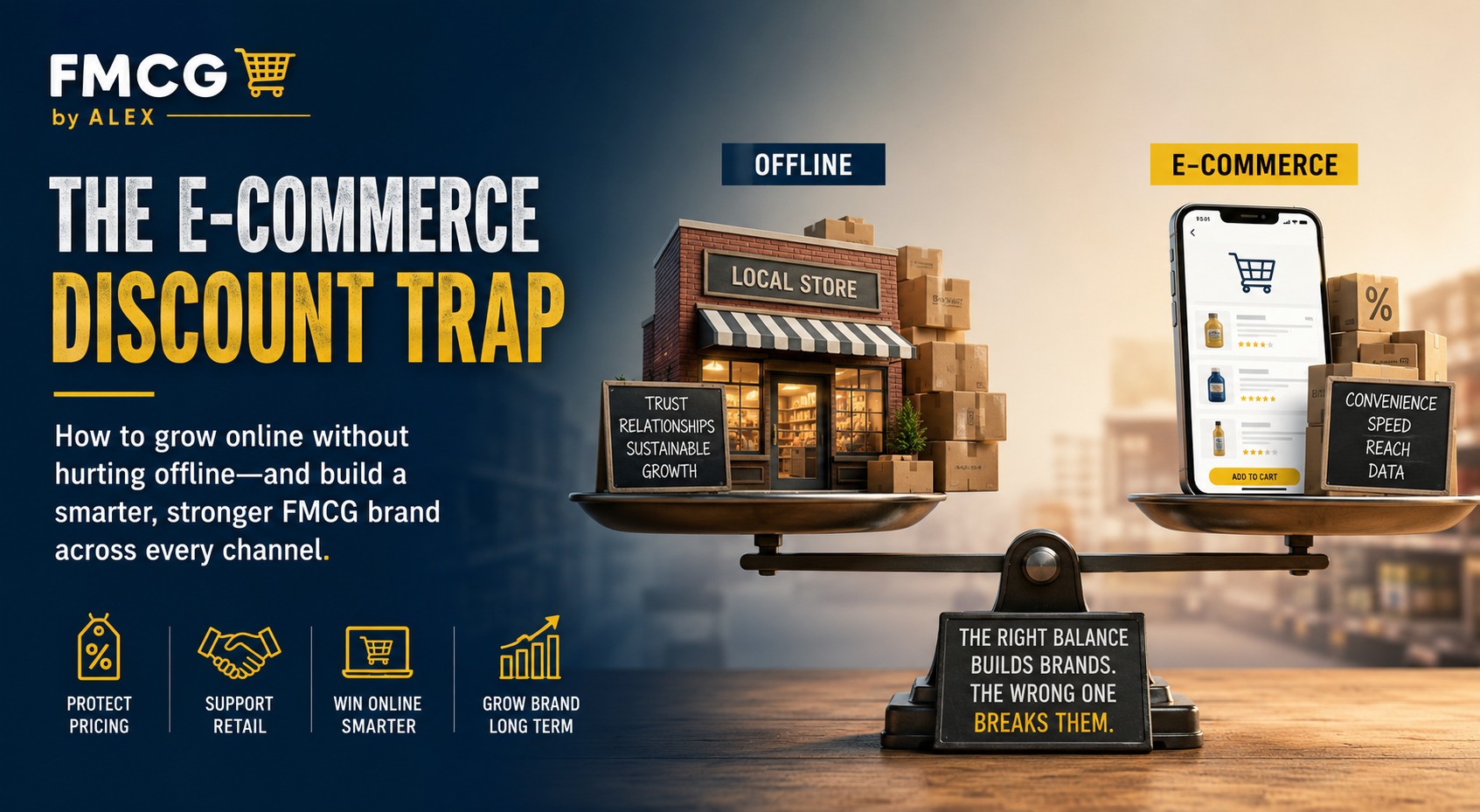
The E-Commerce Discount Trap: A Cautionary Tale for FMCG Brands Trying to Win Online Without Losing Offline
There is a moment in every growing FMCG brand when the e-commerce dashboard starts to look beautiful.
Sales are up. Orders are coming in. Marketplace ranking is improving. The product page has reviews. The digital team is smiling. The founder opens the analytics every morning before coffee, which is dangerous because no human should face conversion rates before caffeine.
For a while, it feels like magic.
The brand is finally moving. Consumers are buying. The warehouse is shipping. Someone in the team says, "This proves we can scale online." Someone else says, "We should push harder." Then someone, usually with terrifying confidence, says the sentence that has damaged many decent FMCG businesses:
"Let's do a bigger discount campaign."
And that is where our story begins.
The Brand That Thought It Had Cracked E-Commerce
Imagine a young FMCG brand. Let's call it BrightBite.
BrightBite sells a range of healthy snacks. Nice packaging. Decent margins. Good taste. Not one of those "healthy" snacks that tastes like compressed cardboard with emotional damage. A real product. Something consumers actually like.
The company started small. A few independent retailers. Some cafes. A couple of specialty stores. Then a regional supermarket chain agreed to test it. The founder was thrilled. The sales team was thrilled. The distributor was thrilled. Even the finance person smiled, which in FMCG is basically fireworks.
But retail was slow.
Listings took time. Store rollout took time. Promotions had to be negotiated months in advance. Sales reps had to visit stores. Distributors asked for margin. Retailers asked for support. Buyers asked for data. Everyone wanted something.
Then e-commerce entered the room wearing sunglasses.
The brand opened an official marketplace store. It launched a direct-to-consumer website. It ran a few ads. It worked with some influencers. It offered a launch discount. Orders started coming in quickly.
Compared to offline retail, online felt fast, flexible, and wonderfully free of buyer meetings in rooms with bad coffee.
The team became excited. They should have been. E-commerce is powerful. It can help a brand create trial, collect reviews, test bundles, learn which flavours work, and reach consumers that offline distribution cannot yet cover.
But then BrightBite made the classic mistake.
It started treating online as a volume machine instead of a channel with a specific role.
The First Discount Felt Harmless
The first campaign was simple.
A marketplace mega-day was coming up. The platform encouraged sellers to participate. There would be banners, higher visibility, extra traffic, and the sweet promise of algorithmic glory.
BrightBite offered 20% off.
Sales jumped.
Everyone loved it.
The founder saw the spike and thought, "This is working." The e-commerce manager saw the spike and thought, "We need to do this more often." The marketplace account manager saw the spike and thought, "Excellent, another brand has entered the promo cage."
The discount ended. Sales dropped back.
Not completely, but enough for the team to notice.
So the next month, they ran another campaign. This time 25% off. Then a bundle campaign. Then a flash sale. Then free shipping. Then another marketplace mega-day. Then an influencer code. Then a platform voucher. Then a payday sale.
At first, the brand was still growing. The online sales graph looked impressive. If you only looked at gross revenue, the story was positive.
But FMCG has a nasty habit of hiding problems underneath attractive top-line growth.
Like a supermarket shelf that looks full from the front but is completely empty behind the first row. Very stylish. Very misleading.
The Price Became Public
Offline, pricing has some natural fog around it.
A supermarket may promote your product this week. A wholesaler may sell it at a different price in another region. A traditional trade outlet may price slightly higher because it has different economics. A cafe may include the product as part of a lunch deal. These differences exist, but they are not always instantly visible to everyone.
Online removes the fog.
BrightBite's discounted price was now searchable. Screenshot-able. Shareable. Comparable.
Consumers noticed. Retailers noticed. Distributors noticed. Competitors noticed. The sales team definitely noticed, because suddenly every offline conversation became more annoying.
A supermarket buyer asked why BrightBite was cheaper online than on their shelf.
A distributor complained that retailers were comparing his wholesale price against marketplace promotions.
Small shop owners started asking why they should buy stock if customers could get it cheaper online.
The sales team pushed back internally. The e-commerce team defended the campaigns. Marketing said the online visibility was good for brand awareness. Finance asked why the margin looked worse than expected. The founder said, "But sales are up," which is technically true in the same way that eating only cake is technically dinner.
BrightBite had not realised that online pricing does not stay online.
It travels.
It becomes the market's reference point.
The Consumer Learned the Wrong Lesson
The most dangerous part was not the retailer complaints. Those were painful, but manageable.
The real danger was what consumers were learning.
At first, consumers saw the discount as a nice deal. Then they started expecting it. Then they started waiting for it.
BrightBite's normal price began to look expensive because the discounted price kept appearing often enough to feel normal.
This is one of the most important truths in FMCG pricing:
The consumer does not remember your pricing strategy. They remember the cheapest price they saw repeatedly.
They do not care whether the discount was funded by a marketplace voucher, a platform subsidy, your trade spend, a campaign budget, or someone pressing the wrong button in Seller Central at midnight.
They simply think:
"I know this brand is often cheaper online."
Once that belief forms, it is hard to reverse.
The brand had not just created sales. It had created a habit.
Unfortunately, the habit was not "I love this product."
The habit was "I buy this product when it is discounted."
That is a very different and much weaker relationship.
The Offline Business Started to Suffer
Meanwhile, offline sales were not collapsing, but the mood was changing.
The regional supermarket that had supported the brand started asking tougher questions. Why should they give BrightBite better shelf space if the brand was constantly pushing online promotions? Why should they invest in displays if shoppers could compare prices on their phones and order cheaper from a marketplace?
The distributor became less enthusiastic. He had taken the risk of building the brand in stores, but now his customers were challenging him with online screenshots.
Traditional retailers, who already operate on tight margins, became irritated. Some reduced orders. Some asked for better deals. Some simply switched attention to other products that caused fewer headaches.
This is the part many digital-first teams underestimate.
Offline retailers do not only buy products. They buy confidence.
They need to believe the brand will support the channel. They need to believe the price structure makes sense. They need to believe the brand will not embarrass them in front of shoppers.
When online constantly undercuts offline, that confidence erodes.
The brand may still be selling, but its route-to-market foundation starts cracking quietly.
And in FMCG, quiet cracks become expensive later.
The Dashboard Was Telling Only Half the Story
BrightBite's e-commerce dashboard still looked good.
Orders were up. Traffic was up. Conversion improved during promotions. Reviews increased. Marketplace rank improved.
But when finance looked deeper, the picture became less romantic.
Marketplace fees were higher than expected. Free shipping costs hurt. Sponsored ads were eating margin. Returns and damaged shipments were small but not zero. Influencer codes created orders, but not always repeat buyers. Some customers only purchased during discount windows.
The gross sales number looked strong.
The contribution margin looked tired.
That is the difference between a sales dashboard and a business.
E-commerce can make brands feel bigger than they are because the data arrives quickly and looks precise. But if the brand is not tracking net profitability, incrementality, and channel impact, it may simply be building a faster route to lower margins.
A campaign that sells 100,000 euros online is not automatically good.
If much of that volume would have sold offline anyway, if the margin is lower, if the promotion damages price perception, and if retailers respond by demanding more trade spend, the brand may have bought growth at a very high hidden cost.
The question is not only:
"How much did we sell online?"
The better question is:
"Did online make the total brand stronger?"
BrightBite had not been asking that question.
The Meeting Nobody Wanted
Eventually, the founder called a commercial meeting.
The e-commerce manager showed the growth numbers.
The sales manager showed retailer complaints.
The distributor manager showed order softness in several offline accounts.
Finance showed margin erosion.
Marketing showed brand search growth and social engagement.
Everyone had a point.
That is what makes channel conflict difficult. Usually, nobody is completely wrong.
The e-commerce manager was right that online was generating demand.
The sales manager was right that offline relationships were being damaged.
Finance was right that gross revenue was hiding margin pressure.
Marketing was right that online visibility had value.
The founder was right to want growth.
The problem was not one channel.
The problem was that the channels were not being managed as one system.
BrightBite had an online plan and an offline plan. What it did not have was a proper omnichannel go-to-market strategy.
Omnichannel is not when you sell everywhere.
That is just availability with better vocabulary.
Real omnichannel means every channel has a role, every price has logic, every promotion has a purpose, and the business understands how one channel affects another.
BrightBite had skipped that part.
To be fair, many brands do.
The Rebuild Started With One Painful Question
The founder asked a simple question:
"What is e-commerce actually supposed to do for us?"
At first, everyone gave predictable answers.
Growth. Awareness. Sales. Data. Convenience. Consumer engagement.
All true. All too vague.
So they pushed harder.
Was e-commerce supposed to be the cheapest place to buy BrightBite?
No. That would damage retail.
Was it supposed to be the main volume channel?
Not yet. Offline still had the bigger opportunity.
Was it supposed to create trial?
Yes.
Was it supposed to build reviews and consumer data?
Yes.
Was it supposed to sell special packs that retailers did not carry?
Yes.
Was it supposed to test new flavours?
Yes.
Was it supposed to offer subscriptions for heavy users?
Possibly.
Was it supposed to dump stock at random discounts?
Everyone looked at the table.
No.
There it was.
The brand did not need to stop selling online. It needed to stop using online as a panic button.
E-commerce would become a channel for discovery, learning, bundles, subscriptions, and controlled convenience.
Not a public discount cannon aimed at its own offline business.
The Hero SKU Was Protected
The first decision was to protect the hero SKU.
BrightBite's bestselling single pack was the product most retailers cared about. It was also the product consumers recognised most easily.
Previously, that SKU had been included in almost every online promotion because it converted well. Of course it converted well. It was the hero product being sold cheaper than normal. That is not exactly discovering fire.
The new rule was simple: the hero SKU could still be promoted, but not constantly and not carelessly.
Deep discounts on the core retail pack would be limited. Promotions would be planned. Offline teams would be informed. Marketplace campaigns would not automatically include the most important retail SKU.
Instead, the brand would use online to sell different formats.
Multipacks. Variety packs. Trial bundles. Limited editions. Subscription boxes. Family packs. Seasonal packs.
This did not eliminate price comparison completely, but it made it less direct.
A supermarket shelf price for one pack is harder to compare with an online variety bundle containing six packs, two exclusive flavours, and a recipe card. The consumer can still calculate the unit price if they really want to, but most normal people have better things to do, like living.
The brand was no longer using the same product everywhere in the same way.
That alone reduced tension.
Bundles Became the New Discount
BrightBite then changed how it thought about value.
Before, value meant discount.
Now, value meant usefulness.
Instead of "20% off snacks," the brand created a "Healthy Office Drawer Bundle." Instead of discounting individual packs, it created a "Family Lunchbox Box." Instead of another flash sale, it launched a "New Flavour Discovery Set."
The difference was important.
A discount tells the consumer, "This product is cheaper today."
A bundle tells the consumer, "This solves a problem."
Parents do not just need snacks. They need lunchbox solutions.
Office workers do not just need snacks. They need something to survive the 15:00 energy collapse without attacking the vending machine.
Health-conscious shoppers do not just need products. They need a routine that feels easy.
This is where e-commerce is powerful. Online allows a brand to merchandise around occasions in a way offline shelves often do not.
The brand stopped thinking only in SKUs and started thinking in consumer missions.
Morning routine. Office snacking. Kids' lunchboxes. Post-gym recovery. Movie night. Travel snacks. Ramadan gifting. Back-to-school. Weekend pantry stock-up.
Suddenly, the online channel became more interesting than a discount machine. It became a storytelling and solution channel.
And because the offers were different from offline retail, the sales team had a much easier time explaining the strategy to retailers.
The Marketplace Store Became the Trusted Source
BrightBite also cleaned up its marketplace presence.
Before, the official store existed, but it was not clearly better than reseller listings. Some resellers used old images. Some had weak descriptions. Some used strange claims. One listing made the product sound like it could improve focus, digestion, inner peace, and possibly your relationship with your mother-in-law. Impressive, but not advisable.
The brand realised that consumers do not always know which seller is official.
If the product arrives late, damaged, or close to expiry, they blame the brand. If the image is wrong, they blame the brand. If the description is confusing, they blame the brand.
So BrightBite improved the official store.
Better images. Better descriptions. Clearer product benefits. Proper flavour explanations. Better bundle pages. Stronger brand story. Review management. More consistent stock. Better customer service.
The goal was not to always be the cheapest seller.
The goal was to be the most trusted seller.
That is a very different strategy.
Marketplaces are often price-driven, but trust still matters. Especially in FMCG categories where consumers care about freshness, authenticity, expiry dates, packaging, and safety.
If your official store looks weaker than a random reseller, you have handed your brand experience to whoever happens to control the listing.
That rarely ends well.
The Distributor Conversation Changed
Once the brand had a clearer strategy, it went back to its distributor.
This conversation mattered.
Distributors do not like surprises. They especially do not like surprises involving online screenshots and angry customers.
BrightBite explained the new structure. The core retail SKU would be protected. Online would focus more on bundles, variety packs, and subscription offers. Promotional calendars would be shared earlier. Clearance would not be dumped publicly in a way that damaged everyday trade pricing.
The distributor did not suddenly burst into song. This was FMCG, not a Disney film.
But the relationship improved because the brand now had a logic.
That is often what trade partners need. They do not expect perfection. They expect consistency, communication, and a commercial structure that does not make them look foolish.
When a brand can explain why a certain SKU is online-only, why a bundle is priced differently, why a promotion is temporary, and how retail is being protected, the conversation becomes manageable.
Without that logic, every online discount feels like betrayal.
The Retail Buyer Still Asked Tough Questions
The supermarket buyer was not instantly convinced either.
Retail buyers have seen enough brand promises to develop the facial expression of a customs officer.
The buyer asked the obvious question:
"How do I know you will not keep undercutting us online?"
BrightBite could not legally promise fixed resale outcomes across the market, and brands should be careful here. In many markets, especially in the EU, resale price maintenance and minimum price restrictions can create serious competition-law issues. So the brand did not make foolish promises.
Instead, it explained its channel architecture.
The supermarket would carry the core retail range.
The marketplace would focus on bundles and variety packs.
The DTC website would focus on subscriptions, limited editions, and consumer data.
Quick commerce would carry convenience formats.
The brand would align major promo periods with the offline calendar where relevant.
The hero SKU would not be thrown into every public online discount.
That was a much better conversation.
The buyer still wanted support, margin, and promotional investment, of course. Buyers do not stop being buyers because you made a nice channel map. But the brand had moved from chaos to strategy.
And in retail, that matters.
The Internal Team Learned to Share the Calendar
BrightBite then fixed one of the most common internal problems in FMCG: teams not telling each other what they are doing.
The e-commerce team had previously launched campaigns quickly because online moves fast.
The offline team worked on longer trade calendars.
Marketing planned content.
Finance tracked margin.
Supply chain tried to keep stock available while everyone else made optimistic promises.
Each function had its own rhythm.
The brand created one shared commercial calendar.
Not a 97-tab spreadsheet that only one person understands and everyone else pretends to read. A simple, visible calendar showing major online campaigns, offline promotions, product launches, influencer pushes, retail activations, seasonal events, and stock priorities.
This helped immediately.
The sales team knew when marketplace campaigns were coming.
The e-commerce team knew when retail promotions were planned.
Finance could estimate margin impact.
Supply chain could prepare stock.
Marketing could align content.
The founder could stop being surprised by his own company.
Which is always nice.
The Brand Stopped Treating Clearance Like Marketing
Another uncomfortable issue was clearance stock.
Like many FMCG brands, BrightBite occasionally had short-dated stock, old packaging, or slow-moving flavours. Previously, the temptation was to push these online with big discounts.
That moved stock, but it also created brand damage.
Consumers saw the brand constantly discounted. Retailers saw low online prices. The marketplace trained shoppers to wait.
So the brand separated clearance from core brand activity.
Clearance became controlled, limited, and less visible. Some stock went through B2B liquidation. Some became staff sales. Some was bundled carefully. Some was used for sampling where appropriate. Public discounting on hero SKUs became the last resort, not the first reflex.
The brand learned an important lesson:
Not every inventory problem should become a consumer-facing promotion.
Sometimes the warehouse problem should stay a warehouse problem.
Not every operational mistake needs a banner ad.
E-Commerce Became a Learning Lab
Once BrightBite stopped using online mainly for discounts, it discovered the real power of e-commerce.
Learning.
The brand tested flavour names. It tested product images. It tested bundle concepts. It tested whether consumers cared more about protein, fibre, low sugar, convenience, lunchbox suitability, or taste.
It discovered that one flavour which retailers had ignored performed very well in online discovery bundles. It found that mixed packs had higher first-time conversion than single-flavour cases. It learned that consumers who bought the office snack bundle often reordered within four weeks. It found that certain product claims converted well online but were too complicated for packaging.
These insights helped offline too.
The sales team used online data in buyer presentations. Marketing refined messaging. Product development adjusted the innovation pipeline. The distributor had better information about which SKUs to push.
This is what e-commerce should do for FMCG brands.
It should not only sell. It should teach.
A good online channel gives the brand faster feedback than offline retail alone. But that only works if the brand is asking real questions, not just screaming "SALE" into the algorithm and hoping wisdom appears.
The Numbers Became More Honest
After a few months, BrightBite's e-commerce revenue was still growing, but the growth looked different.
There were fewer crazy spikes.
There was less discount dependency.
Average order value improved because bundles sold better.
Margins improved because the brand was not constantly discounting single units.
Repeat purchase became easier to track.
The official store captured a larger share of online sales.
Retailer complaints reduced.
The distributor regained confidence.
The supermarket buyer still negotiated hard. But the relationship was more stable.
Most importantly, the brand could finally answer the question that mattered:
Was online making the total brand stronger?
Increasingly, yes.
Not perfect. Never perfect. FMCG is not a yoga retreat. But better.
The business had moved from channel conflict to channel design.
The Bigger Lesson for FMCG Brands
BrightBite is fictional, but the pattern is very real.
Many FMCG brands enter e-commerce with good intentions. They want growth, visibility, consumer data, and convenience. Then the channel becomes competitive. Marketplaces push campaigns. Competitors discount. Resellers undercut. Teams chase targets. Stock needs to move. Suddenly the brand is promoting too often and too deeply.
At first, it feels like growth.
Later, it feels like pressure.
Then offline partners begin to complain.
Then consumers start waiting for discounts.
Then margin erodes.
Then the brand wonders why sales are up but the business feels weaker.
This is the e-commerce discount trap.
And it is not solved by abandoning e-commerce. That would be ridiculous. Consumers are online. Discovery is online. Reviews are online. Search is online. Convenience is online. Your brand needs to be there.
The solution is to stop treating e-commerce like a separate universe.
It is part of the total route-to-market system.
Online pricing affects offline trust.
Offline availability affects online search.
Marketplace reviews affect retail buyer confidence.
Retail promotions affect online conversion.
Social content affects both.
Distributors affect marketplace leakage.
Pack architecture affects price comparison.
Everything is connected.
That is either a strategic advantage or a very expensive mess.
What a Better FMCG E-Commerce Strategy Looks Like
A better strategy begins with role clarity.
The brand needs to know what each channel is for. The supermarket is not the same as the marketplace. The DTC website is not the same as quick commerce. TikTok Shop is not the same as wholesale. A distributor is not the same as an online grocery platform.
Each channel should have a job.
Then the brand needs pack architecture. Do not sell the exact same thing everywhere if it creates direct price conflict. Use core retail packs offline, multipacks online, discovery boxes on DTC, convenience packs in quick commerce, and professional formats for horeca or B2B where relevant.
Then the brand needs promo discipline. Promotions should have a reason. Trial, repeat, basket building, seasonal relevance, stock management, retail support, or subscription growth. "Because the platform asked us" is not a strategy. That is peer pressure with a dashboard.
Then the brand needs marketplace hygiene. The official store should be credible, content should be clean, listings should be monitored, resellers should not define the brand experience, and old stock should not wander around the internet through weak third-party listings.
Then the brand needs internal alignment. E-commerce, sales, trade marketing, finance, supply chain, and leadership should share a commercial calendar. Nobody should discover a major promotion from a retailer's angry screenshot.
Finally, the brand needs better KPIs. Not just online revenue. Not just orders. Not just marketplace rank. Measure margin after fees, repeat purchase, full-price sell-through, bundle share, customer acquisition cost, official-store share, reseller leakage, retailer complaints, and offline impact.
If online growth is profitable, incremental, and brand-building, push it.
If online growth is cheap, cannibalising, and creating conflict, slow down and rebuild.
The Final Lesson
E-commerce can be one of the best things that happens to an FMCG brand.
It can help you reach consumers faster, learn faster, test faster, and build direct relationships that offline retail alone cannot provide.
But e-commerce can also become the fastest way to destroy your price architecture if you treat discounts as strategy.
The real opportunity is not online versus offline.
That debate is outdated.
The real opportunity is designing a route-to-market system where online and offline make each other stronger.
Where e-commerce creates trial without damaging retail.
Where marketplaces provide reach without becoming a price war.
Where DTC builds brand and data instead of becoming a clearance bin.
Where bundles create value without destroying the core SKU.
Where retailers trust the brand because the online strategy makes sense.
Where distributors are not constantly ambushed by marketplace screenshots.
Where consumers buy because the brand is useful, desirable, and available - not only because it is temporarily cheap.
That is the balance FMCG brands need to find.
Because selling online is easy.
Selling online without damaging the rest of the business is the real skill.
And the next time someone says, "Let's just do a bigger discount campaign," take a breath, check the offline price structure, call the sales team, look at the contribution margin, and maybe hide the discount confetti cannon for a day.
Your future brand equity may thank you.
Tools for this topic
View shopCommercial Execution Tee
Soft cotton tee celebrating disciplined FMCG execution.
FMCG Growth Systems (Hardcover)
A tactical leadership guide for building scalable FMCG growth engines.
Related content
When the Shopper Says 'Too Expensive': How Price-Pack Architecture Can Save Your FMCG Brand in Indonesia
A practical and witty guide to price-pack architecture in Indonesia, showing how FMCG brands can stay affordable, protect margins and keep shoppers buying when demand is under pressure.
Route-to-Market Reset for Growth
How FMCG teams can redesign channel strategy, coverage, and distributor economics to unlock profitable growth.
How to Know Whether a Sales Visit Actually Makes Money Without Sacrificing Your Brand
Improving sales route profitability sounds like an obvious objective for any FMCG company. But aggressive cost-to-serve cuts and minimum order sizes can kill a growing brand. Here is how to evaluate true visit economics, protect developing outlets, and balance route efficiency with long-term brand building in Southeast Asia.
How to Build a Better FMCG Route-to-Market
Designing channel roles, distributor economics, and service levels in one RTM framework.
FMCG Pricing Architecture Explained
Break down price ladders, pack roles, and elasticity signals for FMCG growth.