The Discount That Couldn't Make the Consumer Hungry
When FMCG volume falls, the standard response is familiar: reduce the price, increase promotions and offer more product. But what happens when consumers still do not eat more? A discount can improve affordability, but it cannot manufacture appetite.
The Discount That Couldn’t Make the Consumer Hungry
PepsiCo Cut Prices. Consumers Still Ate Less. And Somewhere, an FMCG Promotion Calendar Began to Sweat.
There is a particular kind of Monday morning meeting that exists in almost every FMCG company in the world. The room is too cold, the coffee is too weak and the sales result is too red. Twelve people sit around a table staring at a PowerPoint slide filled with numbers, arrows and increasingly creative explanations for why volume is not where it was supposed to be. Nobody looks directly at the actual volume number. That would feel confrontational. Instead, they study the ceiling, their notebooks, their phones or a mysterious mark on the wall that has suddenly become strategically fascinating.
At the front of the room, the Sales Director clears his throat and announces that volume is “slightly behind plan.” The CEO asks by how much. The Sales Director changes the slide, and the number appears. It is behind plan in the same way that Jakarta is slightly congested at five o’clock in the afternoon.
The Head of Marketing leans forward and says that the consumer is under pressure. This is one of the safest sentences in FMCG because the consumer is almost always under pressure. Inflation, rent, fuel, school fees, medical bills, mortgage payments and a child who suddenly needs a new laptop because apparently homework can no longer be completed using paper, a pen and personal responsibility. The Finance Director nods gravely and asks what the business proposes to do.
Sales and marketing look at each other. They have prepared for this moment.
“We need to offer the consumer stronger value.”
Everyone relaxes. Stronger value sounds strategic. It sounds analytical. It sounds like something produced by a large consulting team after eight weeks of interviews and three nights in a conference hotel.
The next slide explains what stronger value means.
A 15% discount.
An additional promotional week.
A larger pack.
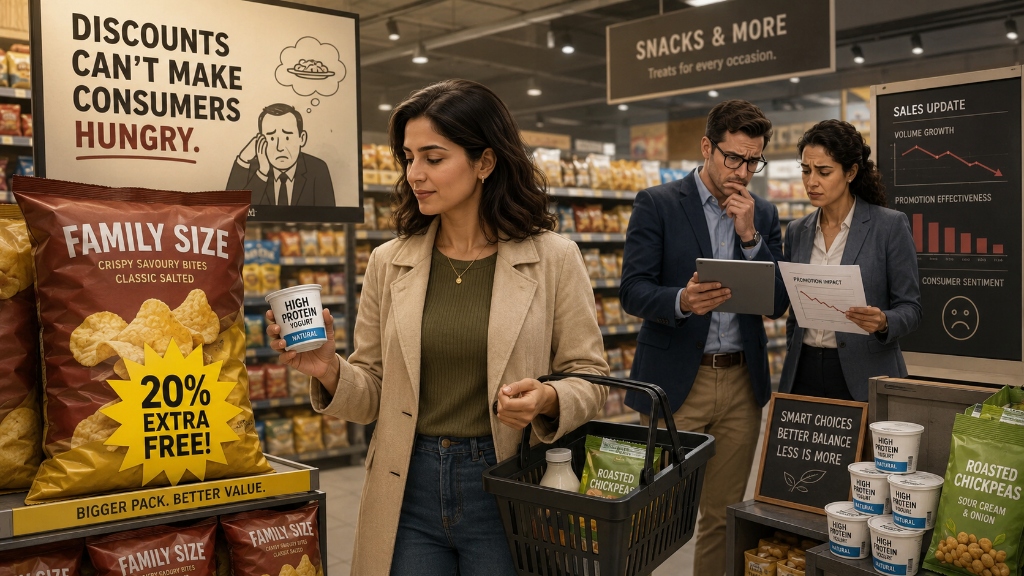
And, naturally, a yellow starburst containing the words 20% EXTRA FREE!
This is the traditional FMCG emergency kit. When volume falls, we lower the price. When it continues to fall, we lower the price again. When that still does not work, we add more product. When the consumer remains unmoved, we hold a regional strategy workshop, rename the problem and produce a new promotional calendar.
For a long time, this approach worked often enough to become a reflex. Consumers liked bargains. Retailers liked promotions. Factories liked volume. Sales teams liked invoices. Everybody could point to pallets leaving the warehouse and feel that the business was moving in the right direction.
But something awkward is now happening in parts of the packaged-food industry.
Companies are making products cheaper, yet consumers are not necessarily consuming more.
That is a deeply uncomfortable development for an industry built around the idea that the correct combination of price, distribution, visibility and promotion can persuade almost anyone to put another item in the basket.
PepsiCo has recently provided a very large and very public example. The company reduced prices on several major North American snack brands, including household names such as Lay’s, Doritos, Cheetos and Tostitos. The affordability push helped PepsiCo defend and gain volume share, but its North American food business still struggled to restore meaningful growth. Consumers appreciated lower prices, but they did not suddenly return to their previous snacking habits in large numbers.
This is not a story about PepsiCo forgetting how to sell snacks. PepsiCo remains one of the most capable consumer-goods businesses in the world, with enormous brands, deep distribution, sophisticated revenue management and a marketing budget larger than the GDP of several pleasant islands. The company knows how to price, promote, innovate and execute.
That is precisely why the situation matters.
If a company with PepsiCo’s scale and capabilities can reduce prices and still find consumers unwilling to eat much more, perhaps the problem is not only affordability. Perhaps something deeper is changing.
Perhaps consumers are not merely asking for cheaper snacks.
Perhaps they are asking whether they still want the snack at all.
When the Promotion Works Perfectly and the Business Still Does Not
Let us return to our Monday morning meeting.
Three months later, the same executives are sitting in the same room. The air conditioning remains unnecessarily aggressive. The coffee has not improved. The promotion has finished.
The sales team secured the displays. Trade marketing produced the point-of-sale materials. The distributor loaded extra stock. Retailers placed large yellow signs near the entrance. The field team submitted 1,800 photographs as evidence of execution, including several pictures that mainly featured the promoter’s thumb.
For two weeks, volume increased.
The promotional report showed a beautiful blue line moving sharply upwards. People congratulated one another. Senior management circulated the result with the subject line “GREAT TEAMWORK.” The retailer requested another promotion. The distributor asked for more stock. Everyone felt that the problem had been solved.
Then the promotion ended.
The blue line fell.
It did not fall back to where it had started. It fell below it.
The shoppers who bought two packs during the promotion did not buy another pack the following week because, in one of the least surprising developments in consumer behaviour, they already had two packs at home.
Sales argued that the campaign had generated strong uplift. Finance argued that the company had borrowed demand from the future. Marketing said it had created trial. The CEO asked whether those consumers had repeated.
The room became quiet.
The mysterious mark on the wall once again received the attention it deserved.
This is one of the great weaknesses of FMCG promotional culture. We are extremely good at measuring activity and not always as good at measuring progress.
A promotion creates movement. Orders rise. Displays appear. Warehouses become busy. Retail buyers answer emails. Sales teams become enthusiastic. Factories schedule additional production. Everyone has something to report.
But movement is not the same as growth.
Promotional volume may represent genuinely incremental consumption, but it may also represent pantry loading, forward buying, brand switching, retailer inventory or existing customers receiving a discount they never required. A household may buy two packs this week instead of one pack this week and one pack next week. The event report records an increase. The monthly household consumption remains exactly the same.
The most important part of a promotion therefore begins when the promotion ends.
What happens afterwards?
Does household penetration increase? Do new users repeat? Does the consumer add an additional occasion? Does the brand retain volume when it returns to the regular price? Or does demand disappear until the next discount arrives?
When the regular price becomes nothing more than the waiting room between promotions, the company no longer has a pricing strategy. It has trained consumers to attend scheduled discount events.
That is not growth. It is calendar management.
The Difference Between “I Cannot Afford It” and “I Do Not Want It”
The packaged-food industry is currently dealing with two problems that often look identical in a monthly sales report.
The first is an affordability problem. Consumers still want the product, recognise the occasion and like the brand, but household budgets are tight. They trade down, wait for promotions, buy private label or choose a smaller pack. When the price-value equation improves, demand responds.
The second is a relevance problem. Consumers no longer want the same product in the same quantity for the same occasion. They may want smaller portions, more protein, more fibre, less sugar, fewer ingredients, greater convenience or a product that can perform the role of a small meal. They may be snacking less frequently. They may be questioning whether the product is worth consuming at all.
Affordability asks, “Can I justify paying for this?”
Relevance asks, “Why would I consume this in the first place?”
These are very different questions, but FMCG companies often respond to both in the same way.
They lower the price.
That is understandable. The industry has sophisticated revenue growth management teams, price-elasticity models, promotional optimisation software, pack-price ladders and margin waterfalls containing enough coloured boxes to qualify as modern art. We know how to investigate what happens when a price changes.
We are less comfortable asking what happens when the occasion itself changes.
A price model can calculate the optimal price for a 300-gram pack. It does not necessarily ask whether the consumer still wants a 300-gram pack.
A promotional model can identify which discount generates the highest short-term uplift. It does not necessarily ask why the product requires a discount every three weeks to maintain movement.
A pack architecture can offer excellent value per gram. It does not necessarily ask whether the shopper wants all those grams.
This is why an FMCG company can become extremely good at optimising the wrong thing.
A perfectly priced irrelevant product remains irrelevant.
A beautifully promoted disappearing occasion remains a disappearing occasion.
And 20% extra free is not a benefit when the customer wants 30% less.
The Consumer Has Started Thinking, Which Is Usually Bad for Impulse Sales
For decades, many packaged-food categories benefited from consumers not thinking too deeply.
A person saw a snack, felt a small amount of hunger, boredom or emotional instability, bought the snack, opened the snack and consumed considerably more than the suggested serving size had predicted. The purchase was not part of a carefully structured nutritional strategy. It was Tuesday afternoon.
The packaged-food industry became exceptionally skilled at turning these moments into revenue. The petrol station, the office drawer, the school run, the supermarket checkout and the evening sofa were not merely locations. They were consumption occasions.
The consumer did not need a detailed reason. Availability, visibility, habit and taste did most of the work.
Now, however, more consumers appear to be thinking before they eat.
Do I really want this?
Will it satisfy me?
How much will I consume once I open it?
Is there enough protein?
How much sugar is inside?
Why does the ingredient list sound like a conference of industrial chemists?
Would yogurt be better?
Could I simply wait until dinner?
Do I want a large pack in the house?
Will I regret eating the entire thing while watching one episode of a programme I do not even like?
GLP-1 medicines have accelerated this conversation in the United States because they reduce appetite and change purchasing behaviour. Users frequently report buying fewer sweet and salty snacks and showing greater interest in protein, fresh foods and smaller portions.
But it would be a mistake to treat GLP-1 medicines as the sole cause of changing consumer behaviour. The direction was already visible.
Consumers were already becoming more conscious of sugar, protein, fibre, ingredients, portion size, gut health, energy, satiety and processing. Fitness culture, wellness content, smaller households, changing work patterns and higher food prices had already encouraged more deliberate choices.
The medicine did not invent the trend. It pressed the accelerator.
The result is that a snack brand may no longer compete only with another snack brand. It may compete with yogurt, fruit, coffee, a protein drink, a small ready meal or the decision to eat nothing.
Nothing is a particularly dangerous competitor.
Nothing has no manufacturing cost. It does not require packaging. It never runs out of stock. It pays no listing fees, creates no supply-chain complexity and is available in every market in the world.
It also has excellent margins.
The Category Report Does Not Know the Consumer Has Left
Most FMCG companies define competition in a comforting and orderly way. A biscuit brand studies other biscuit brands. A salty-snack company tracks other salty snacks. A beverage company compares itself with other beverages.
This is necessary, but it can create a major blind spot.
A consumer who stops buying your product may not have selected the competitor displayed beside it. She may have moved to another aisle or left the category entirely.
The snack may have lost to yogurt.
The soft drink may have lost to water.
The cereal may have lost to a breakfast sandwich.
The chocolate bar may have lost to coffee.
The family-sized pack may have lost to the decision not to keep a family-sized pack in the house.
None of these changes will be fully visible if the company only studies its traditional competitive set.
This is how a brand can gain market share and still have a serious problem.
Imagine that your category is worth €100 million and your brand holds 20% share. You therefore generate €20 million in sales. The following year, the category falls to €90 million, but your share rises to 21%.
The sales presentation opens with a triumphant headline:
SHARE GROWTH!
Your sales are now €18.9 million.
You gained share.
You lost revenue.
The organisation celebrates a larger slice while Finance quietly notices that the pie has become smaller.
Market share tells you whether you are beating competitors inside a category. It does not always tell you whether the category is still winning a place in the consumer’s life.
A company can improve distribution, secure better shelf space, run stronger promotions and execute brilliantly, yet still decline because the occasion itself is weakening.
It is entirely possible to become the best captain on a sinking ship.
The uniform will look excellent in the annual report.
FMCG’s Long and Complicated Love Affair With More
The FMCG industry has always had a deep emotional relationship with quantity.
More volume.
More kilograms.
More litres.
More facings.
More distribution.
More stock.
More calls.
More promotions.
More consumption.
Entire careers have been built around persuading products to leave warehouses in larger numbers.
This is not irrational. Factories like volume. Procurement likes volume. Distributors like volume. Retailers like volume when it moves. Sales bonuses are particularly fond of volume.
The consumer, however, may increasingly prefer something else.
A better portion.
A better flavour.
A better ingredient.
A better use of calories.
A better fit with the occasion.
A better feeling after consumption.
The traditional value equation was simple: more grams for less money.
The emerging equation is more complicated: more satisfaction, convenience or benefit from the quantity the consumer actually wants.
Traditional value remains important. Families managing tight budgets still compare unit prices. Entry packs matter. Large packs matter. Sachets matter. Affordable products matter.
But price per gram is not the only calculation taking place in the shopper’s head.
A large pack may be cheap per gram but expensive per useful experience. It may go stale, create waste, invite overconsumption or occupy half a cupboard. It may contain eight officially recommended servings but only two servings recognised by the consumer: “before the movie starts” and “during the movie.”
A smaller pack may cost more per gram but feel like better value because it is fresher, portable, controlled, satisfying and appropriate for one genuine occasion.
This is why “20% extra free” is no longer automatically good news.
The brand sees additional quantity as generosity.
The consumer may see it as temptation, waste or inconvenience.
The pack announces, “Look how much more we are giving you.”
The shopper thinks, “Why are you giving me so much?”
This does not mean large packs or quantity promotions are finished. They remain extremely powerful in many categories and markets. It means they should not be applied without understanding what the consumer is trying to achieve.
Does the shopper want a lower absolute price?
A lower unit price?
A smaller financial commitment?
A controlled portion?
A premium treat?
A functional benefit?
Or permission to leave the shelf without buying anything?
The correct pack architecture depends on the answer.
Unfortunately, many FMCG portfolios were built during a different era. Household sizes were different, shopping patterns were different and meal routines were different. Over time, companies added new sizes, regional variants, retailer exclusives, promotional packs and limited editions that somehow became permanent because nobody remembered to remove them.
Eventually, the portfolio contains 63 SKUs. Nine generate most of the profit, fourteen exist because a major retailer once requested them, seven survive because a regional manager considers them “strategic” and five remain in production because discontinuing them would require an uncomfortable meeting.
At this point, innovation often means launching SKU number 64.
The company believes it is expanding choice.
The consumer sees six nearly identical products and buys yogurt.
When the Promotional Calendar Becomes Life Support
Promotions are not inherently bad. They can create trial, encourage switching, support launches, reward loyalty, build seasonal occasions and improve affordability.
The problem begins when they are used to perform CPR on a proposition that is losing relevance.
If a product only sells at a discount, management often concludes that the discount needs to become deeper. This is similar to discovering that a restaurant is empty and deciding to make every meal half price without asking why nobody wants to eat there.
Perhaps the restaurant is too expensive.
Or perhaps the food is bad.
Those situations require different strategies.
Every business should therefore pay close attention to what happens after the promotion. I call this the post-promotional silence. The displays are gone, the retailer has removed the sign, the price has returned to normal and the brand is once again required to stand on its own.
Does the consumer return?
Does the new buyer repeat?
Did the brand recruit an additional household?
Did the event create an additional consumption occasion?
Or did the shopper take the discount and disappear into the night?
Promotional reporting often ends too early. It captures the uplift but misses the hangover.
A campaign may generate a 70% increase during the event and still destroy value if it subsidises loyal customers, pulls future purchases forward, damages the reference price, creates excessive trade spending and teaches shoppers to wait.
The volume spike receives applause.
The margin loss is invited to a separate meeting.
This is why promotional effectiveness cannot be measured only through shipments or event-period sell-out. It needs to include incrementality, repeat, post-event performance, household penetration, profitability and category growth.
Otherwise, the organisation is measuring how loudly the cash register rang, not whether the promotion created a healthier business.
Revenue Growth Management Must Be Allowed to Ask Rude Questions
Revenue Growth Management has become one of the most valuable disciplines in FMCG. It brings structure to pricing, pack architecture, promotion and mix. It helps identify where value is leaking and can prevent sales teams from resolving every retailer negotiation by offering another discount.
But RGM becomes less powerful when it is only allowed to optimise the portfolio it has been given.
The model asks, “What is the optimal price for the 300-gram pack?”
The strategic question is, “Why do we still have a 300-gram pack?”
The model asks, “Which promotional mechanic produces the strongest uplift?”
The strategic question is, “Why does the product require a promotion every month to remain visible?”
The model asks, “Which channel should receive the largest pack?”
The consumer asks, “Where is the smaller one?”
The next generation of RGM needs to connect price with occasion, product and portfolio. It should not sit at the end of the innovation process waiting to calculate the best price for whatever marketing has created.
Price and proposition are connected.
Pack and occasion are connected.
Promotion and relevance are definitely connected.
PepsiCo’s own response reflects this reality. Alongside affordability initiatives, the company has been reformulating products, simplifying parts of the portfolio and investing in portion control, hydration, protein, fibre and lower-sugar offerings.
The point is not that every company should copy every PepsiCo initiative. The point is that a pricing problem cannot always be solved by pricing alone.
Sometimes the product must change.
Sometimes the pack must change.
Sometimes the occasion must change.
Sometimes the company must accept that an SKU with fifteen years of history has reached the end of its useful life.
That is difficult because legacy portfolios contain factory investments, customer agreements, internal politics and emotional attachments. The consumer is not aware of any of these.
The consumer does not buy the 450-gram pack because it is important to the annual production plan.
She does not care that the mango-chilli variant was once described as a “billion-dollar growth platform.”
She is hungry or she is not.
She wants the product or she does not.
Everything else is our problem.
Indulgence Is Not Dead, but It May Need Better Manners
Whenever the industry discusses wellness, smaller portions or reduced consumption, somebody becomes nervous and asks whether snacks are dying.
They are not.
People still want crisps, chocolate, ice cream, biscuits and cake. Birthday parties are not about to feature ceremonial bowls of lentils. Cinema audiences will not collectively replace popcorn with steamed vegetables. The human desire for pleasure, reward and convenience remains highly dependable.
But indulgence may become more deliberate.
Consumers may choose fewer occasions, smaller portions, stronger flavours or more premium products. They may want an experience that feels complete without requiring a very large pack.
This can become an attractive commercial opportunity.
A company does not always need to maximise physical volume if it can increase value per occasion. A consumer may buy a smaller premium chocolate bar rather than a large standard one. She may choose a strongly flavoured snack that satisfies in a smaller portion. She may prefer an individually wrapped product that supports control and freshness.
“Less, but better” can be good business.
It may involve fewer tonnes, but better margins.
Factories may not immediately recognise this as positive because tonnage has a comforting physical presence. Margin deserves affection too.
The industry should also resist the temptation to convert every indulgent product into a nutritional intervention. A snack does not need to become a medical device. A biscuit does not need enough protein to qualify for gym membership. A soft drink does not need to promise spiritual development.
Indulgence can remain indulgence.
It simply needs to respect the consumer’s changing boundaries.
A smaller portion that tastes excellent is better than a “healthy” reformulation that removes all pleasure while retaining the original price.
Nothing damages a brand more efficiently than improving the nutrition and destroying the reason people bought it.
What This Means for Indonesia
The PepsiCo example comes from North America, but the underlying question applies much more broadly.
Indonesia will not follow the same path at the same speed. Affordability remains decisive. Millions of households manage purchases around immediate cash availability. Sachets, entry packs, traditional trade and familiar price points remain commercially essential.
Any strategy that ignores affordability in Indonesia is not a strategy.
It is a PowerPoint presentation.
But Indonesian consumer behaviour is also evolving. Urbanisation, smaller households, long commutes, food delivery, quick commerce, fitness culture, sugar awareness and social-media nutrition advice are changing eating patterns. Breakfasts are becoming more fragmented. Meals are increasingly replaced by snacks, drinks and smaller food occasions.
A young office worker in Jakarta may want a small, filling breakfast during the commute. A student may want an affordable snack with enough substance to replace a missed meal. A parent may seek a lower-sugar beverage for a child. A gym user may want protein without paying the imported-product prices charged by brands that package everything in matte beige.
The opportunity is not to copy Western wellness products and place them in Indonesian stores at unrealistic prices. It is to translate changing needs into locally relevant products.
That could mean affordable protein from soy, tempeh, egg, dairy, nuts or legumes. It could mean smaller portions with stronger local flavours. It could mean practical hydration, compact breakfasts, lower-sugar drinks and filling mini-meals.
The strongest Indonesian portfolios may need to operate two architectures at the same time.
The first is affordability architecture: entry packs, accessible price points, simple benefits and strong traditional-trade distribution.
The second is relevance architecture: portion control, convenience, function, nutrition and products designed around specific occasions.
A brand that focuses only on affordability risks becoming interchangeable.
A brand that focuses only on relevance risks becoming unaffordable.
The commercial challenge is to deliver both without creating 94 SKUs and causing the supply-chain director to seek early retirement.
The Same Product Means Something Different in Every Channel
The shift will not look the same across channels.
In traditional trade, the product has only seconds to communicate. The shopper may ask the warung owner which option is cheapest. The benefit must be clear, the pack familiar and the cash price accessible. A complicated explanation about metabolic health is unlikely to survive contact with the shopping mission.
A small pack can succeed because it is affordable, but it may also succeed because it offers the exact quantity the consumer wants. Not every small pack is a poverty pack. Sometimes it is simply appropriate.
Modern trade creates more room for comparison. Shoppers can study protein, sugar, ingredients, pack size and price. They may consult reviews on their phones while standing in the aisle. Here, brands can communicate more complex propositions, but they also compete across categories.
The consumer does not necessarily think in the neat category definitions used by suppliers. She thinks in needs.
Breakfast.
Energy.
Protein.
Hydration.
A small meal.
A treat.
Something for the children.
Something that will prevent her ordering food later.
Those needs cross category boundaries. A yogurt competes with a bar. A drink competes with a snack. A snack competes with a mini-meal.
Online, the change becomes even clearer. In a physical store, the product sits in an aisle. Digitally, it sits inside a search intention.
“High-protein snack.”
“Low-sugar drink.”
“Filling breakfast.”
“Affordable protein.”
“Snack under 200 calories.”
The algorithm does not care that your company has historically classified the product as a biscuit. It cares whether the product matches what the shopper typed.
This creates opportunities for challenger brands. A smaller company may lack national shelf space but can own a specific online need. The established brand may dominate the biscuit aisle while remaining invisible in a search for “protein breakfast.”
The digital shelf cannot be managed with cardboard displays and personal relationships alone.
The algorithm does not accept lunch invitations.
The Questions the Dashboard Cannot Answer
FMCG companies have more data than ever. Sales data, retailer data, loyalty data, consumer panels, promotional analytics, distribution reporting, social listening and search trends.
Sometimes the organisation has so much data that nobody has time to understand the person buying the product.
The dashboard can show what moved. It may not explain why the occasion disappeared.
That requires better questions.
Do not only ask consumers whether they like the flavour, whether the price is acceptable or which pack design they prefer.
Ask what they were doing before they considered the product.
Were they hungry, tired, bored, commuting or socialising?
What alternatives did they consider?
Did they finish the pack?
Did they feel satisfied?
Would a smaller portion have been better?
Why did they stop buying?
What replaced the product?
Did another brand win, or did the occasion disappear?
The last question is especially important.
A shopper who switches brand may be recovered through pricing, product superiority or communication.
A shopper who leaves the category needs a new reason to return.
Companies spend a great deal of time interviewing loyal users. Loyal users are pleasant. They know the brand, say positive things and willingly attend research sessions where they are given free sandwiches.
The people who stopped buying are more difficult.
They are also more useful.
They can tell you where the demand went.
What a Serious 90-Day Response Looks Like
The solution does not need to begin with a five-year transformation programme containing 26 workstreams and a newly designed logo.
A company can learn a great deal in 90 days.
During the first month, the business should diagnose the decline properly. Not only by brand, but by pack, channel, household, occasion and price state. Regular-price sales should be separated from promoted sales. Post-promotional performance should be studied. Lapsed buyers should be interviewed.
The central question is simple:
Do consumers still want the same product, in the same quantity, for the same reason?
During the second month, the business should test different value equations.
A lower price tests affordability.
A smaller pack tests entry price and control.
A premium smaller pack tests “less, but better.”
A resealable format tests freshness and waste.
A stronger flavour tests whether satisfaction can be delivered through a smaller portion.
A protein or fibre extension tests functional relevance.
A mini-meal format tests a new occasion.
The company should not change the recipe, price, design, size and communication simultaneously and then act surprised when the research cannot identify what worked.
Every test needs a clear hypothesis.
During the third month, resources should be reallocated. Promotions that create uplift without repeat should receive less funding. Formats that create new occasions should receive more. Weak SKUs should be removed. Retailer conversations should focus on category value rather than shipment volume.
This is the stage where organisational reality arrives.
Marketing wants innovation.
Sales wants listings.
R&D wants time.
Supply chain wants fewer SKUs.
Finance wants margin.
The retailer wants exclusivity.
The distributor wants faster rotation.
The consumer wants a snack.
The task of management is to turn that simple consumer decision into a system the entire business can execute.
That is what FMCG strategy really is.
Not a workshop.
Not a slogan.
Not a promotional calendar.
A system.
The Question Before the Next Discount
At the next Monday meeting, the CEO should not immediately approve another promotion. He should ask whether consumers are buying less because they cannot afford the product or because they want less of it. He should ask whether market-share growth is hiding a declining category, whether promotions create new consumption or merely shift purchases between weeks, which occasions are disappearing and which occasions are emerging.
He should ask whether the company is giving consumers more quantity when they want more benefit.
He should ask which SKUs exist only because nobody wants to discontinue them.
And then he should ask the most uncomfortable question of all:
What would we launch today if the current portfolio did not already exist?
Legacy businesses rarely ask this because the answer may threaten years of investment, internal assumptions and factory planning. But the consumer does not purchase history. She purchases relevance.
PepsiCo’s recent experience does not mean price reductions are useless. Affordability initiatives can protect share, improve competitiveness and give consumers a reason to reconsider a product.
Price matters.
Value matters.
Entry price matters.
Promotions matter.
But they all have limits.
A lower price can persuade a budget-conscious shopper to reconsider. It cannot restore an occasion that no longer fits her life. It cannot make a large pack appropriate for someone who wants a smaller one. It cannot create protein, reduce sugar, improve convenience or turn an automatic habit back on after the consumer has begun making deliberate choices.
The industry needs to separate demand that is temporarily suppressed from demand that has moved elsewhere.
Suppressed demand may return when affordability improves.
Displaced demand requires a new proposition.
That is a more difficult problem, but it is also a more valuable one to solve.
The Discount Could Not Make the Consumer Hungry
Six months later, our Sales Director and Head of Marketing return to the same meeting room. The temperature remains unreasonable. The coffee remains an unresolved organisational failure.
But the sales slide looks different.
The company has discontinued several weak SKUs. It has introduced a smaller, more satisfying format. Blanket discounting has been reduced. A new office-snacking proposition has created a clearer occasion. The affordable entry pack still exists because affordability remains important. The large family pack still exists because some households genuinely value it.
The portfolio is smaller.
The occasions are clearer.
Volume has not returned to old levels in every segment, but the business is healthier. Repeat has improved. Promotions are less frequent and more productive. Margins are stronger.
The CEO studies the results and asks, “So the answer was not another discount?”
The Sales Director thinks for a moment.
“The discount helped where the problem was price.”
“And where it was not?”
The Head of Marketing smiles.
“We had to give people a reason to buy.”
That is the issue now facing much of FMCG.
For decades, growth depended on making products available, visible, affordable and easy to consume. Those principles remain essential. But availability cannot compensate for irrelevance. Visibility cannot restore a disappearing occasion. Affordability cannot make unwanted quantity desirable. A bigger pack cannot solve a smaller appetite.
The industry does not need to panic. Snacking is not dead. Indulgence is not dead. Large packs are not dead. Traditional value is not dead.
But the era in which more quantity automatically meant more value is becoming less dependable.
Consumers may eat less. They may eat differently. They may expect more from every serving. They may buy fewer occasions and choose better ones. They may no longer reward a brand simply because it is cheaper than it was last month.
That changes the role of marketing.
It changes innovation.
It changes pricing.
It changes pack architecture.
It changes the conversation with retailers.
Most importantly, it changes the question.
The old question was:
How do we persuade the consumer to buy more?
The new question is:
How do we become the product the consumer still considers worth consuming?
A discount can make the pack cheaper. A promotion can move it to the front of the store. A large size can improve the price per gram. A yellow starburst can shout at the shopper.
But none of these can create appetite where appetite has gone.
You can optimise the price.
You can redesign the pack.
You can increase distribution.
You can demand more displays.
You can offer 20% extra free.
You can hold another Monday morning meeting.
But you cannot discount somebody into being hungry.
Tools for this topic
View shopThe FMCG Pricing Handbook (eBook)
A practical handbook to design profitable price-pack architecture.
FMCG Revenue Growth Sprint
A practical RGM sprint program for commercial teams.
Related content
The Weather App Has Joined the Sales Meeting
How heatwaves and weather volatility are quietly rewriting FMCG forecasting, demand planning, revenue growth management, pricing, and supply chains.
El Niño Is Coming for Your Gross Margin: What Indonesia’s Staple Prices Mean for Pack-Price Architecture
Indonesia's rising staple prices matter less as an inflation headline than as a warning for FMCG gross margins. The practical response is to map ingredient exposure, understand cost lags and redesign pack-price architecture before cost increases reach the P&L.
Your Sales Are Up 30%. Congratulations. Now Tell Me How Many More Units You Actually Sold.
Why FMCG commercial teams must separate top-line revenue growth from physical volume, penetration, pack-price architecture, and net contribution—especially in Indonesia.
Trade Promotion ROI Dashboard Walkthrough
A practical dashboard design for tracking promo effectiveness by retailer and mechanic.