When Consumers Start Eating Less: What Happens to the FMCG Brands Still Selling “20% Extra Free”?
GLP-1 medicines, protein demand and changing attitudes toward portion size are reshaping food and beverage. Here is what FMCG brands in Indonesia should do next.
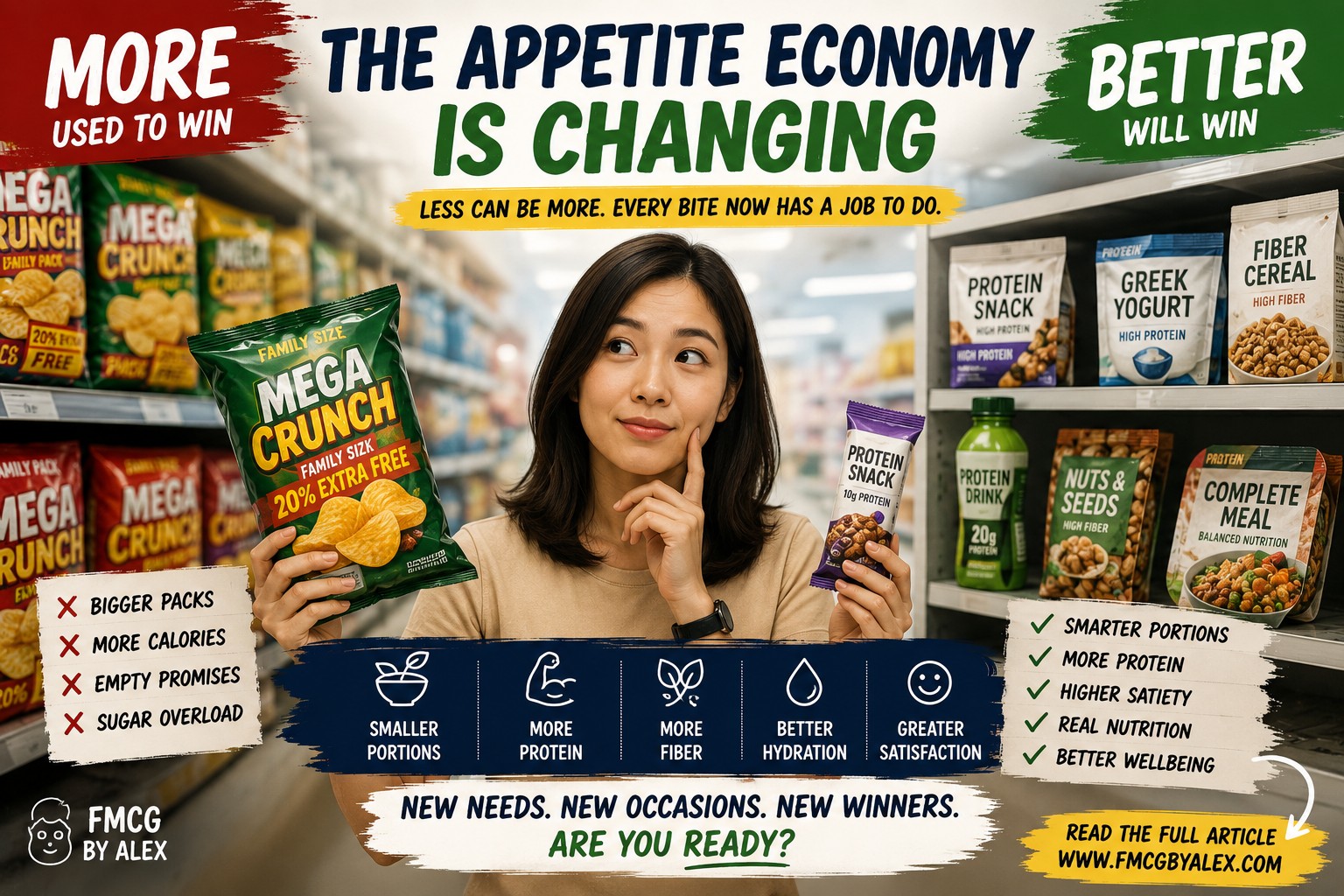
For decades, one of the safest ideas in food marketing was that more is better.
A bigger bag looked generous. A larger bottle looked economical. An extra twenty percent felt like a gift from the manufacturer, even if nobody had asked for another handful of cheese-flavoured corn curls at 11:30 in the evening.
“Family size” became a flexible term. Sometimes it meant enough food for a family. Sometimes it meant enough food for one person watching a football match and making a series of increasingly poor decisions.
The FMCG industry became very good at selling abundance.
More grams. More pieces. Bigger portions. Larger multipacks. Extra filling. Double cheese. Triple chocolate. Mega size. Jumbo size. Party size. A pack large enough to require planning permission.
Then something changed.
Consumers began paying more attention to sugar, protein, fibre, digestion, energy and metabolic health. Portion awareness became more mainstream. High-protein products escaped from the gym bag and entered supermarkets, cafés and office drawers. Functional nutrition became less niche.
And then GLP-1 medicines arrived in the wider consumer conversation.
These medicines were developed for serious medical purposes, including diabetes and obesity management, and decisions about using them belong between patients and qualified healthcare professionals. But their effect on appetite has created a commercial question that food and beverage companies cannot ignore:
What happens when a growing group of consumers simply does not want as much food as before?
Not “does not want your brand.”
Not “has stopped shopping.”
Not “will never touch chocolate again and now survives entirely on steamed broccoli and inner peace.”
They may simply want less.
Smaller meals. Fewer snacks. Different snacks. More nutrition from each eating occasion. Stronger reasons to consume. Better portion control. Products that provide protein, fibre, hydration or satisfaction without demanding the appetite of a teenage football team.
For an industry that spent years putting “20% extra free” on everything, this is an awkward development.
MegaMunch Encounters a Small Problem
Let us imagine an Indonesian snack company called MegaMunch.
MegaMunch has built its success on a simple philosophy: nobody ever complained about receiving more snacks.
Its bestselling products include the Big Crunch Bag, the Mega Family Bag and the Ultimate Sharing Pack, which consumers mostly share with themselves.
The packaging is bright. The flavour is strong. The sales team understands the product. Distributors like the velocity. Retailers like the margin. The factory likes the volume.
Everyone is happy.
Then the category data starts behaving strangely.
The biggest packs are not collapsing, but growth is becoming harder. Some consumers are choosing smaller formats. Others are looking at protein claims, fibre content and sugar levels. Retailers are asking for more portion-controlled options. Online searches increasingly include words like “high protein,” “low sugar,” “healthy snack” and “filling.”
The MegaMunch management team gathers for an innovation meeting.
The marketing manager opens with a confident statement.
“Consumers want healthier snacks.”
Everyone nods.
The brand manager proposes changing the front of the pack from red to green.
This is a traditional FMCG wellness strategy. Green packaging has cured many products of being exactly the same as before.
Someone suggests adding the phrase “better choice.”
Another person suggests placing an illustration of a leaf near the logo.
The R&D manager quietly asks whether the actual product will change.
The room becomes less enthusiastic.
Eventually, MegaMunch launches MegaMunch Active: essentially the same snack in a smaller bag with a runner printed on the front.
Sales are disappointing.
This surprises everyone except the consumer.
The mistake was assuming that health-conscious behaviour is mainly a packaging trend. It is not. The consumer is becoming more demanding about what the product actually delivers.
She may eat less, but she expects every bite to work harder.
That does not mean every biscuit needs to become a medical device. It means empty promises and cosmetic reformulation will be easier to spot.
This Is Bigger Than GLP-1
It would be easy to write this entire trend off as a pharmaceutical story affecting wealthy consumers in the United States and Europe.
That would be a mistake.
GLP-1 adoption is currently more advanced in some markets than others, and access remains uneven. Indonesia will not suddenly become a nation of consumers taking appetite-suppressing medication next Tuesday.
But the medicines are accelerating a wider shift that was already happening.
Consumers are thinking more about satiety. They are interested in protein, fibre, gut health, hydration, blood-sugar stability, energy and weight management. They are reading labels more carefully. They are questioning oversized portions. They are becoming sceptical of products that deliver a lot of calories without much nutritional or emotional value.
Social media is also changing expectations. Nutrition information that once lived mainly with dietitians, sports professionals and dedicated health enthusiasts now appears daily in short videos, product reviews and shopping content.
Not all of it is accurate, naturally. The internet remains a place where a person with a ring light can announce that one ingredient is destroying civilisation before recommending a powder through an affiliate link.
Still, the overall effect is real. Consumers have more questions.
How much protein does this contain?
Will it keep me full?
Is it very sugary?
Does it contain fibre?
Will it upset my stomach?
Is it worth the calories?
Can I eat a smaller amount and still feel satisfied?
That final question should concern every FMCG company whose value proposition is mainly “there is a lot of it.”
Less Food Does Not Necessarily Mean Less Value
The most obvious interpretation of smaller appetites is negative.
If consumers eat less, food companies sell less.
That may be true for some categories and some occasions. Research already suggests that GLP-1 use can reduce grocery spending, particularly on calorie-dense snacks and processed products.
But volume is not the only route to value.
Consumers eating smaller quantities may become more selective about quality. They may pay more for products that offer better nutrition, stronger flavour, greater convenience or a more satisfying experience.
A person who no longer wants a large frozen meal may still buy a smaller one containing good protein, vegetables and fibre.
A consumer who reduces mindless snacking may still buy a premium portion of chocolate.
Someone who drinks fewer sugary beverages may buy a functional hydration drink.
A shopper who eats a smaller breakfast may want yogurt, protein cereal, eggs, soy products or a nutrient-dense drink.
The commercial opportunity may shift from selling more food to making each eating occasion more valuable.
This is uncomfortable for companies built around tonnage.
Factories like volume. Procurement likes scale. Sales teams like cartons. Distributors do not usually celebrate a strategy presentation titled “Consumers will buy fewer grams, but perhaps in a more meaningful way.”
Yet the companies that adapt early may discover new margin pools.
A smaller product can still create strong value when the benefit is clear. Better nutrition, portion control, portability, freshness, premium ingredients, intense flavour or convenient preparation can all justify a different price-value equation.
The key is that “smaller” must not feel like “less for the same money because finance found scissors.”
The Smaller-Portion Opportunity
MegaMunch eventually brings in an outside commercial adviser, which is what companies do after discovering that green packaging did not solve consumer behaviour.
The adviser asks a basic question:
“What if consumers do not want a healthier version of a huge snack? What if they want a genuinely satisfying smaller snack?”
This leads to an awkward silence.
The company has spent years teaching the market that value means quantity. Now it has to consider that value may mean control.
A smaller portion can serve several needs.
It can help consumers manage calories without abandoning indulgence. It can provide portability. It can protect freshness. It can create a lower entry price. It can allow a stronger or more premium recipe. It can reduce guilt around treating oneself.
But the proposition must be honest.
A company cannot quietly reduce a pack from 100 grams to 75 grams, keep the same price, add the word “mindful,” and expect applause.
Consumers understand shrinkflation. They own calculators and social media accounts. This is a dangerous combination.
The smaller pack needs a reason to exist.
Perhaps it contains more protein or fibre. Perhaps it uses better ingredients. Perhaps it offers a measured portion. Perhaps it provides stronger flavour, so less is satisfying. Perhaps the pack is designed for lunchboxes, handbags or office drawers. Perhaps each portion is individually wrapped to help freshness and control.
The benefit must be visible.
“Smaller because we think this is a better experience” can work.
“Smaller because palm oil and cocoa became expensive, but we hoped you would not notice” is harder to build a campaign around.
Protein Is Moving Out of the Gym
Protein used to occupy a fairly specific commercial world.
Large tubs. Serious typography. Muscular people looking disappointed in everyone else’s lifestyle choices. Flavours called things like Extreme Chocolate Impact.
That world still exists, but protein has moved into mainstream food.
Protein yogurts, beverages, cereals, bars, snacks, bakery products, ready meals and even confectionery are appearing across ordinary retail channels. The consumer is no longer only a bodybuilder preparing twelve identical containers of chicken and rice.
She may be a busy professional looking for breakfast. A parent trying to improve a lunchbox. An older consumer concerned about muscle maintenance. A shopper trying to manage appetite. A commuter looking for something more satisfying than a sweet drink and two biscuits.
This creates an enormous FMCG opportunity, but also a great deal of nonsense.
Adding a small amount of protein to a product and printing the word in very large letters is not automatically innovation.
The product must deliver a meaningful nutritional benefit, comply with claims regulations and still taste good.
That final point is where some product developers become distracted.
Consumers may say they want protein. They do not usually mean they want to chew a dense beige rectangle with the texture of building material.
Taste remains the entry ticket.
Texture matters. Aroma matters. Mouthfeel matters. Familiarity matters. Repeat purchase matters.
A product may win one trial because it contains twenty grams of protein. It earns a second purchase because the consumer does not dread eating it.
That distinction has ruined many excellent PowerPoint concepts.
Indonesia Should Not Copy Western Protein Culture Blindly
The Indonesian opportunity will not be won by importing every Western protein-food idea and translating the label.
Local food culture, price points, ingredients, textures, halal requirements and consumption occasions matter.
Indonesia already has strong protein ingredients and food traditions.
Tempeh, tofu, soy, mung beans, eggs, milk, fish, chicken, peanuts and legumes can all play roles in accessible functional nutrition. Traditional snacks can be reformulated thoughtfully. Breakfast beverages can deliver better nutrition. Ready meals can be designed around reasonable portions and satisfying protein. Yogurt and dairy drinks can target satiety and digestive health. Plant-based products can use ingredients consumers already recognise.
The winning proposition is unlikely to be a very expensive imported bar that tastes like compressed ambition.
It is more likely to be familiar, tasty, halal, convenient and affordable.
Consider the difference between these two concepts:
A Rp45,000 specialist protein cookie with imported ingredients and a long English claim.
A locally relevant, portion-controlled tempeh or nut-based snack at a price suitable for regular purchase.
Both can have a market. But only one is likely to reach broad Indonesian FMCG scale quickly.
The market opportunity lies in making better nutrition feel normal, not medical.
Consumers should not feel they have entered a hospital waiting room every time they open a snack.
Fibre Is the Less Glamorous Hero
Protein receives most of the attention because it sounds powerful. Fibre has a quieter image.
Nobody has ever filmed an action movie trailer about dietary fibre.
Yet fibre may be equally important in the appetite economy.
Fibre can support fullness, digestive health and metabolic wellbeing. Consumers are becoming more aware of gut health, but many still do not consume enough fibre-rich foods.
This creates room for cereals, beverages, snacks, bakery products, yogurts, meal replacements and ready meals with meaningful fibre content.
Again, honesty matters.
Adding a tiny amount of fibre and covering the package in illustrations of wheat fields does not transform the product.
The product should deliver enough benefit to justify the communication, without creating unpleasant digestive surprises. Nobody wants to become memorable for the wrong functional effect.
For Indonesia, familiar sources such as oats, legumes, fruits, seeds, vegetables and whole grains can support innovation. Products can combine protein and fibre to offer more satisfying eating occasions.
But companies should avoid turning the pack into a nutrition thesis.
Consumers need a clear reason to buy.
“Helps you feel satisfied for longer” is understandable when substantiated and permitted.
“Contains a proprietary multi-pathway metabolic optimisation matrix” is how products end up being discussed only by the people who created them.
Indulgence Is Not Dying
At this point, the MegaMunch team becomes nervous.
If consumers care about protein, fibre, smaller portions and metabolic health, what happens to chips, chocolate, biscuits, ice cream and confectionery?
Do we all start eating lentils while discussing our glucose response?
Fortunately for the indulgence industry, consumers remain human.
People will continue buying treats. Food is not only fuel. It is pleasure, comfort, celebration, reward, tradition, social connection and something to do while pretending to watch a film but actually scrolling on the phone.
The indulgence occasion may change, however.
Consumers may choose smaller portions. They may buy fewer treats but expect better quality. They may prefer individually wrapped servings. They may look for products with stronger flavour, so a smaller amount feels worthwhile. They may balance indulgence with better nutrition elsewhere.
This creates an opportunity for “less, but better.”
A smaller chocolate bar using better cocoa.
A portion-controlled premium biscuit pack.
A highly flavoured savoury snack that satisfies with fewer pieces.
A small ice cream format designed as a deliberate treat.
The industry has spent decades telling shoppers to consume more. It may now need to become better at making smaller moments feel complete.
This does not require placing protein in every chocolate bar. Sometimes chocolate should remain chocolate.
Functionalising every indulgence can become exhausting.
Consumers do not always want a brownie that supports their personal development.
Sometimes they want a brownie.
The strategic decision is understanding which products should deliver function and which should deliver pleasure honestly and brilliantly.
Hydration Becomes More Interesting
GLP-1 use and wider wellness trends also create opportunities around hydration.
Some consumers using these medicines may need greater attention to fluid intake, but the opportunity extends beyond medication users. Indonesia’s climate, active lifestyles, commuting patterns and growing wellness awareness already support beverages offering hydration, electrolytes or lower sugar.
The beverage industry should pay attention.
Traditional sugary drinks may face pressure as consumers scrutinise calories more carefully. But that does not mean beverages become boring. Taste, refreshment and enjoyment remain essential.
The winning products may combine strong sensory appeal with lower sugar, minerals, electrolytes, vitamins or familiar functional ingredients.
Again, there is a temptation to overcomplicate.
A hydration drink does not need seventeen claims, five adaptogens and an ingredient discovered by monks on a Himalayan cliff.
Sometimes consumers want something refreshing, tasty, trustworthy and not overloaded with sugar.
That is already a serious innovation challenge.
The Mini-Meal May Become a Major Occasion
One of the more interesting possibilities is the rise of the nutrient-dense mini-meal.
Consumers with smaller appetites may struggle with large conventional meals but still need sufficient protein, fibre, vitamins and minerals. Busy consumers already skip meals or replace them with snacks.
This creates space between the traditional meal and the traditional snack.
A yogurt with protein and fruit.
A small rice bowl with vegetables and chicken.
A soy or mung-bean drink with meaningful nutrition.
A compact soup.
An egg-based breakfast product.
A portion-controlled ready meal.
A fortified savoury snack.
The key is satisfaction without heaviness.
For Indonesia, this is particularly relevant in urban markets. Commuters, office workers, students and young professionals often eat around busy schedules. They need convenient options, but many existing choices are either nutritionally weak snacks or full meals that may be too large for the occasion.
A well-designed mini-meal can occupy breakfast, afternoon energy, post-exercise, late dinner or travel occasions.
MegaMunch, after several uncomfortable meetings, eventually considers launching a baked tempeh-and-nut snack with protein and fibre in a controlled portion.
The R&D team creates a prototype.
It is nutritious.
It is also almost impossible to chew.
This is progress of a sort.
After further work, the company develops a product that tastes good, feels familiar and provides a clearer functional benefit. It is not marketed as “GLP-1 food.” It is marketed as a satisfying, practical snack.
That distinction matters.
Do Not Turn Medicine Into a Marketing Costume
The rise of GLP-1 creates a temptation for opportunistic branding.
“GLP-1 friendly.”
“Ozempic support.”
“Perfect for weight-loss injections.”
This is risky territory.
Foods are not medicines. Brands should not imply medical compatibility, treatment benefits or clinical outcomes without proper substantiation and regulatory clearance.
Consumers using GLP-1 medicines may also have varied nutritional needs and side effects. Product claims should not replace professional medical advice.
The safer and more sustainable approach is to solve genuine needs.
Smaller portions.
Protein.
Fibre.
Hydration.
Nutrient density.
Easy digestion.
Convenience.
Transparent labelling.
These benefits can serve GLP-1 users while also appealing to a much larger audience interested in health, weight management and better everyday nutrition.
A product built around a real consumer need has longevity.
A product built around a pharmaceutical hashtag may look opportunistic and become obsolete when the conversation changes.
There is also a human point here.
Not everyone wants their medication status announced by the food in their shopping basket.
A shopper may prefer a good high-protein meal rather than a package shouting, “HELLO, THIS PERSON MAY BE USING WEIGHT-LOSS DRUGS.”
Discretion is still a feature.
Retailers Will Need to Reconsider the Shelf
This trend will not only affect manufacturers.
Retailers will need to reconsider category structure, assortment and merchandising.
Where do protein-rich products sit?
Should functional snacks remain in a separate health aisle, or move into mainstream snacking?
How should mini-meals be grouped?
Can portion-controlled indulgence command dedicated space?
Should yogurt, beverages, bars and ready meals be merchandised around needs rather than traditional categories?
The physical shelf is still organised largely by product type. But consumers increasingly shop by purpose.
Protein breakfast.
Gut health.
Energy.
Weight management.
Hydration.
Healthy snacking.
This creates opportunities for cross-category merchandising, bundles and retail media.
A retailer could build a “satisfying lunch” solution combining a protein product, fruit and lower-sugar drink.
An online platform could create a “high protein and fibre” category.
Quick commerce could merchandise nutrient-dense mini-meals for office workers.
But retailers should resist turning every aisle into a wall of health claims. The shopper still wants simplicity.
The goal is to help, not to create a nutrition examination before checkout.
Sales Teams Will Need a New Story
FMCG salespeople are accustomed to selling velocity, margin, distribution, promotions and category growth.
The appetite economy requires a more nuanced story.
A smaller pack may sell fewer grams but create higher value per gram.
A nutrient-dense product may have a higher price but address a growing need.
A portion-controlled indulgence may improve category frequency by reducing guilt.
A mini-meal may compete across several traditional categories.
The salesperson must explain why the product belongs on shelf and how it expands the category rather than simply cannibalising existing SKUs.
Saying “protein is trending” will not be enough.
Retail buyers have heard the word protein enough times to require evidence.
The sales story should cover the target consumer, consumption occasion, expected price point, incremental role, repeat potential and channel fit.
Does the product attract a new shopper?
Does it create a new occasion?
Does it trade consumers up?
Does it improve category margin?
Can it work without permanent discounts?
These questions determine whether the innovation is commercially useful or merely fashionable.
Do Not Reformulate the Entire Portfolio in a Panic
When a major trend emerges, FMCG companies tend to react in one of two ways.
The first is denial.
“This will not affect our market.”
The second is uncontrolled enthusiasm.
“Put protein in everything by Tuesday.”
Neither is ideal.
Brands should begin with the portfolio and the consumer.
Which categories are most exposed to smaller appetites?
Which products depend on volume consumption?
Which products could benefit from smaller portions?
Where does protein or fibre genuinely improve the proposition?
Which indulgence products should remain indulgent?
Which pack sizes are vulnerable?
Which channels will see change first?
Then test.
Use e-commerce for concept testing. Launch limited editions. Trial smaller pack formats in selected stores. Work with nutrition professionals. Study repeat purchase, not only initial curiosity. Monitor whether consumers buy the product because of the function or despite it.
Innovation teams should also remember that consumers are terrible at eating PowerPoint slides.
A concept can test beautifully when described. The real product still needs to taste, smell and feel right.
MegaMunch eventually learns this after its first protein prototype achieves excellent internal feedback from people who know their performance reviews are approaching.
Actual consumers are less diplomatic.
The recipe improves substantially after that.
Indonesia’s Opportunity Is Better Everyday Food
The most promising Indonesian opportunity is not a shelf filled with expensive products explicitly marketed to medication users.
It is better everyday FMCG.
Affordable protein.
More fibre.
Less unnecessary sugar.
Smarter portions.
Functional hydration.
Convenient mini-meals.
Traditional ingredients used in modern formats.
Halal-certified products consumers trust.
Indulgence that feels intentional rather than excessive.
The market does not need every food to become a supplement. It needs more products that deliver a sensible balance of taste, convenience, nutrition and price.
This is harder than adding a claim.
It requires product development, sourcing, formulation, packaging, pricing and education. It also requires patience. Functional products often need clearer explanation and trial support.
But brands that solve the problem well may build strong loyalty.
A consumer who finds an affordable product that tastes good, fits her routine and helps her feel satisfied has a reason to return.
That is more valuable than attracting a one-time shopper with a large “HIGH PROTEIN” badge and a product she never wants to eat again.
The New Value Equation
The old food value equation often centred on quantity.
How much do I get for my money?
That question remains important, especially in value-conscious markets.
But a second equation is becoming more relevant:
What does this food do for me?
Does it satisfy?
Does it provide protein?
Does it support digestion?
Does it hydrate?
Does it give me energy?
Does it fit my health goals?
Does it still bring pleasure?
The strongest products will answer both equations.
They will be affordable enough to buy and useful enough to justify the price.
This is especially important in Indonesia. A technically impressive product priced outside regular consumption will remain niche. A cheap product with no real benefit may win trial but struggle to build long-term differentiation.
The commercial prize lies in accessible functionality.
Not luxury wellness theatre.
Not medicalised snacking.
Not a Rp60,000 biscuit requiring a vocabulary lesson.
Useful, enjoyable food at realistic price points.
MegaMunch Finally Learns to Sell Less
After a year of testing, MegaMunch launches three new formats.
The first is a smaller portion of its core indulgent snack, with stronger flavour and clear portioning.
The second is a baked tempeh-and-nut snack offering protein and fibre at an accessible price.
The third is a compact office mini-meal designed for afternoon consumption.
The company does not abandon its large family packs. Those still serve parties, households and sharing occasions.
Instead, MegaMunch builds a broader architecture.
Large packs for sharing.
Small packs for control.
Functional snacks for satisfaction.
Mini-meals for convenience.
The lesson is not that “big is dead.”
The lesson is that one size no longer tells the whole story.
Consumers still want abundance sometimes. They also want restraint, nutrition, convenience and quality.
The brand that understands the occasion can sell the right amount.
The brand that only understands tonnage may keep adding free grams while wondering why the shopper is walking away.
Final Thought: Every Bite Now Has a Job Interview
The appetite economy is changing.
GLP-1 medicines are accelerating the conversation, but the underlying shift is broader. Consumers are becoming more deliberate about portion size, nutrition, satiety and the value of each eating occasion.
This will create winners and losers.
Products that depend on mindless overconsumption may face pressure.
Products that deliver genuine satisfaction, nutrition, convenience or pleasure can grow.
Protein and fibre will become more mainstream. Hydration will evolve. Mini-meals will expand. Portion-controlled indulgence will become more sophisticated. Pack architecture will matter. Claims will require credibility. Taste will remain non-negotiable.
Above all, brands must stop assuming that “more” is always the strongest value proposition.
Sometimes the shopper wants more nutrition.
More satisfaction.
More flavour.
More convenience.
More confidence.
But not necessarily more grams.
That is a difficult adjustment for an industry that spent decades putting “extra free” on the front of the pack.
Still, the opportunity is significant.
If consumers are eating less, every product must earn its place more clearly.
Every snack needs a reason.
Every beverage needs a role.
Every portion needs to feel worthwhile.
Every calorie has, in effect, been invited to a job interview.
And the candidate who turns up saying only, “There is twenty percent more of me,” may discover that the position has already been filled.
Tools for this topic
View shopFMCG Revenue Growth Sprint
A practical RGM sprint program for commercial teams.
The FMCG Pricing Handbook (eBook)
A practical handbook to design profitable price-pack architecture.
Related content
What Indonesia’s Marketplace Tax Collection Actually Does to Your SKU Margin
Indonesia’s marketplace PPh 22 collection is scheduled to begin on 1 November 2026. Here is what the 0.5% actually means for SKU margin, settlement cash, pricing and marketplace reconciliation.
Your Product Just Got a School Report
Under BPOM Regulation No. 10 of 2026, Indonesia has introduced front-of-pack Nutri-Level grading. Here is how sugar, salt, and fat grades (A to D) will turn reformulation into brand strategy, category management, and a front-of-pack marketing battle.
First the Retailer Sold Your Product. Now It Is Selling Your Customer Back to You.
How retail media, shopper data, and digital platforms are transforming FMCG supplier-retailer economics from physical margin negotiations to paid customer access in Indonesia and beyond.