The New FMCG Shelf Is an Algorithm: A Story About Winning Online Visibility Without Becoming a Discount Addict
FMCG brands no longer fight only for supermarket shelf space. They now fight for search ranking, marketplace visibility, reviews, quick-commerce availability and algorithmic attention. Here is how to win the new digital shelf without becoming addicted to discounts.
The New FMCG Shelf Is an Algorithm: A Story About Winning Online Visibility Without Becoming a Discount Addict
There was a time when an FMCG sales manager could understand the battlefield by walking into a supermarket.
He would enter the store, look left, look right, inspect the shelf, count the facings, check the price tag, complain about the competitor’s promotion, take a few photos, send them to the WhatsApp group, and then ask the eternal question of FMCG field execution:
“Who removed our shelf talker?”
It was not a perfect world, of course. The competitor always seemed to have a better gondola end. The promoter was sometimes missing. The price tag was sometimes wrong. The product that should have been at eye level was somehow sitting near the floor, where only toddlers and very determined shoppers could find it.
But at least the shelf was visible.
You could stand in front of it. You could point at it. You could say, “This is the problem.” You could blame merchandising, the store team, the buyer, the distributor, the salesman, the competitor, the planogram, the moon phase, or whoever had last touched the display.
Today, that shelf still matters. Physical retail is not dead. Anyone who says that has probably not visited enough Indonesian minimarkets, supermarkets, pharmacies, beauty stores, warung or traditional outlets. FMCG is still very physical. People still pick up products, compare packs, check prices, ask store staff, look at displays and make impulse purchases they later justify as “necessary.”
But something has changed.
The shelf has multiplied.
Your product is no longer only fighting for space in a supermarket aisle. It is also fighting inside a phone screen. It is fighting in marketplace search results, TikTok Shop tiles, quick-commerce apps, sponsored product placements, online grocery carousels, review pages, livestream offers and “recommended for you” sections that seem to know more about shoppers than their own families do.
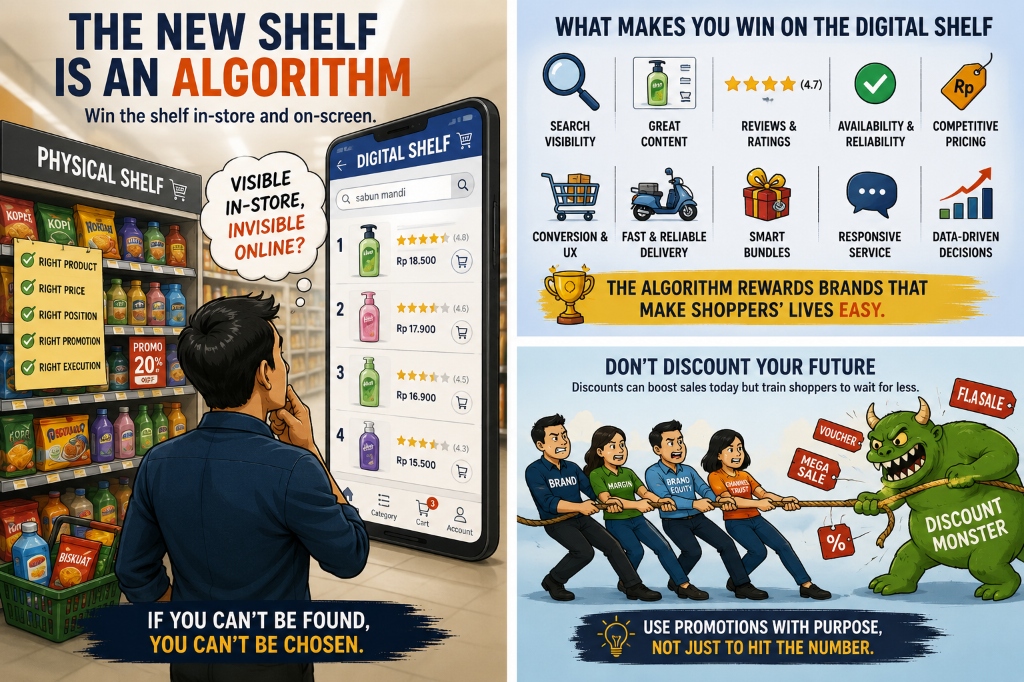
The new FMCG shelf is an algorithm.
And the algorithm is not sentimental.
It does not care that your founder has passion. It does not care that your sales deck has 47 slides. It does not care that your packaging won an internal compliment from someone’s cousin. It cares whether shoppers click, buy, review, reorder and receive the product without drama.
This is where many FMCG companies are still catching up.
They know how to fight for shelf space. They know how to negotiate with buyers. They know how to push distributors. They know how to run promotions. They know how to argue about facings with the seriousness of diplomats negotiating world peace.
But when the battle moves to the digital shelf, they often behave like tourists.
They upload a product photo, write a basic title, set a price, join a marketplace campaign, add a discount, and hope the algorithm develops sympathy.
It does not.
Budi Meets the Shelf He Cannot See
Let us meet Budi.
Budi is an experienced sales manager in Indonesia. He is good at his job. He knows which distributors are strong, which outlets are serious, which modern trade buyers are tough but fair, and which ones smile nicely while asking for the kind of trade support that makes finance reach for a chair.
Budi understands traditional retail warfare. He knows the value of eye-level shelves. He knows what happens when your product loses facings. He knows that an out-of-stock bestselling SKU is not a supply chain issue; it is a crime against the sales target.
One afternoon, Budi visits a supermarket in Jakarta. His brand is present. The shelf looks decent. The price is correct. The competitor has a promotion, which annoys him, but competitors exist mainly to annoy sales managers, so this is not unusual.
Budi feels reasonably calm.
Then Dina, the e-commerce manager, opens her phone.
She searches the product category on a marketplace.
Budi’s brand does not appear on the first screen.
She searches another keyword.
Still not there.
She checks a quick-commerce app.
The product is listed, but out of stock in several locations.
She checks a competitor.
The competitor has thousands of reviews, a strong rating, several bundle options, a sponsored placement, attractive product images and a discount badge bright enough to guide ships at night.
Budi looks at the physical shelf. Then he looks at the phone.
The store shelf says the brand is present.
The phone says the brand is invisible.
That is the modern FMCG problem.
You can win the shelf in the store and lose the shelf on the screen.
And increasingly, the shopper may check the screen before she ever reaches the shelf.
The Shopper Does Not Shop in Straight Lines Anymore
The old FMCG model was relatively easy to understand. The consumer saw advertising, went to the store, saw the product, compared the price, maybe remembered the brand, and bought it.
Today, the journey is less of a straight line and more of a bowl of noodles.
A shopper may see a product on TikTok, check the price on Shopee, read reviews on Tokopedia, ask a friend on WhatsApp, notice the product later in Guardian, compare the price on a quick-commerce app while standing in the aisle, then buy it from whichever channel feels most convenient at that moment.
Or she may discover the product in a supermarket, scan the price mentally, search online, find a bundle, wait for payday, forget about it, see a livestream, add to cart, abandon the cart, receive a voucher, and then buy a competitor because it had better reviews.
This is not a funnel anymore.
This is a maze with free shipping.
For FMCG brands, the implication is simple: the shopper does not separate online and offline the way companies do.
Inside the company, there is a modern trade team, a general trade team, an e-commerce team, a marketing team, a finance team, and sometimes a digital team that uses words nobody else fully understands but everyone nods at.
The shopper does not care.
She sees one brand.
If the shelf price is high but the marketplace price is always discounted, she notices.
If the product is available in-store but invisible online, she notices.
If the official store has poor images while a reseller has better content, she does not care who uploaded what. She only sees the experience.
If reviews are bad, if delivery is slow, if the product description is confusing, if the online pack looks different from the offline pack, the brand loses trust.
The shopper does not care which department caused the problem.
She just buys something else.
Very rude, but commercially important.
The Digital Shelf Has Its Own Version of Bad Merchandising
In physical retail, bad execution is easy to spot. The product is out of stock. The shelf is messy. The price tag is wrong. The display is missing. The promoter is chatting with someone near the entrance while your competitor is selling.
Online, bad execution is quieter, but just as damaging.
A weak product title is like placing your product in the wrong aisle.
A blurry image is like putting dusty packaging on the shelf.
No reviews is like asking the shopper to trust a stranger in a dark alley.
Out-of-stock status is like locking the store door and wondering why nobody entered.
A bad product description is like hiring a promoter who only says, “Good product, Kak.”
A slow response to chat is like watching a customer ask a question and then pretending to be a plant.
The digital shelf needs the same seriousness as the physical shelf. In fact, sometimes it needs more, because online the shopper can leave instantly. In a physical store, she may still walk past your product. Online, one thumb movement and she is gone forever, possibly into the arms of a competitor with worse packaging but better search optimisation.
This is where Budi starts to understand Dina’s world.
The marketplace product page is not admin. It is retail execution.
The first image is the front facing.
The title is the shelf signage.
The description is the promoter script.
The reviews are word of mouth.
The rating is trust.
The delivery promise is convenience.
The stock status is availability.
The bundle is value architecture.
The keyword is location.
If you get these wrong, you may technically be online, but commercially invisible.
There is a big difference.
The Algorithm Likes Boring Things
Many brands imagine that winning online is about clever hacks. Secret tricks. Viral content. Flash sales. Livestream magic. Influencer explosions. Some mysterious digital spell performed by a 23-year-old who says “conversion funnel” with alarming confidence.
Sometimes those things help.
But most online FMCG success is built on boring excellence.
The product is always in stock. The title is clear. The images are sharp. The claims are understandable. The price makes sense. The reviews are strong. The store replies quickly. The delivery is reliable. The bundle is useful. The shopper understands the offer. The product page converts. People reorder.
Not very glamorous.
Very effective.
The algorithm may look complicated, but much of what it rewards is simple commercial discipline. It rewards products that shoppers can find, understand, trust and buy. It rewards conversion. It rewards availability. It rewards response. It rewards consistency.
This is frustrating for teams looking for magic, because the answer is often operational.
Fix the image.
Improve the title.
Answer the chat.
Stop going out of stock.
Ask for reviews.
Create a better bundle.
Track conversion.
Reduce cancellations.
Improve delivery promise.
Make the benefit clear.
This does not sound like digital transformation. It sounds like work.
Unfortunately, work remains popular with results.
The Discount Button Is Very Tempting
When Budi asks Dina how to improve online visibility quickly, Dina gives him the answer he both expected and feared.
“Discounts help.”
Of course they do.
Discounts attract clicks. They improve conversion. They help marketplace campaigns. They can push products up the ranking. They make dashboards look better. They give sales teams a temporary reason to smile.
But discounts also behave like a friendly monster.
At first, you feed the monster because you need trial. Then you feed it because the campaign performed well. Then you feed it because competitors are discounting. Then because the platform invited you to another mega campaign. Then because sales are weak without it. Then because the monthly target is looking at you with judgement.
Before long, the shopper has learned the real lesson:
This brand is usually cheaper if I wait.
That is not loyalty. That is training.
The danger is even bigger when offline channels matter. If the same SKU is always cheaper online, modern trade buyers notice. Distributors notice. Resellers notice. Your own sales team notices, usually when a buyer sends a screenshot with the message, “Please explain.”
There are few messages in FMCG more painful than “Please explain” attached to a marketplace screenshot.
The issue is not that online promotions are bad. They are necessary. The issue is whether they have a purpose beyond panic.
A discount should have a job. It should create trial, build repeat, support a launch, clear specific inventory, defend a strategic keyword, reward a bundle purchase or help a defined customer segment convert.
If the only reason is “the platform asked us” or “the month is scary,” the brand may be feeding the monster again.
And the promo monster is never full.
Bundles Are the Civilised Alternative to Screaming Discount
Dina shows Budi another option.
Instead of discounting the hero SKU every week, the brand can build bundles.
A bundle does something a straight discount often cannot. It creates value without always destroying the single-unit reference price.
A coffee brand can sell a morning routine pack. A snack brand can sell a school lunchbox bundle. A skincare brand can sell a cleanser, serum and sunscreen set. A sambal brand can sell a family meal kit. A beverage brand can sell a mixed-flavour discovery case. A baby-care brand can sell a new-parent starter pack. A household brand can sell a monthly refill bundle.
This makes sense because shoppers do not live in SKU codes. They live in situations.
Breakfast. Office snacks. Kids’ lunchboxes. Movie night. Ramadan gifting. Weekly pantry refill. Beauty routine. Travel convenience. Post-gym recovery. Emergency dinner because everyone forgot to buy groceries.
A good bundle says, “Here, we solved something.”
A bad bundle says, “Here are three slow-moving products tied together with despair.”
The shopper can tell the difference.
So can the algorithm, eventually, because useful bundles convert better.
For FMCG brands, bundles can increase average order value, reduce shipping pain per unit, introduce new SKUs, protect hero SKU pricing and create a stronger consumer occasion.
That is smarter than discounting everything and calling it strategy.
Retail Media Is the New Gondola End, But With More Dashboards
Once Budi understands the digital shelf, Dina introduces him to retail media.
Budi immediately becomes suspicious.
This is wise.
Retail media is powerful. It allows brands to buy visibility inside marketplaces, online grocery platforms and retail apps. Sponsored search, banners, product boosts, campaign placements, livestream slots and recommended listings can place the brand closer to the moment of purchase.
In theory, this is excellent.
In practice, it can become the new trade spend black hole.
Old-school trade spend had gondola ends, catalogues, displays, leaflets and promo fees. Retail media has sponsored keywords, banners, platform campaigns and ROAS dashboards. The names changed. The danger remains the same.
You can spend a lot of money and still not know whether the activity truly created incremental profit.
The dashboard may show clicks. It may show GMV. It may show a nice ROAS number that makes the room feel intelligent. But after platform fees, discounts, ad spend, shipping subsidies, vouchers, returns, content cost and internal team time, did the campaign actually make money?
Did it increase organic visibility later?
Did it improve repeat purchase?
Did it defend an important keyword?
Did it generate reviews?
Did it help the brand learn something?
Or did it just rent attention for three days and then disappear like a promoter after lunch?
Retail media should be managed like trade spend, not like casino chips.
This is where sales, marketing, e-commerce and finance need to work together. If the e-commerce team celebrates GMV, finance sees margin damage, and the modern trade team receives angry screenshots about online pricing, the company does not have omnichannel strategy.
It has departmental jazz.
Everyone is playing something, but nobody is sure it is the same song.
Reviews Are the New Promoters
Budi has always believed in promoters. A good promoter can explain the product, answer questions, encourage trial and close the sale.
Online, reviews do part of that job.
A product with thousands of good reviews feels safer. A product with no reviews feels like a gamble. A product with bad reviews feels like a warning sign wearing a price tag.
Reviews matter because FMCG shoppers do not always want to research deeply. Most people do not want to spend an entire evening comparing dishwashing liquid, biscuits or body wash. They want quick confidence.
Reviews provide that confidence.
They also provide language the brand can use.
If customers keep saying a snack is “not too sweet,” that may be a stronger claim than whatever the brand team wrote. If shoppers say a lotion is “not sticky,” that is gold in Indonesia. If buyers say a sambal “makes simple food exciting,” congratulations, the consumer just wrote your campaign.
Reviews are not only feedback. They are sales assets.
But they need management.
Ask for reviews. Respond to complaints. Fix repeated issues. Monitor ratings by SKU. Turn strong reviews into content. Use customer language in product pages. Watch for complaints about damaged packaging, expiry dates, delivery problems or confusing variants.
A review is a small salesperson working 24 hours a day without transport allowance.
Treat it well.
Quick Commerce Is Not Just Faster Delivery
Then Dina opens a quick-commerce app.
Budi sees the brand is available in some areas, missing in others, and out of stock in places where it should definitely be present.
Quick commerce looks simple from the outside. A shopper orders. A rider delivers. Everyone is happy.
But commercially, it changes the purchase occasion.
Quick commerce captures urgency.
The shopper forgot something. The child needs milk. Guests arrived. The cooking oil is finished. The shampoo ran out. Someone used the last coffee sachet and put the empty pack back, which should be classified as a household crime.
In these moments, the shopper is not casually browsing. She is solving a problem.
That means the assortment must be sharp. Quick commerce does not need every SKU. It needs the right SKUs.
Daily essentials. Fast movers. Top-up packs. Refills. Personal care basics. Snacks. Beverages. Cooking necessities. Emergency household items. Products people need now, not after a three-day comparison journey.
The digital shelf in quick commerce is smaller and more brutal. If you are out of stock, the shopper buys someone else. If your image is unclear, she ignores you. If your product is not in the right location, it might as well not exist.
Quick commerce is retail with a stopwatch.
It rewards brands that understand urgency.
Small Brands Can Still Win
At this point, Budi asks the question many companies ask.
“How can smaller brands compete with big brands online?”
The answer is: not everywhere.
That is the trick.
Small FMCG brands should not try to beat large brands across every keyword, every category and every platform. That is a fast way to spend money and become tired.
Small brands can win by being specific.
Own one use case. Own one community. Own one keyword cluster. Own one hero product. Own one strong bundle. Own one local delivery area. Own one problem that shoppers care about.
Small brands can move faster. They can test titles, improve images, reply to reviews, create real behind-the-scenes content, build WhatsApp repeat orders, work with micro-creators, create niche bundles and speak like humans instead of brand manuals.
This is a real advantage.
Large brands often have budget. Small brands can have closeness.
The mistake is when small brands try to look big too soon. They spread themselves thin, join every campaign, discount too often, launch too many SKUs and confuse activity with traction.
A small brand does not need to be everywhere.
It needs to be easy to find where it matters.
Easy to trust.
Easy to buy.
Easy to reorder.
That is enough to start.
The Dashboard Can Lie Politely
Digital commerce gives brands more data than ever.
This is useful, but also dangerous.
Dashboards can make bad decisions look scientific.
A campaign can show strong sales but weak profit. A product can rank well only because it is heavily discounted. Paid ads can generate sales that would have happened anyway. A bundle can increase revenue but reduce margin. A livestream can sell many units to bargain hunters who never return. A marketplace store can grow while offline retailers become irritated about price gaps.
Numbers are not the problem.
Bad questions are the problem.
Instead of asking only whether online sales grew, brands should ask whether online growth made the total business stronger.
Did the campaign create incremental sales?
Did it improve organic rank?
Did it generate repeat buyers?
Did it protect contribution margin?
Did it improve reviews?
Did it reduce dependence on discounts?
Did it create useful consumer learning?
Did it hurt offline channels?
Did it shift volume from one channel to another at a lower margin?
This is the difference between digital activity and digital strategy.
Activity is easy. Strategy is where the thinking starts.
Unfortunately, thinking is harder to automate than promo codes.
The New Perfect Store Has Two Doors
By the end of the day, Budi sees the business differently.
He still believes in the physical shelf. He should. The store remains powerful. The shopper still needs to see, touch, compare and trust products in real life. Distributors still matter. Retailers still matter. Merchandising still matters. Promotions still matter. Price tags still matter. Missing POS material will continue to ruin mornings.
Some traditions are eternal.
But Budi now understands that the perfect store has a digital twin.
The brand must win the store shelf and the phone shelf.
It must be visible in the aisle and visible in search.
It must have facings and reviews.
It must have price tags and product titles.
It must have promoters and product videos.
It must have gondola ends and sponsored placements.
It must have availability in-store and availability in quick commerce.
It must have trade promotions and retail media discipline.
It must have physical execution and digital execution.
The shopper moves between both worlds. The brand must do the same.
Final Thought: The Shelf Did Not Disappear. It Multiplied.
The new FMCG shelf is not replacing the old one.
It is multiplying it.
There is still a shelf in the supermarket, but now there is also a shelf inside Shopee, Tokopedia, TikTok Shop, online grocery, quick commerce, search results, sponsored listings, livestreams and review pages.
The brands that win will not be the ones that only shout louder or discount deeper. They will be the ones that become easy to find, easy to understand, easy to trust, easy to buy and easy to reorder.
That requires discipline.
It requires strong product content, good availability, clear pricing, useful bundles, review management, retail media control, quick-commerce logic and proper alignment between sales, marketing, e-commerce and finance.
It also requires humility.
Because the algorithm does not care about your internal politics.
It does not care that sales wants volume, marketing wants brand equity, finance wants margin, and e-commerce wants campaign participation.
It only sees shopper behaviour.
If shoppers click, buy, review and reorder, the brand has a chance.
If they do not, the brand becomes invisible.
The old shelf rewarded brands that could win space.
The new shelf rewards brands that can win attention, trust and conversion.
The best FMCG brands will learn to win both.
They will still fight for facings. They will still negotiate with buyers. They will still manage distributors. They will still complain when the shelf talker disappears, because we are human and some things are unforgivable.
But they will also fight for search rank, review quality, digital availability and algorithmic visibility.
Because in modern FMCG, the shopper may never see your beautiful shelf display if your product loses the battle on the phone first.
The shelf did not disappear.
It multiplied.
And one of those shelves has an algorithm, a dashboard, a media budget and absolutely no sympathy for brands that forgot to optimise their product title.
Tools for this topic
View shopCommercial Execution Tee
Soft cotton tee celebrating disciplined FMCG execution.
Related content
What Indonesia’s Marketplace Tax Collection Actually Does to Your SKU Margin
Indonesia’s marketplace PPh 22 collection is scheduled to begin on 1 November 2026. Here is what the 0.5% actually means for SKU margin, settlement cash, pricing and marketplace reconciliation.
First the Retailer Sold Your Product. Now It Is Selling Your Customer Back to You.
How retail media, shopper data, and digital platforms are transforming FMCG supplier-retailer economics from physical margin negotiations to paid customer access in Indonesia and beyond.
The Shopper Has Left the Store. Their AI Agent Is Doing the Shopping
What happens to FMCG marketing when AI assistants build grocery baskets and substitute products before a human ever sees the shelf? Explore the rise of agentic commerce and machine-legible brands in Indonesia.