
Why a Phased Product Launch Is Usually the Wisest Way to Win in FMCG
Pushing distribution before proving repeat traction is the most dangerous sentence in FMCG. A phased launch gives you the time and cash runway to validate your model before scaling.
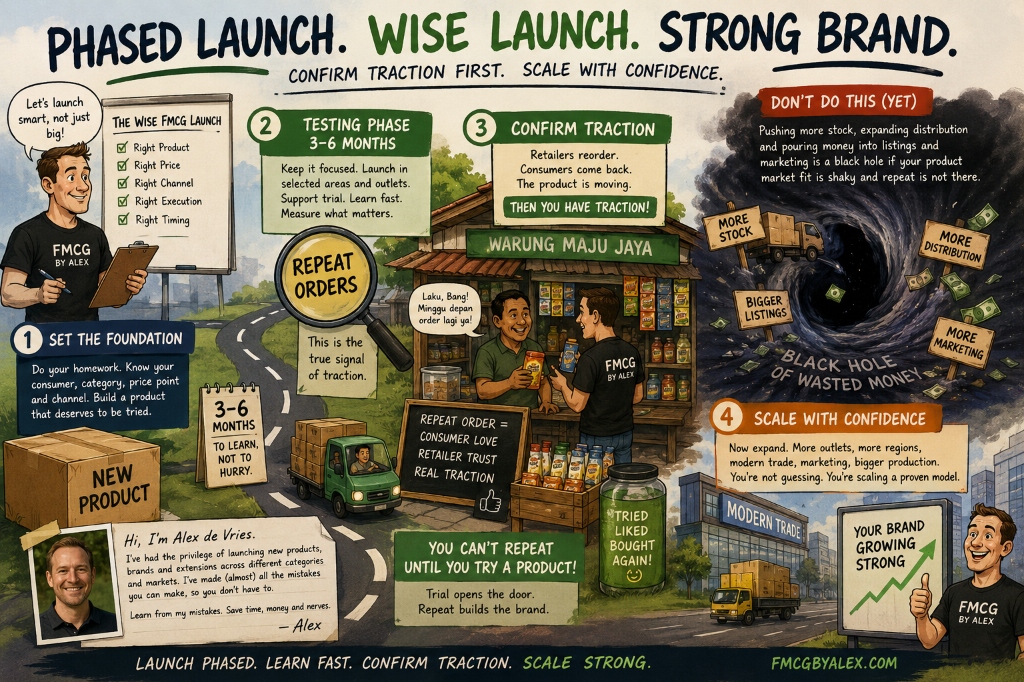
TL;DR
Pushing distribution before proving repeat demand is an expensive way to relocate warehouses. A phased launch gives you the time and cash runway to validate product-market fit, price architecture, and repeat traction in selected channels (like General Trade) before scaling aggressively. Focus on the second order—that's the real exam.
There is a dangerous moment in every FMCG launch.
It usually happens after the first production run is done, the packaging looks beautiful, the founder is holding the product like a newborn baby, and the sales team has managed to get the first few retailers to say yes. Suddenly, everyone becomes very brave.
The spreadsheet starts glowing. The investor deck looks more confident. Someone says, “If we can get into 10,000 stores, the numbers are huge.” Someone else says, “We need to go big now before competitors copy us.” A marketing agency appears from the shadows with a very nice proposal, a very serious mood board, and an invoice that could make your finance manager suddenly develop a religious life.
And then the most dangerous sentence in FMCG is spoken.
“Let’s push distribution.”
It sounds sensible. It sounds ambitious. It sounds like growth. But if the product has not yet proven traction, if retailers are not reordering, if consumers are not actually coming back for more, pushing more stock into the market can quickly become less of a launch strategy and more of a very expensive warehouse relocation program.
Because in FMCG, the first order is not proof. The first order is curiosity. The first listing is not victory. The first listing is permission to be tested. The first shipment is not market acceptance. It is merely the opening scene.
The real test is what happens after the product lands on the shelf.
Does it move? Does it move fast enough? Do consumers come back? Do retailers reorder without needing to be begged, bribed, threatened, or emotionally manipulated with stories about your entrepreneurial journey? Does the distributor want more, or are they suddenly “checking internally” for six weeks?
This is why a phased product launch is often the wisest way to build an FMCG brand, especially in a market like Indonesia where the opportunity is massive, but the cost of being wrong can also be massive. A phased launch gives you time to confirm whether your product has legs before you start buying it expensive shoes.
This is not theory from a comfortable chair and a suspiciously clean whiteboard. I am Alex de Vries, and I have had the privilege of launching new products, new brands, and product line extensions across different FMCG categories, channels, and markets. Some launches went beautifully. Some taught me lessons the polite way. Others taught me lessons the FMCG way, which usually involves stock sitting somewhere it should not, retailers suddenly becoming hard to reach, distributors “checking internally,” and spreadsheets quietly losing their optimism.
Over the years, I have made, seen, fixed, or narrowly avoided most of the mistakes you can make when launching FMCG products. Launching too wide before repeat was proven. Trusting sell-in too much. Underestimating the effort needed to create trial. Thinking distribution alone would create demand. Believing a good product would magically move through the channel without the right price point, retailer support, and market activation. These lessons are expensive when you learn them in real time. So I am sharing them here for one simple reason: so you do not have to pay the full tuition fee yourself.
The Market Does Not Care About Your Confidence
Every founder believes in their product. That is part of the job. If founders were not optimistic, most products would never leave the kitchen, factory, farm, lab, or overly dramatic branding workshop where someone decided the logo needed to represent “movement, trust, heritage, and disruption.”
But the market does not care how much you believe.
The market is brutally practical. Consumers care about price, taste, convenience, packaging, trust, habit, and whether the product solves a real problem or creates enough desire to justify a purchase. Retailers care about margin, stock rotation, credit terms, display discipline, category fit, and whether your product will actually move instead of sitting there like a decorative souvenir from a trade show.
That is why the first three to six months of a launch should be treated as a testing phase, not as a victory lap.
Three to six months is enough time to see whether your product can survive outside your own imagination. It gives you several retail cycles. It gives consumers time to try the product, forget about it, remember it, compare it, and maybe come back. It gives retailers time to see whether the product moves naturally or whether the only reason sales happened was because your sales team was standing next to the shelf like proud parents at a school performance.
During this testing phase, the most important signal is not how many outlets you shipped to. It is not how many boxes left your warehouse. It is not how many salespeople posted selfies with store owners. Repeat orders from retailers are the signal that matters most.
Repeat orders are where the truth begins.
A retailer who orders once may be curious. A retailer who orders twice is telling you something more important. They are saying, “This product created enough movement for me to give it more space, more cash, and more attention.” That is a very different signal from “Sure, leave one carton and we will see.”
In FMCG, repeat orders are traction. Not likes. Not compliments. Not “wah, packaging bagus.” Not “my cousin says this could be big.” Repeat orders.
That is the sound of the market quietly voting with money.
The First Order Is Easy. The Second Order Is the Exam.
Getting the first order is often not as difficult as people think, especially if you have a decent sales team, good relationships, attractive margins, a reasonable product story, or a distributor who is willing to help. Retailers are used to trying new products. Some will take a small quantity just to see what happens. Others will take it because the category is moving. Some take it because the salesperson is persistent and they want the person to stop returning every Tuesday with the same enthusiastic face.
But the second order is different.
The second order has no romance. The retailer has already seen the product on the shelf. They have seen whether people pick it up. They have heard whether anyone complained. They know whether the product moved faster than a sleepy turtle or whether it actually performed. They know whether your product deserves cash again.
That is why measuring repeat orders is so powerful. It cuts through fantasy.
A product that gets initial sell-in but no repeat is not necessarily a bad product, but it is a warning sign. Something is not yet working. Maybe the price is wrong. Maybe the packaging does not communicate clearly. Maybe the product tastes good but not good enough to replace existing habits. Maybe the margin is unattractive. Maybe the retailer placed it in a terrible location next to dust, expired batteries, and a lonely packet of something from 2019. Maybe the distributor shipped it to the wrong type of outlet. Maybe the category itself needs education. Maybe consumers need sampling. Maybe the product is simply too premium for the channel.
The point is that you need to know this before you scale.
Because once you start expanding aggressively, every small weakness becomes expensive. A pricing issue in 50 stores is a problem. A pricing issue in 5,000 stores is an opera. A packaging problem in one city is annoying. A packaging problem after national listing fees, campaign spending, distributor incentives, and large production commitments is the kind of thing that makes people stare silently at walls.
A phased launch allows you to learn while the mistakes are still affordable.
Distribution Is Not the Same as Demand
One of the classic FMCG illusions is confusing distribution with demand.
It is easy to look at a shipment report and feel successful. The warehouse moved stock. Distributors received stock. Retailers received stock. The sales dashboard looks alive. Everyone is smiling. The boxes are no longer your problem.
Except, of course, they may still be your problem. They have merely changed address.
Sell-in is what you sell into the channel. Sell-out is what consumers buy from the channel. The difference between the two is where many FMCG dreams go to become accounting headaches.
You can push stock into distributors and retailers, but if consumers do not buy it, the channel clogs. Retailers stop reordering. Distributors become cautious. Sales teams start offering discounts. Marketing starts blaming visibility. Finance starts asking uncomfortable questions. Operations starts worrying about expiry dates. The founder starts saying things like, “Maybe we just need more brand awareness,” which is sometimes true and sometimes just a polite way of saying nobody wants to admit the product-market fit is still shaky.
This is why pushing stock before confirming traction is dangerous. It can create the illusion of growth while hiding weak consumer pull.
In the early phase, you are not trying to impress yourself with volume. You are trying to discover whether the product can repeat. That means you need to follow the stock. You need to know which outlets sold, which outlets did not, which ones reordered, how quickly they reordered, and what kind of outlet performs best.
Not all distribution is equal.
A product may perform beautifully in small neighborhood stores but die in minimarkets. Another may perform in pharmacies but not in general trade. Another may work in urban modern trade but fail in rural traditional trade because the price point is wrong. Another may sell in warung near schools but not in grosir. Another may look like a family product but actually be bought mostly by young working adults.
The market will tell you, but only if you listen before shouting louder with more stock.
Indonesia Rewards Patience, But Punishes Laziness
Indonesia is a beautiful, complicated, exciting, frustrating, and very humbling FMCG market. It has enormous scale, diverse channels, regional differences, price sensitivity, strong informal trade, and consumers who can be both brand-loyal and highly experimental depending on the category and price point.
It is also a market where general trade can still be one of the cheapest and smartest places to start, especially for certain FMCG products.
General trade, or GT, gives you access to warung, small independent shops, semi-wholesale outlets, local groceries, market stalls, and the everyday retail points where millions of Indonesians buy products in practical, affordable quantities. For a new product, GT can be attractive because you may avoid some of the heavier listing fees, formal campaigns, long negotiation cycles, and central buying requirements that come with modern trade.
But GT is not magic. GT is not a charity program for new brands. GT is not a place where you throw cartons into the universe and wait for destiny.
GT works when the product fits the channel.
That often starts with price point. In traditional trade, the “sweet spot” matters enormously. If your product sits at a price that feels natural for the consumer, gives the retailer a workable margin, and fits the purchase habit of the category, you have a chance. If your price is awkward, too premium, too large in pack size, too low in margin, or too confusing versus alternatives, the channel will quietly reject you.
And it will not send a formal rejection letter.
It will simply stop reordering.
That is why price architecture is not some boring finance exercise done in a spreadsheet after everyone has finished the fun branding work. Price architecture is strategy. In Indonesia, pack size, sachet format, affordable unit price, margin structure, and channel fit can decide whether your product gets trial or becomes “interesting but difficult.”
There is a reason sachets, small packs, affordable single-serve formats, and sharp entry price points have played such an important role in Indonesia’s FMCG landscape. They reduce the risk of trial. They fit cash-on-hand purchasing. They allow consumers to test without making a big commitment. And for a new brand, trial is oxygen.
You cannot get repeat if people never try.
But trial does not happen just because the product exists. That is where many brands misunderstand GT.
You Cannot Just Ship to Grosir and Hope for a Miracle
There is a tempting shortcut in Indonesia. You find grosir outlets or wholesalers, sell stock to them, and assume the product will naturally flow downstream to smaller retailers and then consumers. In theory, this sounds efficient. In practice, it can become the FMCG version of throwing a message in a bottle and calling it a logistics strategy.
Grosir can be powerful. Wholesalers can move volume. They can influence smaller outlets. They are often important nodes in the distribution ecosystem. But for a new product, you cannot simply ship to grosir and assume the market will open itself.
Why would smaller outlets buy the product from the wholesaler if they do not know it yet? Why would consumers ask for it if they have never seen or tried it? Why would a retailer risk limited shelf space and cash on an unknown item when familiar products already move?
Products do not automatically trickle down just because a box arrived somewhere upstream.
For new brands, you often need to actively kickstart the market. That means working with distributors to not only place stock at grosir, but also bypass or directly seed smaller outlets where trial can happen. It means helping the product reach the actual points of consumption and purchase, not just the bigger trade nodes where stock can sit comfortably while everyone pretends distribution has been achieved.
This is where distributor support becomes critical.
A distributor who only receives stock and waits is not really launching your product. They are storing your product with extra steps. A good distributor helps create movement. They help identify the right outlets. They push the product into relevant neighborhoods, not just random stores. They support sales calls. They give feedback. They help activate smaller retailers. They may support visibility, sampling, bundles, starter packs, or sales incentives. They understand that a new product needs momentum before the channel trusts it.
Of course, distributors are not magicians either. They will not carry all the risk for a product that has not proven itself. That is why your launch plan must be realistic. You need to give them a reason to believe. You need to support the first push. You need to track results. You need to show that certain outlet types are working and that repeat orders are coming.
A distributor becomes much more motivated when they can see evidence.
Not founder passion. Evidence.
Founder passion is nice, but you cannot invoice it.
Trial Is the Doorway to Repeat
One of the simplest truths in FMCG is also one of the easiest to forget: nobody can repeat-buy a product they have never tried.
This sounds painfully obvious, but many launch plans behave as if consumers will spontaneously buy unknown products because the packaging is nice and the brand manifesto mentions “quality.” In reality, people are busy. They are habitual. They buy what they know. They buy what their family likes. They buy what fits their budget. They buy what the retailer recommends. They buy what is visible. They buy what they have tried before and did not regret.
For a new product, the first challenge is trial. The second challenge is repeat. Both need to be designed.
Trial can come from affordability, sampling, small pack sizes, retailer recommendation, visibility, promotions, bundles, community selling, digital awareness, or simply being available in the right place at the right time. But trial must be intentional. You cannot assume people will discover your product just because it technically exists somewhere in the trade.
This is especially true in GT. A warung is not a showroom. It is a practical selling point. Space is limited, attention is limited, and the shop owner is not there to explain your brand story like a TED Talk with instant coffee. Your product has to be easy to understand, easy to price, easy to recommend, and easy to stock.
The first purchase is a small act of trust.
The repeat purchase is the real prize.
If consumers try the product but do not come back, you have a product problem, a price problem, a usage problem, or an expectation problem. If consumers try and come back, you have something worth building.
That is why the testing phase should focus so heavily on repeat. Do not just ask, “Can we sell it?” Ask, “Can we sell it again to the same outlet because consumers are pulling it through?”
That is a much better question.
It is also a much less comfortable question, which is usually how you know it is useful.
The 3–6 Month Testing Phase Is Not a Delay. It Is Insurance.
Some founders feel that a phased launch slows them down. They worry that competitors will move faster. They worry that investors want growth. They worry that distributors will lose interest. They worry that the team will lose momentum.
These concerns are understandable. But a disciplined testing phase is not a delay. It is insurance against expensive stupidity.
In the first three to six months, you should be learning aggressively. Which outlets reorder? How long does stock take to move? Which regions respond best? Which price point works? Which pack size creates the least friction? Which distributor actually supports the launch? Which retailer type gives you the strongest rotation? What objections are salespeople hearing? Are consumers confused? Are they comparing you to the wrong competitor? Is the product being used the way you expected? Is the margin structure attractive enough for the channel? Does the product need education, or does it sell intuitively?
This is the kind of learning that saves money later.
A phased launch does not mean sitting around admiring your own caution. It means controlled action. You launch in selected areas, selected channels, and selected outlet types. You track properly. You support the product enough to give it a fair chance. You measure repeat. You adjust. Then you expand from strength.
The goal is not to be small. The goal is to avoid scaling confusion.
If the first phase shows strong repeat orders, good sell-out, and clear channel fit, then you have earned the right to expand. Now pushing distribution makes sense. Now marketing money has something to amplify. Now listings become more defensible. Now bigger production runs are less terrifying. Now distributors can be shown real evidence. Now modern trade buyers can see traction instead of just hearing ambition.
But if the first phase shows weak repeat, slow movement, unclear positioning, or price resistance, then you have saved yourself from pouring fuel into a car with no engine.
And yes, that is bad for the car.
Marketing Cannot Rescue a Product That Has Not Found Its Fit
Marketing is powerful. But marketing is not a miracle cream for poor product-market fit.
There is a dangerous belief that if a product is not moving, the answer must be more awareness. Sometimes that is true. Many good products fail because nobody knows them, nobody sees them, or nobody understands them. But sometimes the product is not moving because the proposition is weak, the price is wrong, the channel is wrong, or the product simply does not create enough desire to repeat.
Pouring marketing money into that situation is a black hole.
The campaign may generate some trial. It may create some temporary sell-out. It may produce attractive social media screenshots. It may even make everyone feel better for a while because at least something is happening. But if repeat is not there, marketing becomes an expensive way to continuously refill a leaking bucket.
That is why the phased launch matters. Before spending heavily on marketing, you want to know what you are amplifying.
If you have strong repeat in a test area, marketing can accelerate momentum. If you have weak repeat, marketing can hide the problem temporarily but not solve it. It is like spraying perfume in a burning kitchen. Nice effort, wrong priority.
The same applies to listings.
Paying for listings, displays, gondola ends, modern trade entry, big visibility packages, and national promotions before confirming traction can be extremely risky. These tools can be useful when the fundamentals are proven. But if the product-market fit is shaky, they can become very expensive theatre.
A product launch should not be a performance for internal confidence. It should be a disciplined search for evidence.
The Right Kind of Small Is Very Powerful
There is a big difference between launching small because you are afraid and launching focused because you are smart.
A weak small launch is passive. You place the product in a few outlets, do very little support, gather poor data, and then conclude that the market is difficult. That is not a test. That is a shrug.
A strong phased launch is focused, active, and measurable. You choose the right test areas. You choose outlets that match the target consumer. You ensure the price point is realistic. You align the distributor. You support trial. You collect feedback. You track repeat orders. You compare outlet types. You learn which sales arguments work. You improve.
That kind of small launch can be incredibly powerful.
It gives you a living laboratory. Instead of debating endlessly in meeting rooms, you let the market speak. And the market is usually more honest than people in meeting rooms, partly because the market is not trying to protect anyone’s feelings.
In a good phased launch, the first area becomes your proof point. Once you can show that a product works in selected GT outlets with a certain price point, a certain sales approach, and a certain repeat cycle, you have a model. Then you can replicate. You can expand to similar outlets, similar neighborhoods, similar cities, similar distributor structures.
Scale should come from a repeatable model, not from desperation.
The strongest FMCG businesses are not built by pushing stock everywhere and hoping the average result looks acceptable. They are built by understanding where the product wins, why it wins, and how to repeat that win in more places.
Retailers Are Your Early Warning System
Retailers are not just sales points. They are sensors.
They hear consumer questions. They know what sells. They know what comes back. They know whether people ask for the product by name or only buy it when pushed. They know whether the price feels right. They know if the packaging causes confusion. They know whether the product is easy to explain. They know whether it competes with something already trusted.
In the testing phase, retailer feedback is gold.
But you have to ask the right questions. Do not only ask, “Can you order more?” Ask what happened. Who bought it? Did they compare it to something else? Did they ask about the price? Did anyone come back? Was the pack size right? Did the product need explanation? Did the margin feel worth it? Was the product placed visibly? Did it sell better at certain times of day or to certain types of consumers?
This kind of feedback helps you improve before scaling.
Sometimes the answer is not dramatic. Maybe the product needs a smaller carton size because retailers do not want to commit too much cash. Maybe the outer box needs clearer communication. Maybe the salesperson needs a better one-sentence pitch. Maybe the recommended retail price needs to be rounded to a more natural number. Maybe the product should be sold near a complementary item. Maybe the pack design looks premium but the target consumer wants value cues. Maybe the product is good, but the channel needs a different margin structure.
These are fixable problems if you catch them early.
They become expensive problems if you discover them after a national push.
Modern Trade Can Come Later, Stronger
Many FMCG founders dream of seeing their product in big modern trade chains. It feels official. It looks impressive. It gives the brand credibility. It also creates beautiful photos for LinkedIn, where everyone can pretend the hard part is over.
But modern trade can be expensive and unforgiving. Listing fees, trading terms, promotion requirements, visibility costs, service levels, returns, payment cycles, and operational complexity can put pressure on a young brand. If the product has not yet proven repeat demand, modern trade can drain cash quickly.
This does not mean modern trade is bad. It means timing matters.
If you enter modern trade after proving traction in GT or selected channels, you come with a stronger story. You know your best-performing price point. You know your consumer. You know your rotation. You know what kind of support is needed. You know which claims matter. You know which pack size works. You can negotiate from evidence.
Modern trade buyers also prefer evidence. They have limited shelf space and many brands fighting for attention. A product that already shows repeat orders and sell-out in other channels is more credible than a product arriving with only a passionate founder and a very shiny brochure.
The same logic applies to major marketing campaigns. Launching above-the-line or heavy digital campaigns after proving repeat is much smarter than launching big before you know whether the product sticks.
Marketing should accelerate a working engine, not decorate a parked car.
The Cash Discipline of a Phased Launch
A phased launch is not just a sales strategy. It is a cash strategy.
FMCG eats cash in many small bites until one day you realize it has eaten the whole buffet. Production, packaging, raw materials, warehousing, logistics, sales teams, distributor margins, retailer margins, promotions, samples, damaged goods, returns, credit terms, listing fees, content, agencies, influencers, displays, and working capital all compete for money.
If you scale before confirming repeat, you increase cash pressure before knowing whether the model works.
That is dangerous because weak traction often creates more spending, not less. When products do not move, teams respond with discounts, extra promotions, bigger incentives, more visibility, more sales pushes, and more marketing. Some of that may be necessary, but without clear evidence, it can become a cycle of paying the market to tolerate your product.
A phased approach protects cash. It allows you to spend where learning is highest. It lets you invest in the right support without committing too early to a large national rollout. It gives you time to improve the product, channel strategy, price structure, sales pitch, and distributor model before the stakes become too high.
This is especially important for startups and challenger brands. Large companies can sometimes absorb inefficient launches. They may not enjoy it, but they have deeper pockets, bigger teams, and existing distribution muscle. Smaller brands do not have that luxury. For them, a badly timed expansion can be fatal.
Discipline is not lack of ambition. Discipline is how ambition survives contact with reality.
When to Expand
Expansion should be earned.
That does not mean waiting for perfection. FMCG is never perfect. If you wait until every outlet is happy, every consumer understands your product, every distributor is fully aligned, and every forecast is accurate, you will launch sometime around the year 2087, probably with a very nice spreadsheet and no business.
But you should wait for enough evidence.
You want to see repeat orders from a meaningful group of retailers. You want to see that the product moves without excessive pushing. You want to see that the price point works. You want to know which outlets are best. You want to understand the sales cycle. You want to confirm that distributor support can be replicated. You want to see that consumers are not only trying once but coming back.
Once those signals are present, you can expand in waves.
A second geography. A broader distributor network. More GT outlets. Selected modern trade. Stronger marketing support. Better visibility. Larger production runs. More structured trade programs.
At that point, spending becomes more rational. You are not guessing blindly. You are scaling a pattern.
And that is the heart of a wise FMCG launch: find the pattern before you fund the expansion.
The Founder’s Ego Must Not Drive the Rollout
One of the quiet enemies of a good launch is ego.
Founders naturally want momentum. Investors want growth. Teams want proof. Distributors want volume. Retailers want support. Marketing wants budget. Everyone wants the story to move forward.
But the market does not care about our emotional timeline.
A phased launch requires humility. It requires the willingness to say, “We do not know yet.” It requires listening to small retailers, salespeople, distributors, and consumers. It requires accepting that maybe the first version of the product is not perfectly tuned. Maybe the pack size needs work. Maybe the price point is slightly off. Maybe the product should start in a different channel. Maybe the brand message that sounded brilliant in the boardroom means absolutely nothing to a mother buying snacks in a warung while her child is trying to climb a shelf.
That humility can save the business.
The brands that survive are often not the ones that launch with the loudest confidence. They are the ones that learn fastest. They treat the first phase as a conversation with the market. They do not confuse rejection with failure. They do not confuse initial orders with success. They do not scale until the product has earned the right to travel.
And this is exactly why I like sharing these lessons openly. Not because every launch is the same, and definitely not because there is one magic FMCG formula hidden in a secret temple guarded by category managers. There is no magic formula. But there are patterns. There are mistakes that repeat across categories, markets, and channels. There are warning signs you learn to recognize after you have seen enough launches go through the beautiful chaos of reality.
If sharing those lessons helps another founder, brand owner, or commercial team avoid even one expensive mistake, then that is already a win. FMCG is hard enough without voluntarily stepping on every rake in the garden.
A Phased Launch Is Not Playing Small
Some people hear “phased launch” and think it sounds cautious, maybe even timid. But done properly, it is one of the most aggressive strategies you can use, because it attacks the biggest risk first.
The biggest risk is not whether you can produce the product. The biggest risk is not whether you can convince some outlets to take it once. The biggest risk is whether the product can generate repeat demand at a price and margin structure that makes sense.
A phased launch focuses directly on that question.
It says: let us prove repeat before we scale. Let us confirm traction before we expand distribution. Let us understand GT before assuming it will carry us. Let us work with distributors to open the market properly, not just dump stock into grosir and pray. Let us support trial, because no consumer can repeat a product they never tried. Let us avoid pouring money into listings and marketing until we know we are amplifying something real.
That is not small thinking.
That is intelligent growth.
FMCG success is not built on one heroic shipment. It is built on thousands of small repeat decisions: the retailer who reorders, the consumer who comes back, the distributor who believes because the numbers make sense, the sales team that knows which outlets to target, the founder who listens before scaling.
The market will always be noisy. People will always push for faster expansion. The spreadsheet will always look seductive at 10,000 stores. But the wiser question is not “How fast can we distribute?”
The wiser question is, “Where are we already repeating, and why?”
Answer that first.
Then scale.
Because in FMCG, the product that wins is not the one that gets shipped once to the most places. It is the one that gets bought again, reordered again, restocked again, recommended again, and slowly becomes part of the consumer’s routine.
That is when you know you are not just launching.
You are building a brand.
Tools for this topic
View shopFMCG Growth Systems (Hardcover)
A tactical leadership guide for building scalable FMCG growth engines.
Related content
The 30-Store Trap: Why FMCG Growth Comes From Developing Existing Outlets, Not Just Visiting More of Them
Visiting 30 outlets a day is easy to measure, but real FMCG growth happens inside the store. Here is how field salespeople move beyond basic replenishment, overcome 'Masih ada stok, Mas,' and expand from one SKU to eight in Indonesian general trade.
The Product Is Everywhere. So Why Is It Always Out of Stock?
Why distribution, availability, and being able to actually buy the product are not the same thing. How out-of-stocks silently destroy FMCG sales while internal dashboards stay green.
How to Know Whether a Sales Visit Actually Makes Money Without Sacrificing Your Brand
Improving sales route profitability sounds like an obvious objective for any FMCG company. But aggressive cost-to-serve cuts and minimum order sizes can kill a growing brand. Here is how to evaluate true visit economics, protect developing outlets, and balance route efficiency with long-term brand building in Southeast Asia.
How to Build a Better FMCG Route-to-Market
Designing channel roles, distributor economics, and service levels in one RTM framework.