When Should an FMCG Brand Switch from Direct Distribution to Distributors?
The real question is not whether distributors are good or bad, but at what point direct distribution stops being a growth engine and starts becoming a bottleneck.
When Should an FMCG Brand Switch from Direct Distribution to Distributors?
The moment your sales team becomes a very expensive delivery company
There is a dangerous phase in every FMCG company where things look like they are going well.
Orders are coming in. Retailers know your brand. Your sales team is busy. The warehouse is moving stock. Your vans, your people, your WhatsApp groups and your Excel files are all working overtime.
And then one day you realize something uncomfortable.
You are not really building a brand anymore.
You are running a miniature logistics company, a credit-control department, a merchandising agency, a customer-service desk, a debt-collection unit, a sales academy, and a fire brigade.
All at the same time.
This is usually the moment the distributor conversation starts.
In FMCG, direct distribution is often romanticized. It feels close to the market. You control the customer. You know which store is buying, which buyer is difficult, which shelf is messy, which competitor is discounting, and which outlet owner still owes you money from three months ago but always smiles nicely when your salesman visits.
That closeness is valuable. In the early days, it is often essential. But direct distribution is also expensive, complicated and surprisingly good at hiding its true cost. Many founders think they are saving margin by avoiding distributors, while quietly spending that margin on sales salaries, vans, fuel, returns, bad debt, warehouse handling, supervisors, field apps, stock reconciliation and management headaches.
So the real question is not: “Are distributors good or bad?”
The real question is: “At what point does direct distribution stop being a growth engine and start becoming a bottleneck?”
That is the inflection point.
Direct distribution is brilliant when you are still learning
In the beginning, direct distribution is often the right choice.
When your product is new, you need market feedback. You need to know whether retailers understand your proposition. You need to see how consumers react. You need to learn which pack size moves fastest, which price point creates resistance, which channel gives you repeat orders, and which product variant everyone says they love but nobody actually reorders.
A distributor cannot learn this for you in the same way. They can move boxes. They can open doors. They can add your product to their catalogue. But they will not automatically care about the small details that shape your business model.
In the early stage, your own team needs to feel the market directly.
Direct sales teaches you the truth. Sometimes that truth is painful, but it is useful. The product might not be priced correctly. The trade margin may be too thin. Your packaging may look premium in a PowerPoint presentation but invisible on a crowded shelf. Your “unique selling point” may be unique only to you and completely irrelevant to a shop owner who wants faster turnover and fewer complaints.
That is why young FMCG brands should not rush too early into distribution partnerships. If you hand your product to a distributor before you understand your own commercial engine, you are basically outsourcing confusion.
And distributors do not fix confusion. They multiply it.
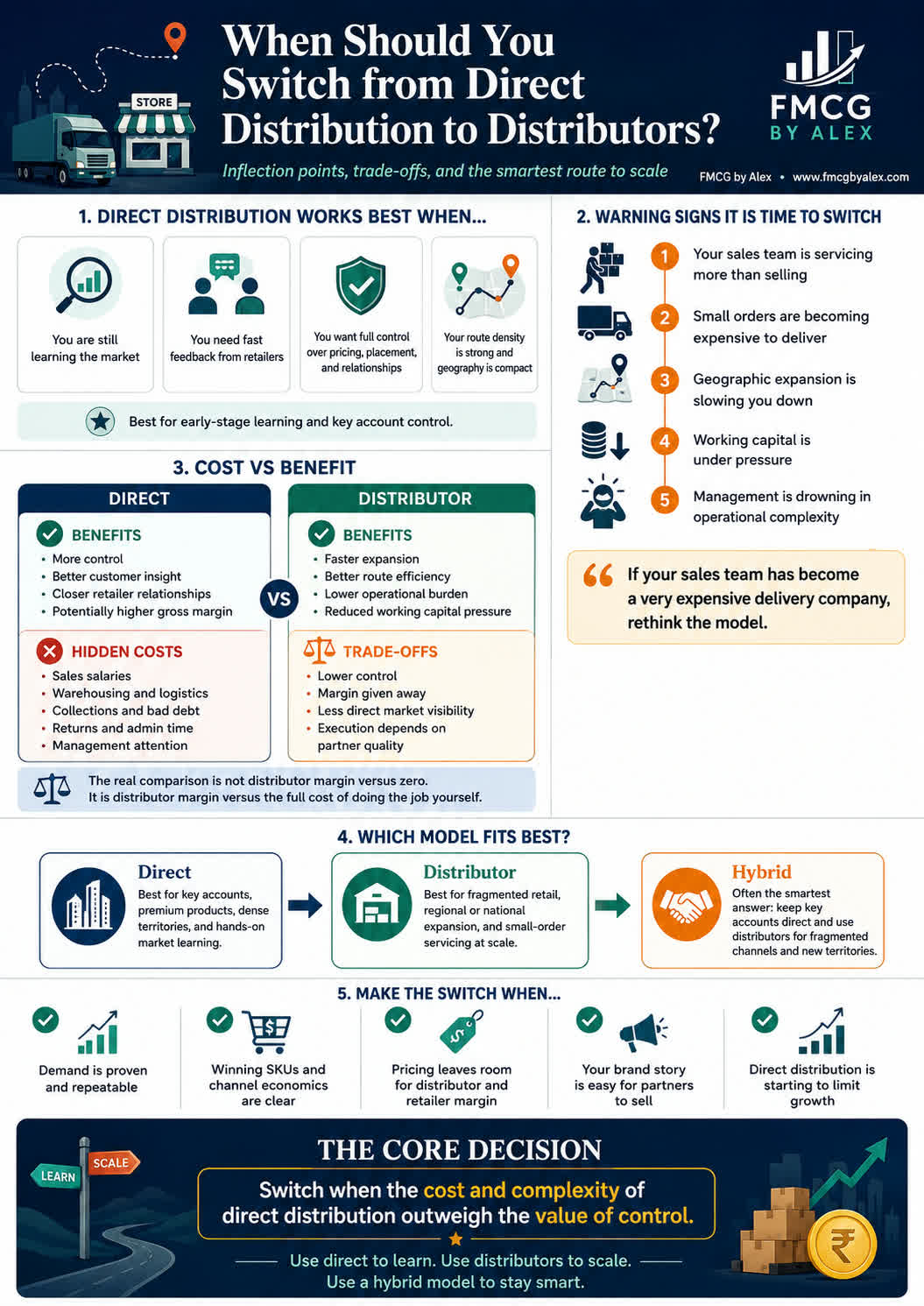
The first warning sign: your team is selling less and servicing more
The first major inflection point comes when your sales team spends more time maintaining the system than expanding it.
At the start, your salespeople are hunters. They open new outlets, convince buyers, fight for listings, secure first orders and create momentum. That is valuable sales work.
But over time, something changes. They start chasing payments. They check deliveries. They follow up on missing invoices. They deal with damaged stock. They visit stores that reorder tiny quantities. They solve complaints. They explain promotions. They help unload cartons. They chase the warehouse. They become part salesperson, part admin assistant, part therapist.
This is where direct distribution starts eating your growth.
A good salesperson should be creating demand, developing accounts and expanding the brand. If that person spends half the week solving operational issues, the cost per productive sales call becomes ridiculous.
The business may still feel active, but activity is not the same as progress. A hamster in a wheel is also very active. It is still in the same cage.
The second warning sign: small orders become operationally expensive
Direct distribution becomes dangerous when small orders start looking profitable on paper but unprofitable in reality.
A store orders a few cartons. The gross margin looks fine. Everyone is happy. But then you include the real cost.
Someone had to take the order. Someone had to process it. Someone had to pick and pack it. Someone had to deliver it. Someone had to invoice it. Someone had to follow up payment. Someone had to handle the return when one carton was damaged or close to expiry.
Suddenly, that nice little order is not so nice anymore.
This is one of the classic FMCG traps. Companies look at gross margin and forget cost-to-serve. A product may have a 35% gross margin, but if the order size is too small, the delivery route is inefficient, payment is slow and the outlet requires frequent attention, the real profit may be zero or negative.
Distributors exist partly because they aggregate complexity. They already visit many outlets. They already have trucks on the road. They already have relationships, credit systems, collectors and route plans. They can often serve smaller outlets more efficiently than a brand owner can.
That does not mean distributors are cheap. They are not. They take margin because they perform work. But sometimes their margin is cheaper than your chaos.
The third warning sign: expansion slows because management is drowning
Another clear inflection point arrives when the company wants to expand geographically, but management is already exhausted by the current territory.
This is common. A brand proves itself in one city, region or channel. Then everyone gets excited.
“Let’s go national.”
Beautiful words. Very dangerous words.
Going national with direct distribution is not just “doing more sales.” It means more warehouses or cross-docking points, more field reps, more supervisors, more vehicles, more credit exposure, more HR problems, more store-level execution issues and more reporting gaps. It also means more distance between head office and reality.
The founder who used to personally visit key stores can no longer see everything. The sales manager who knew every customer by name now depends on reports. The finance team suddenly discovers that “sales growth” and “cash collection” are not always close friends.
At this point, distributors can become a scaling tool. They allow the brand to expand into new territories without building the entire commercial infrastructure from scratch.
But this only works if the brand is ready. A distributor is not a magic carpet. It is more like a motorcycle. It can get you there faster, but only if you know how to steer. Otherwise, it just helps you crash in a more dramatic way.
The cost question: margin lost versus complexity removed
The emotional objection to distributors is always the same.
“They take too much margin.”
Sometimes they do. But the better question is: compared to what?
If a distributor takes 15%, 20% or even more, that sounds painful. But direct distribution has its own hidden “margin.” It just does not appear on one neat invoice. It hides across salaries, logistics, warehousing, bad debt, discounts, returns, damaged goods, admin time, management attention and opportunity cost.
A direct model may appear to give you better gross margin, but it can produce worse net profitability if your cost-to-serve is high.
The right comparison is not distributor margin versus zero.
The right comparison is distributor margin versus the full cost of doing the distributor’s job yourself.
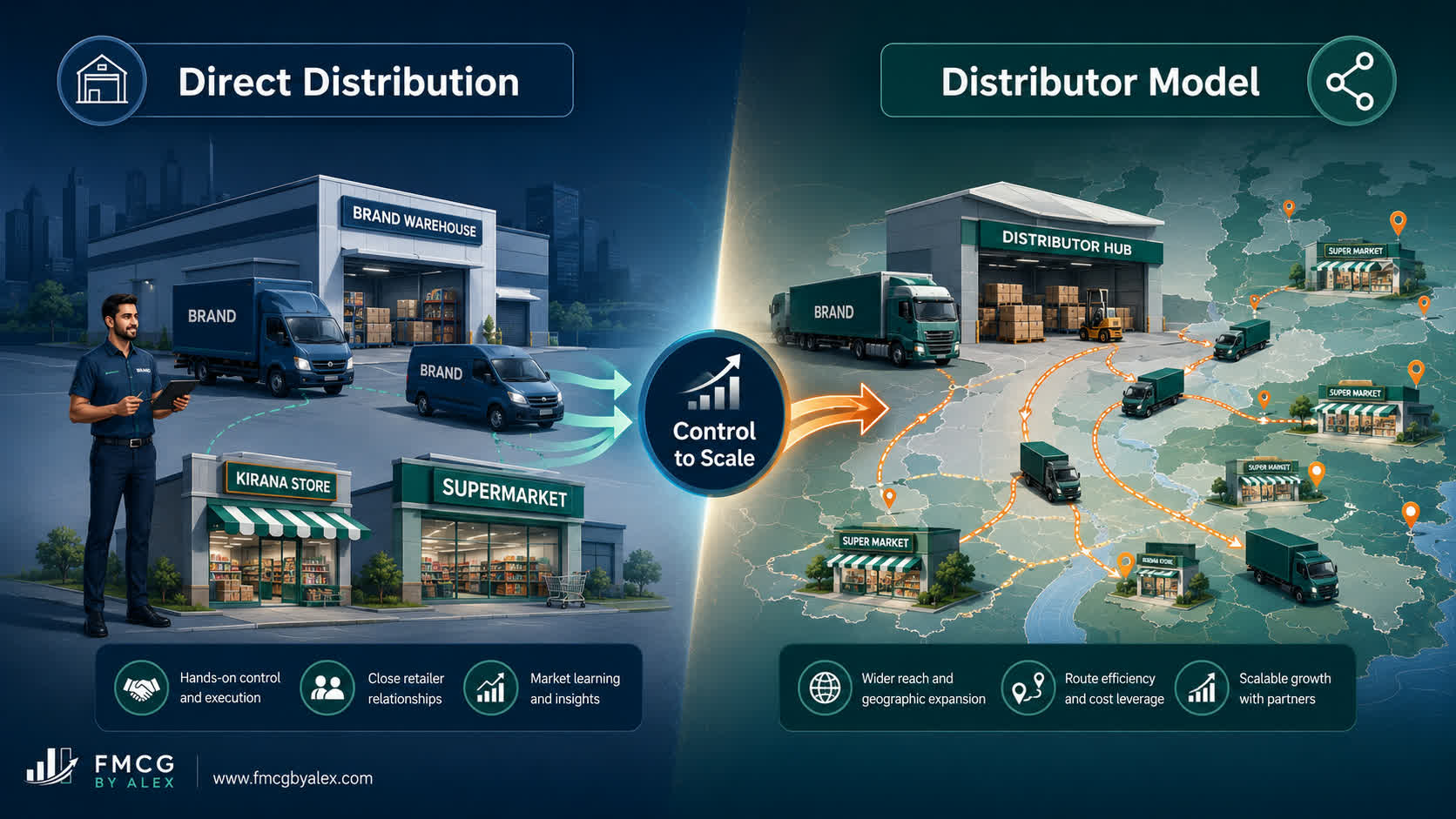
If you can serve modern trade directly with large orders, predictable delivery windows and centralized buying, direct may still make sense. If you are delivering small mixed cartons to hundreds or thousands of fragmented outlets, a distributor may be far more efficient.
The decision depends on channel, territory, order size, frequency, payment terms, product shelf life, required merchandising, and how much control you truly need.
Control is the price you pay
Of course, distributors come with trade-offs.
The biggest one is control.
When you sell directly, you know the customer. You own the relationship. You can influence the shelf. You can negotiate promotions. You can collect feedback quickly. You can push a new SKU with urgency. You can see problems before they become disasters.
With distributors, there is always some distance. Your product becomes one of many. Their sales team may prioritize faster-moving brands, higher-margin items or companies that give better incentives. Your beautiful brand story may become, in the mouth of a tired distributor salesman, “new product, good margin, please try.”
That is why choosing a distributor is not just about reach. It is about attention.
A bad distributor gives you theoretical coverage. On a map, it looks fantastic. In reality, your stock sits in a warehouse, your brand gets no push, and after six months everyone says the product “doesn’t move.”
Maybe the product was wrong. Maybe the price was wrong. But maybe nobody actually sold it.
Distribution is not the same as availability. Availability is not the same as visibility. Visibility is not the same as rotation. And rotation is what pays the bills.
The biggest distributor myth: once appointed, the job is done
Many FMCG brands appoint distributors and then relax.
This is a mistake.
Working with distributors does not mean you stop selling. It means your customer changes. You are now selling to the distributor, selling with the distributor and selling through the distributor.
That requires a different skill set.
You need joint business planning. You need targets. You need territory agreements. You need minimum stock levels. You need sales incentives. You need visibility programs. You need data. You need regular reviews. You need to know which outlets are buying, not just how much the distributor ordered last month.
Because distributor orders can lie.
A big opening order may look like success, but it may simply be stock loading. If the stock does not move out to retailers and consumers, the next order will be smaller. Then smaller again. Then comes the dreaded sentence: “The market is not responding.”
The market may never have properly seen the product.
A distributor relationship must be managed like a commercial partnership, not like a warehouse transfer.
When direct still makes sense
There are situations where direct distribution remains the better model.
For key accounts, especially modern trade, direct relationships are often too important to surrender. Major retailers want structured negotiations, promotional calendars, service levels, category discussions and sometimes direct access to the brand owner. In these channels, using a distributor may reduce your influence and increase your distance from the buyer.
Direct can also make sense for premium or niche brands where education matters. If your product requires storytelling, demonstration, sampling or careful positioning, your own team may do a better job than a distributor’s general sales force.
It can also work in dense urban areas where many outlets are close together and route efficiency is high. If your team can serve a large number of accounts profitably within a compact territory, direct distribution may still be attractive.
And finally, direct is useful when data is strategically important. Early-stage brands often need to know exactly which outlets reorder, at what frequency, at what price and after which promotions. Distributors may not always provide that level of transparency unless you negotiate it from the start.
So the answer is not “direct bad, distributors good.”
The answer is: direct is best when learning, control and strategic account management matter most. Distributors are best when reach, route efficiency, working capital leverage and operational scale matter more.
The hybrid model is often the grown-up answer
In reality, many FMCG companies end up with a hybrid model.
They keep direct control over key accounts, strategic retailers, flagship channels and sometimes e-commerce. Then they use distributors for traditional trade, regional expansion, horeca, independent retailers or territories where building a full team would be too slow or too expensive.
This is often the healthiest structure.
It allows the brand to stay close to the most important customers while using distributor infrastructure to reach fragmented markets. It also creates a useful comparison. If your direct team performs better in one channel and your distributors perform better in another, you can learn where each model belongs.
The danger is when the hybrid model becomes messy. If roles are unclear, conflict starts. Your own sales team and your distributor may chase the same accounts. Retailers may compare prices. Promotions may overlap. Stock may leak from one territory into another.
That is when the market becomes a food fight, and not the fun kind.
A hybrid model needs clear channel rules, pricing discipline, territory boundaries and account ownership. Otherwise, you have not built a distribution strategy. You have built a family argument with invoices.
The working capital effect nobody talks about enough
One of the biggest reasons to use distributors is working capital.
Direct distribution often means you carry more stock, fund more receivables, manage more credit risk and wait longer for cash. As sales grow, this can become painful. Growth consumes cash before it produces cash.
Distributors can absorb part of that burden. They buy stock, hold inventory, extend credit to retailers and collect payments. That can improve your cash cycle, especially if you negotiate sensible payment terms.
But again, there is no free lunch. If the distributor takes on working capital risk, they will expect margin. If they pay faster than the market pays them, that has value. If they hold stock in multiple regions, that has value. If they collect from difficult small outlets, that definitely has value, and probably deserves a medal.
The key is to understand what you are paying for.
If a distributor simply buys from you and waits passively, the margin may be too high. If they actively sell, deliver, merchandise, collect and build your market, the margin may be justified.
A practical way to know it is time
You are probably ready to consider distributors when several things are true at the same time.
Your product has proven repeat demand. You know your winning SKUs. You understand your trade margins. You have a pricing structure that leaves enough room for distributor margin and retailer margin. Your brand story is simple enough for another sales team to explain. You have basic sales materials, merchandising guidelines and promotional mechanics. You can produce reliably. You can support the distributor with marketing, not just hope they perform miracles.
Most importantly, you know your economics.
You should know the minimum profitable order size for direct delivery. You should know the cost-to-serve by channel. You should know your gross margin after trade discounts. You should know your return rates, expiry risks, payment days and logistics costs.
If you do not know these numbers, bringing in distributors may simply create a more complicated version of your existing problem.
But once you do know them, the decision becomes clearer. If direct distribution is limiting your growth, draining your team, slowing expansion and producing weak net margins despite healthy sales, it may be time to shift.
The emotional part: letting go without losing the brand
For founders and commercial leaders, switching to distributors can feel like giving away the baby.
You built the relationships. You fought for the first listings. You carried cartons into stores. You convinced skeptical buyers. You survived the early chaos. Now someone else is supposed to represent the brand?
That feeling is understandable.
But scaling FMCG requires letting go of certain tasks while keeping control of the important things. You do not need to personally manage every delivery. You do need to protect pricing, positioning, visibility, product quality, key customer relationships and consumer demand.
That is the difference between delegation and abdication.
Using distributors should not mean disappearing from the market. The best brand owners still visit stores, talk to retailers, monitor execution, train distributor teams and study sell-out data. They just stop pretending that doing everything themselves is always noble.
Sometimes it is not noble.
Sometimes it is just expensive.
The real answer
The right time to switch from direct distribution to distributors is not a fixed revenue number. It is not “after 500 stores” or “after three cities” or “once the founder gets tired,” although that last one is usually a useful early warning signal.
The right time is when the cost and complexity of direct distribution start to outweigh the value of control.
In the early stage, control is worth a lot. You need learning, feedback and direct market contact. In the growth stage, reach and efficiency become more important. At that point, a good distributor can help you scale faster, reduce operational burden, improve working capital and open markets that would take years to build alone.
But distributors are not a shortcut around strategy. They are an amplifier. If your product, pricing, margins and channel plan are strong, they can accelerate growth. If those things are weak, they can accelerate disappointment.
So before you switch, ask yourself one honest question:
Are we using direct distribution because it gives us a strategic advantage, or because we never redesigned the model after the business grew?
If the answer is the second one, it may be time to stop running a delivery company with a brand attached to it — and start building an FMCG business that can actually scale.
Tools for this topic
View shopFMCG Growth Systems (Hardcover)
A tactical leadership guide for building scalable FMCG growth engines.
Related content
How to Set Up Distribution for an FMCG Brand
Distribution isn't access. It's a repeatable system that turns availability into reorders. Here's how to build one without lighting your cash on fire.
Growth Has Stalled. The Factory Still Opens Monday.
What an Area Sales Manager can actually do when the business stops growing. Operational field tactics for routes, store availability, shelf capacity, and trade spend.
The Product Is Everywhere. So Why Is It Always Out of Stock?
Why distribution, availability, and being able to actually buy the product are not the same thing. How out-of-stocks silently destroy FMCG sales while internal dashboards stay green.
How to Build a Better FMCG Route-to-Market
Designing channel roles, distributor economics, and service levels in one RTM framework.