The Finance Director Looked in the Bin and Found a New Product Category
FMCG companies used to ask how cheaply they could dispose of production waste. Now rising costs, regulation and new technology are forcing them to ask a more interesting question: why are we paying somebody to remove our next product category?
The Finance Director Looked in the Bin and Found a New Product Category
How FMCG companies are learning that yesterday’s waste may be tomorrow’s premium ingredient—provided somebody can make it taste less like yesterday’s waste
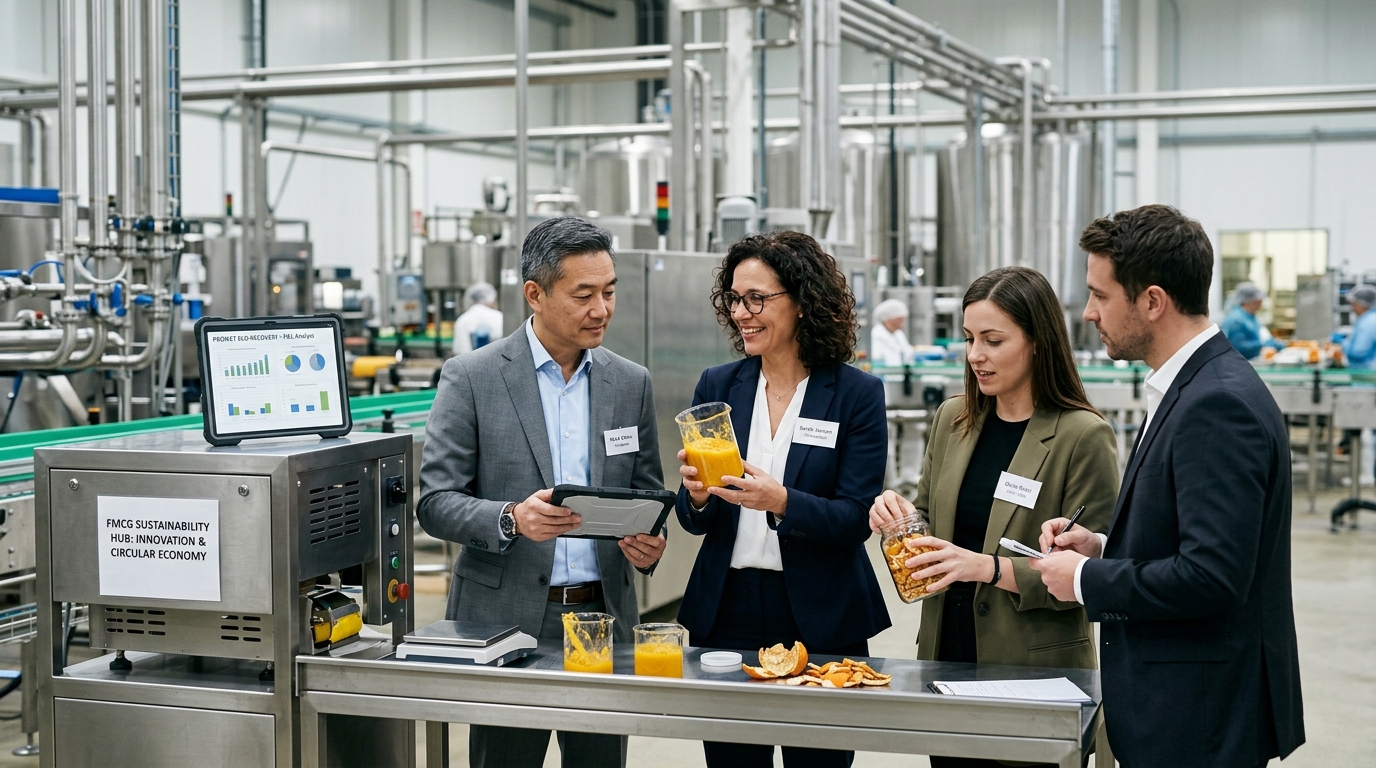
At ten forty-three on a Wednesday morning, the Managing Director of Perfectly Fresh Foods was standing beside a stainless-steel production line, watching thirty thousand bottles of fruit juice move towards the loading bay.
It was one of those factory visits designed to make senior management feel connected to operations.
Everyone had been issued a white coat, a hairnet and safety shoes capable of surviving an attack by a moderately determined forklift. The Plant Manager was explaining improvements in line efficiency. The Quality Director was pointing at screens displaying temperatures and production speeds. The Marketing Director had taken several photographs for LinkedIn, carefully positioning herself so the hairnet appeared strategic rather than medical.
The Managing Director was pleased.
The line was moving quickly. The bottles were attractive. The factory was clean. Orders were strong. A new retailer listing had recently been secured after nine months of negotiation, seven product revisions and a final discussion in which the buyer had used the phrase “partnership” immediately before requesting another three percent.
Then the Managing Director noticed a worker pushing a large container towards the rear of the plant.
The container was filled with fruit pulp, peel and pieces that had failed to become juice.
“What happens to that?” he asked.
The Plant Manager looked briefly towards the container.
“We dispose of it.”
The Managing Director nodded. Disposal sounded organised.
“How?”
“A contractor collects it.”
The Finance Director, who had been walking slightly behind the group and had shown limited interest in juice viscosity, suddenly moved closer.
“How much does that cost?”
The Plant Manager gave him the figure.
The Finance Director stopped walking.
There are moments when sustainability becomes financially interesting.
This was one of them.
Until that point, the contents of the container had been waste. It was soft, damp and unappealing. Nobody had included it in the annual innovation presentation. It had no packaging concept, no target consumer and no proposed retail price. It was what remained after the commercially useful part of the fruit had departed in a bottle.
But the moment the Finance Director learned that the company was paying somebody to remove it, the material changed.
It was no longer waste.
It was an expense.
Expenses receive much more senior-management attention.
“You mean,” he said slowly, “we buy the fruit, transport it here, process it, use part of it and then pay another company to take the rest away?”
The Plant Manager confirmed that this was broadly the arrangement.
The Finance Director looked into the container again.
The fruit pulp had become personally offensive.
A few metres away, the Innovation Manager made the mistake—or perhaps the career-defining decision—of mentioning that the discarded material still contained fibre, flavour compounds and potentially useful nutrients.
The Finance Director turned towards her.
“Useful for what?”
“Well, there are companies using fruit side streams in snacks, ingredients, bakery products, drinks and supplements.”
“How much could we sell it for?”
“I don’t know.”
The Finance Director frowned.
He was prepared to accept that a new product might not yet have a name, packaging design or route-to-market strategy. He was less prepared to accept that it did not yet have a margin estimate.
By lunchtime, Perfectly Fresh Foods had established the Circular Innovation Taskforce.
By three o’clock, the taskforce had a Teams channel.
By Friday, it had a logo.
This is how revolutions begin in large companies.
Not with a radical idea, but with the discovery of an avoidable invoice.
The Bin Receives a Promotion
Upcycled food is one of the latest ideas to enter the FMCG industry carrying both an environmental promise and a business case. The concept is straightforward: ingredients, produce or production side streams that might otherwise be wasted are recovered and converted into products of higher value.
The word “upcycled” is important because “made from things we previously threw away” performed poorly in early consumer testing.
Across the world, companies are finding new uses for imperfect vegetables, stale bread, fruit pulp, coffee by-products, spent grain and other materials that once had the commercial status of an inconvenience. Danish startup Rootly has used surplus vegetables and juice pulp in plant-based products. American brand Uglies makes crisps from potatoes rejected for cosmetic imperfections. Britain’s Toast Ale uses surplus bread in beer production. Other businesses are converting coffee biomass, potato-processing side streams and food-industry residues into snacks, fibres, supplements and ingredients. Reuters reported in July 2026 that the global market for upcycled food products was estimated at $66.8 billion in 2025 and could approach $125 billion by 2035.
Those numbers are large enough to attract both entrepreneurs and corporations.
An entrepreneur sees a broken food system and an opportunity to redesign it.
A corporation sees a $66.8 billion market and begins scheduling meetings.
The underlying waste problem is undeniably serious. Nearly one-fifth of food produced globally is lost or wasted, while the associated greenhouse-gas emissions are estimated at between eight and ten percent of the global total.
But environmental concern is not the only force pushing food companies to inspect their bins more carefully.
Waste costs money.
A manufacturer pays for raw material, inbound transport, storage, energy, labour and processing. It then pays to separate, handle and remove what remains. In some cases, the company has effectively invested in the material three times before paying somebody to make it disappear.
This is not circularity.
It is a loyalty programme for waste contractors.
Regulation is also making the subject harder to leave in the sustainability department. The European Union’s amended Waste Framework Directive introduced binding national food-waste reduction targets for 2030, including a ten-percent reduction in food processing and manufacturing and a thirty-percent per-capita reduction across retail, food service and households, using the 2021–2023 average as the baseline.
Food waste is therefore moving from the softer territory of corporate commitments into the more urgent territory of targets, measurement and eventual accountability.
This causes a familiar transformation inside the organisation.
When reducing waste is presented as “the right thing to do,” it appears on the sustainability roadmap.
When reducing waste is presented as “a legally relevant cost-saving opportunity with potential revenue,” it appears on the CEO’s agenda.
The orange peel does not mind which argument wins.
It merely prefers not to be buried.
The First Prototype Tastes Like a Garden Centre
At Perfectly Fresh Foods, the Circular Innovation Taskforce held its first workshop the following Monday.
There were sixteen attendees.
Operations brought samples of the fruit pulp.
Marketing brought trend reports.
Finance brought a spreadsheet.
Sustainability brought a diagram containing several green arrows.
Sales brought the opinion that retailers would demand an exclusive version.
Procurement asked whether the waste could be purchased more cheaply from the company itself.
The taskforce began by renaming the waste.
This was necessary because nobody wanted to attend a workshop called “What Can We Do With the Wet Material Near the Loading Dock?”
The preferred term became nutrient-rich fruit side stream.
This immediately improved its strategic value.
Language plays an important role in innovation.
A bruised carrot is waste.
A rescued carrot is a mission.
Old bread is unsold stock.
Surplus artisan bakery input is the beginning of a circular beer story.
Fruit pulp is something stuck inside a filter.
Plant-based fibre is a consumer benefit.
The company decided to create a fibre-rich snack bite using material recovered from juice production. The concept sounded excellent.
The product would reduce waste, contain fibre, support the company’s sustainability commitments and create a second revenue stream from the same raw material.
Marketing produced a mood board featuring earth tones, smiling farmers and a hand-written typeface.
Finance produced a margin calculation based on several assumptions that had not yet survived contact with reality.
R&D produced the first sample.
The first sample was circular in the sense that everybody passed it around and nobody finished it.
It had the colour of compressed soil and the texture of a product designed to repair a damaged wall. The fruit flavour was present but appeared to be hiding behind a large amount of fibre.
The Managing Director took one bite and chewed thoughtfully.
Senior executives are reluctant to express disappointment during innovation tastings because doing so may discourage the team. They are especially reluctant when the product has already been mentioned in a board presentation.
“It is certainly substantial,” he said.
The Marketing Director tried another piece.
“It has a very authentic texture.”
The Sales Director reached for water.
The Finance Director asked whether the serving size could be reduced.
This is where many circular-food projects encounter their first great truth.
A sustainable ingredient does not receive permission to become a bad product.
Consumers may support reducing food waste. They may agree that resources should be used more efficiently. They may tell researchers that they actively seek sustainable products.
But when standing in a supermarket, they still expect the snack to taste good.
The consumer is surprisingly traditional in this respect.
She may admire your mission.
She may appreciate your carbon calculation.
She may be delighted that the biscuit has rescued part of a pineapple.
She will nevertheless stop buying it if it tastes like a pineapple rescued from a drainage system.
Sustainability can improve the proposition.
It cannot replace the proposition.
Nobody Wants to Buy Waste
The language used around upcycled food presents a delicate marketing problem.
Companies want consumers to understand the environmental benefit, but they do not want the product to sound as though it was recovered during the final ten minutes before the rubbish truck arrived.
“Waste” has negative associations.
It suggests dirt, contamination, age and neglect.
“Upcycled” suggests intelligence, resourcefulness and tasteful furniture made from an old fishing boat.
The physical material may be identical.
The emotional material is not.
Research and industry commentary suggest that some businesses hesitate to emphasise upcycling because consumers in different markets may interpret it differently. What sounds innovative and responsible to one shopper may sound like a lower-quality leftover to another. Some companies instead lead with more conventional benefits such as fibre, taste, organic credentials or nutrition, allowing the upcycled origin to support the story rather than carry it alone.
This is commercially sensible.
Consumers do not generally wake up wanting to purchase waste.
They wake up wanting breakfast.
They want a snack, drink, sauce, supplement or meal that tastes good, performs well, feels safe and costs an acceptable amount.
The fact that the product uses resources more efficiently can strengthen the choice.
It should not require the consumer to make a sacrifice large enough to qualify as a charitable donation.
The strongest upcycled proposition does not say:
“Please eat this because otherwise we would discard it.”
It says:
“This is a good product. It contains useful fibre, tastes excellent, is priced sensibly and also prevents valuable material from being wasted.”
The order matters.
Taste first.
Usefulness second.
Convenience third.
Price always somewhere nearby, watching carefully.
Mission supporting the whole story.
Many sustainability-led innovations reverse that order. They begin with the environmental achievement, then expect the consumer to become emotionally attached to the operational process.
The pack explains that the company has diverted 2.4 kilograms of fruit pulp, reduced water use, created a circular side-stream partnership and contributed to several Sustainable Development Goals.
The consumer turns the package over and asks:
“Is it chocolate?”
An Orange Peel Walks Into a Dutch Factory
The Netherlands offers a useful glimpse of what upcycling can look like when it moves beyond a small kitchen experiment and becomes an ingredient business.
PeelPioneers processes citrus peel left after fresh orange juice is squeezed and extracts natural fibres, oils and other useful ingredients for applications in food, cosmetics and cleaning products. The company describes uses in products including sauces, marinades, baked goods and meat or fish alternatives, as well as personal-care applications.
This is commercially more sophisticated than placing a photograph of a sad orange on a snack wrapper.
The orange peel is not necessarily sold to consumers as orange peel.
It becomes functionality.
It provides texture, flavour, fragrance, colour or fibre.
The waste stream has been translated into an ingredient specification.
That translation is crucial.
Factories do not purchase inspiring stories.
They purchase consistent inputs.
The material needs predictable quality, food-safety assurance, supply continuity, technical documentation and a price that makes sense compared with conventional alternatives.
A chef may create an excellent special using yesterday’s vegetables.
An FMCG manufacturer needs to create the same product millions of times.
Circularity becomes industrial only when it can survive procurement.
This is why initiatives such as Foodvalley’s UPcycled4Food programme focus not only on ideas but also on shared definitions, trusted impact measurement, communication and connections between innovators and companies capable of using the resulting ingredients at scale.
The romantic version of upcycling is that a clever founder looks at discarded material and sees possibility.
The operational version includes microbiological specifications, moisture variation, transport distances, shelf stability, contamination risks, production planning and a customer who wants the price reduced by twelve percent in the second year.
Both versions are true.
Only one usually appears in the launch video.
The Side Stream Develops an Attitude
Back at Perfectly Fresh Foods, R&D reformulated the snack bite.
Sugar was adjusted.
The fruit balance changed.
A binding ingredient was introduced.
The fibre level was reduced to a point where the product no longer required the consumer to make a written commitment before swallowing.
The fifth prototype tasted good.
Not “good considering the sustainability story.”
Actually good.
This created a new problem.
The company could not produce enough recovered pulp of consistent quality throughout the year.
Seasonal fruit variation affected flavour, colour and moisture. Some production runs generated more material than others. The side stream, having been ignored for twenty years, had developed supply-chain demands.
Procurement was asked to secure external supplies.
The Procurement Director was surprised to discover that material described internally as waste became more expensive once another company cleaned, stabilised, tested and delivered it according to specification.
“This is supposed to be free,” he said.
“The original material is inexpensive,” explained R&D. “Making it usable is not.”
This is the second great commercial truth of upcycling.
Waste is not automatically a cheap raw material.
It may be geographically dispersed, unstable, wet, contaminated, inconsistent or expensive to transport. The useful fraction may require drying, extraction, fermentation or separation. Food-safety controls must be established. Equipment must be installed. Energy is consumed. People expect salaries.
A pile of peel becomes valuable only after somebody solves the unglamorous problem of turning it into something another factory can reliably use.
That problem is where much of the real innovation sits.
The side stream may have a negative value at the source because the producer wants it removed. After collection, cleaning, processing, testing, documentation and delivery, it may cost more than the standard ingredient it is intended to replace.
The commercial case therefore cannot depend on the belief that all recovered material is nearly free.
It may instead depend on several benefits working together: reduced disposal cost, lower exposure to volatile commodities, improved resource efficiency, a distinctive consumer proposition, regulatory preparation and a higher-value finished product.
Finance prefers one clear source of return.
Circular businesses often arrive carrying six smaller ones and a spreadsheet with several tabs.
The Cocoa Problem and the Grape Seed That Applied for the Job
Commodity volatility is giving upcycled ingredients another route into FMCG discussions.
When the price or availability of a major raw material becomes painful, companies become more imaginative about alternatives. Reuters noted that Cargill’s NextCoa range uses upcycled grape seeds as part of a cocoa-alternative proposition, while other businesses are recovering starch from potato-processing water or transforming grain and coffee side streams into higher-value products.
This demonstrates that upcycling is not limited to launching a worthy snack for environmentally aware consumers.
It can also support ingredient resilience.
A company facing expensive cocoa, limited supply or sustainability risk may investigate whether other plant materials can reproduce some of cocoa’s colour, flavour or functionality.
The grape seed, previously not considered a serious applicant for the chocolate department, receives an interview.
This does not mean consumers will happily accept any substitute.
Chocolate buyers are not known for their flexibility.
A product can explain that it reduces pressure on cocoa supply chains, uses recovered plant material and contributes to a more resilient food system.
The consumer will still notice if it does not taste like chocolate.
FMCG innovation repeatedly discovers that consumers appreciate change most when the experience remains reassuringly familiar.
They want the environmental improvement.
They would prefer not to taste the engineering.
Indonesia and the Business Hiding Around the Bean
The upcycling opportunity may be even more significant in agricultural economies where large amounts of value remain concentrated in the primary commodity.
Indonesia has substantial agricultural and food-processing side streams from plantations, farms, mills and processing facilities. The FAO has highlighted the potential for circular agricultural models in the country, including the reuse of organic material from processing and farming to create new products and reduce environmental impact.
Coffee provides an obvious example.
Consumers and businesses focus on the bean, but the coffee cherry contains much more biological material than the roasted product appearing in the cup. Pulp, husk and spent grounds may be used in ingredients, beverages, compost, biochar, animal feed, packaging materials and other applications, depending on safety, processing and local economics. Indonesian research has examined Kintamani coffee pulp as a potential functional-food ingredient, while other work has explored more circular coffee-production models and the commercial use of coffee-processing residues.
The opportunity is not confined to coffee.
Cocoa pods, coconut fractions, banana peel, cassava residues, rice bran and fruit-processing by-products all create questions about whether Indonesia captures enough value from the complete agricultural input.
Too often, the commercial model focuses on selling the recognised primary product.
The bean is sold.
The pulp remains.
The oil is extracted.
The shell remains.
The juice is bottled.
The fibre remains.
Then another country imports the primary ingredient, develops branded products, discovers applications for the secondary fractions and sells the resulting innovation back at a premium.
This is an unusually generous international value-chain strategy.
Indonesia’s broader policy direction has increasingly emphasised agricultural downstreaming and higher-value processing rather than remaining only a supplier of primary commodities.
Upcycling fits naturally inside that ambition.
The objective should not merely be to reduce waste.
It should be to build businesses around the entire crop.
A coffee company should ask not only how many kilograms of beans it can sell, but how much value it can create from the fruit, husk, grounds and rejected material surrounding those beans.
A coconut processor should not think in terms of one product and several leftovers. It should think in terms of a platform of oils, fibres, food ingredients, feed, fuel, growing media, cosmetics and packaging inputs.
The language of “waste” can hide value because it places all non-primary outputs into one unimportant category.
The factory records one hero product.
Everything else becomes supporting material with poor self-esteem.
Sustainability Meets the Supermarket Buyer
Perfectly Fresh Foods eventually presented its circular fruit snack to a major retailer.
The meeting began well.
The buyer liked the taste.
She liked the fibre claim.
She liked the environmental story.
She liked the packaging, although she asked whether it could become fully recyclable, use less material, remain visually premium and cost less.
Then she asked the traditional retail questions.
What is the recommended retail price?
What margin does it provide?
How quickly will it rotate?
How much promotional support is available?
Can the company fund a launch discount?
Is the product incremental?
Does it compete with the company’s existing snack range?
Could the retailer receive an exclusive flavour?
Would Perfectly Fresh Foods consider manufacturing a private-label version?
The Innovation Manager looked at the Managing Director.
The Finance Director looked at the margin calculation.
The circular economy had arrived at the joint business plan.
This is the point where mission-led products become FMCG products.
They must obtain listings, survive retailer economics and earn repeat purchase.
A sustainability story may secure a meeting.
It does not automatically secure a second order.
The retailer wants innovation, but it also wants dependable supply, healthy margin and evidence that the product will leave the shelf without requiring permanent promotional assistance.
This creates a risk for upcycled brands.
The production process may be more complex and expensive than expected. The pack may need to communicate an unfamiliar concept. Volumes begin small. Retailers nevertheless compare the price with established products produced at scale.
The circular startup arrives carrying impact data.
The buyer arrives carrying a margin target.
Neither is wrong.
The commercial model must connect them.
The Green Claim Enters the Legal Department
Communicating the environmental advantage also requires care.
Terms such as “sustainable,” “circular,” “rescued” and “waste reducing” can sound powerful while remaining vague. Regulators and policymakers are applying greater scrutiny to environmental marketing, particularly where companies cannot substantiate the claims being made. Reuters noted that concern about greenwashing and uncertainty about consumer interpretation continue to affect how upcycled products are marketed.
This means the brand cannot simply place a green arrow on the package and announce that the planet has improved.
It must understand what would otherwise have happened to the ingredient.
Was it destined for landfill, energy recovery, animal feed or another use?
How much waste was genuinely prevented?
What processing was required?
How much energy and transport were involved?
Does the upcycled route create a better overall outcome than the previous use?
Circular claims can become complicated because material rarely moves from “no value” to “perfect value” in one step.
Spent grain used for animal feed is not the same as spent grain sent to landfill.
Bread donated to a food bank is not the same as bread converted into energy.
A material may already have an alternative market.
Moving it into human food could create greater value, but the complete impact should be examined rather than assumed.
This is not as enjoyable as designing the packaging.
It is, however, more likely to survive a conversation with regulators, customers and journalists.
Marketing departments are fond of simple stories.
Supply chains are rarely cooperative enough to provide them.
The Product Launch Nobody Wanted to Call Waste
Perfectly Fresh Foods launched the snack under the name Second Harvest Bites.
The words “fruit waste” did not appear prominently on the front.
The pack led with flavour and fibre. The circular ingredient story appeared beneath, explained in straightforward language. Consumers were told that useful fruit material from juice production had been recovered and made into a good snack rather than discarded.
The first production run sold well.
The second production run revealed that one flavour was considerably more popular than another.
The apple-cinnamon version repeated.
The carrot-orange-ginger version attracted a small but passionate group of consumers and a much larger group of people who appeared to admire it from a distance.
Marketing had initially expected the sustainability message to drive the purchase.
Consumer research showed that taste and fibre were stronger reasons.
The environmental story increased trust and helped people feel better about the choice, but it was not enough to create loyalty on its own.
This disappointed the Sustainability Director slightly and pleased the Sales Director enormously.
Both reactions were reasonable.
A successful upcycled product does not need the consumer to deliver a speech about circularity each time she purchases it.
The most meaningful environmental innovation may eventually become ordinary.
The consumer buys the snack because it is good.
The company uses the resource because wasting it would be stupid.
The supply chain becomes more efficient.
Nobody requires a celebratory mural.
That is real progress.
The Finance Director Returns to the Bin
One year after the factory visit, the Managing Director and Finance Director returned to the same production line.
The juice bottles still moved towards the loading bay, but the waste container was smaller. Part of the pulp stream was now stabilised for the snack product. Another fraction was being tested by an ingredient partner. Disposal costs had fallen. Revenue from the new range remained modest compared with the core juice business, but the margins were improving as volume increased.
The Finance Director stood beside the container.
“There is still material in there,” he said.
The Plant Manager explained that not every side stream could yet be recovered economically or safely.
The Finance Director looked disappointed.
He had begun to regard total waste elimination as a personal challenge.
The Innovation Manager mentioned that the remaining material might be suitable for fermentation, animal nutrition or soil applications.
“Can we sell it?”
“Possibly.”
“When?”
“We need to test it.”
“How long?”
The Managing Director smiled.
A year earlier, the material had been invisible.
Now the company was impatient that part of it remained unused.
That is perhaps the most important change created by the rise of upcycled food.
It changes what the organisation sees.
A container of peel, pulp or grain is no longer automatically the end of a process. It may be the beginning of another one.
This does not mean every factory bin contains a bestseller.
Some waste is unsafe.
Some is too inconsistent.
Some is already being used effectively elsewhere.
Some costs more to recover than it is worth.
Some can become ingredients but not products.
Some can become products that nobody wants.
The circular economy does not repeal ordinary economics.
It does, however, demand a better question.
Instead of asking how quickly the company can remove the material, management asks whether the material still contains function, nutrition or commercial value.
Instead of designing one product around one raw material, the company begins designing a portfolio around the whole input.
Instead of regarding disposal as an unavoidable final step, it regards disposal as evidence that value may have escaped.
This creates new roles for operations, R&D, procurement and marketing.
Operations must separate and protect the side stream.
R&D must make it usable.
Procurement must create consistency.
Quality must make it safe.
Marketing must explain it without making the consumer imagine the factory drain.
Sales must persuade the retailer.
Finance must discover whether the entire exercise earns money.
Sustainability must occasionally remind everyone why they began.
Upcycled food is therefore not one innovation category.
It is an organisational test.
It reveals whether the company can look beyond the product it already sells and understand the value moving through the entire system.
For years, FMCG companies measured success by what left the factory through the loading bay.
Cases shipped.
Pallets invoiced.
Tonnes sold.
Revenue booked.
Everything travelling in the other direction was treated as a cost, a compliance issue or something best hidden behind a door labelled “authorised personnel only.”
That door is beginning to open.
Behind it are orange peels that can become fibres and oils, stale bread that can become beer, grain that can become food ingredients, coffee side streams that can become snacks or materials, and fruit pulp that can become the product appearing in next year’s innovation presentation.
There will also be many unpleasant containers that remain unpleasant containers.
Innovation requires optimism.
Food manufacturing requires handwashing and realistic expectations.
The opportunity lies in telling the difference.
Perfectly Fresh Foods did not save the world with one snack bite. It did something more credible.
It reduced a cost.
Recovered useful material.
Created a product consumers enjoyed.
Learned how to work with a variable side stream.
Built a new supplier network.
Prepared for tighter waste expectations.
And changed the way its managers looked at the factory.
The next time the Finance Director passed the waste area, he no longer saw rubbish.
He saw raw material without a business plan.
This is both inspiring and slightly dangerous.
Because once a Finance Director believes the bin contains revenue, no container in the factory is safe from a quarterly review.
The coffee grounds will be summoned.
The broken biscuits will receive a forecast.
The potato peel will be assigned a project manager.
Somewhere in procurement, an old spreadsheet will be renamed Circular Value Platform v7 FINAL FINAL.
And the Innovation Director will be asked the question that begins every serious FMCG transformation:
“How soon can we show this to the retailer?”
Tools for this topic
View shopFMCG by Alex Notebook
Dot-grid strategy notebook for planning weekly commercial priorities.
Trade Promotion Masterclass
Build higher-ROI trade plans with structured diagnostics and execution control.
Related content
When Consumers Start Eating Less: What Happens to the FMCG Brands Still Selling “20% Extra Free”?
GLP-1 medicines, protein demand and changing attitudes toward portion size are reshaping food and beverage. Here is what FMCG brands in Indonesia should do next.