How to Know Whether a Sales Visit Actually Makes Money Without Sacrificing Your Brand
Improving sales route profitability sounds like an obvious objective for any FMCG company. But aggressive cost-to-serve cuts and minimum order sizes can kill a growing brand. Here is how to evaluate true visit economics, protect developing outlets, and balance route efficiency with long-term brand building in Southeast Asia.
How to Know Whether a Sales Visit Actually Makes Money Without Sacrificing Your Brand
Improving sales route profitability sounds like an obvious objective for any FMCG company. Why spend money visiting customers who barely order enough to cover the cost of servicing them? The problem is that optimising distribution and building a brand are not necessarily the same thing. In fact, taken too far, one can seriously undermine the other.
Anyone who has spent enough time working in FMCG sales and distribution will recognise the familiar situation. A sales representative returns from a long day in the field, having visited 30 stores, collected orders from 20 and perhaps convinced a couple of retailers to try an additional product. The supervisor checks the daily results, the distributor prepares the deliveries, and management reviews the numbers against the sales targets. On the surface, everything looks reasonably productive. The sales representative has covered the assigned territory, generated orders and maintained contact with the customer base, which is essentially what the organisation pays the sales team to do.
But there is a question that often gets overlooked in all this activity: how much money did those visits actually make for the business? It is entirely possible for a sales representative to achieve a respectable daily sales figure while collecting several orders that cost more to service than they contribute in gross profit. Salaries, commissions, fuel, vehicle maintenance, warehouse handling, delivery expenses, administration and credit collection all have to be paid for, regardless of how much revenue appears on the daily sales report. When these costs are considered properly, the economics of individual customers can look considerably less attractive than their order values initially suggest.
The logical response is to improve efficiency, and there is certainly nothing wrong with doing so. Every distributor should regularly examine its operating costs, identify unnecessary expenditure and make sure its resources are being used intelligently. The difficulty begins when management takes the next seemingly logical step and decides that customers generating insufficient profit should simply receive fewer visits, face higher minimum order values or be removed from the route altogether. From a purely operational perspective, such decisions may make perfect financial sense, particularly when margins are under pressure. However, from the perspective of a brand trying to establish or expand its market presence, the same decisions can be surprisingly destructive.
This is where we need to distinguish between optimising an existing distribution operation and building a sustainable FMCG brand, because although these activities are connected, they do not always have the same priorities or time horizons.
Understanding What a Sales Visit Really Costs
Most FMCG companies have no difficulty telling you how much their salespeople sell. They know their monthly targets, achievement percentages, outlet coverage figures and average order values, while more sophisticated organisations will also monitor gross margins, product mix and working capital. What is often considerably less clear is how much it actually costs to generate and fulfil those orders, particularly when sales and distribution expenses are allocated across a large number of relatively small customers.
Consider a sales representative working for a distributor in Indonesia, visiting traditional retail outlets or warungs throughout the day. The company pays the representative's salary, commissions, benefits and transportation costs, while a supervisor manages the territory and monitors performance. Once an order has been collected, warehouse employees have to prepare it, delivery vehicles have to transport it, and administrative staff have to process the documentation and, where applicable, handle collections. The business may also have to absorb returns, damaged products, promotional spending and the financing costs associated with providing credit to retailers. These expenses are not always directly visible in the sales figures, but they are very much part of the economics of serving the customer.
Naturally, not every outlet creates the same level of expense. A retailer that places a substantial order once a week, pays promptly and rarely returns products may be relatively inexpensive to service, while another customer might place several small orders, require additional deliveries and frequently delay payment. Even the location of the outlet matters, because visiting 30 stores within a compact urban neighbourhood is very different from covering 30 customers spread across a large rural territory. Route density, traffic conditions, delivery distances and the availability of suitable transportation can all have a significant effect on the final cost.
This is why simply measuring revenue or even gross margin does not tell the complete story. Gross margin tells us what remains after the cost of the products themselves, but the contribution generated by an order also depends on the additional expenditure involved in securing and servicing it. For operational analysis, it is useful to examine what remains after relevant trade spending and servicing costs have been deducted, while remembering that this is not necessarily the same as the company's final accounting profit. Shared overheads and other business expenses still exist, and not every allocated cost will disappear simply because one customer receives fewer visits.
Nevertheless, understanding contribution gives management a much clearer starting point for evaluating route profitability and identifying opportunities to operate more efficiently.
Why Small Orders Can Become Expensive
To illustrate the issue, let's take a hypothetical distributor selling a range of FMCG products to traditional retail customers. Suppose a retailer places an order worth Rp500,000 and the distributor earns a gross margin of 24%, leaving Rp120,000 before additional commercial and servicing expenses. If we then deduct Rp15,000 in trade spending, Rp42,000 for delivery and handling, Rp25,000 as the allocated cost of the sales visit and Rp10,000 for administration and credit servicing, the order leaves a contribution of just Rp28,000 before other overhead expenses.
That is not an especially attractive amount, but at least the contribution is positive. The situation changes considerably if the same retailer places an order worth only Rp300,000 while the distributor continues to incur the same servicing costs. At a 24% gross margin, the smaller order generates Rp72,000 before additional expenses. After deducting trade spending of 3%, equivalent to Rp9,000, the remaining Rp63,000 is insufficient to cover the Rp77,000 in assumed servicing costs, leaving a negative contribution of Rp14,000.
Under these illustrative assumptions, the break-even order value would be approximately Rp367,000, which means that a manager looking exclusively at profitability might reasonably conclude that the distributor should stop accepting orders below Rp400,000. After all, why should the company continue spending money on activities that do not generate a positive contribution? Increasing the minimum order requirement might immediately improve the average profitability of the orders being processed, reduce the number of small deliveries and allow the sales organisation to concentrate its resources on more productive customers.
The calculation itself is not the problem, provided the underlying assumptions are reasonable. In practice, some servicing costs are fixed over the short term, others vary with order size or delivery frequency, and some are merely allocations of expenses that will remain even if one order is eliminated. A distributor should therefore be careful not to confuse the allocated profitability of a customer with the actual savings that can be achieved by changing how that customer is serviced. Even so, the example demonstrates why small orders deserve attention and why operational optimisation can create meaningful improvements in distribution economics.
What it does not demonstrate, however, is whether refusing those small orders would be the right strategic decision for the brand.
Where Distribution Optimisation Starts Working Against Brand Building
Imagine that the retailer placing the Rp300,000 order has only recently started selling the brand. Perhaps the sales representative spent several weeks convincing the shopkeeper to try two products, because the retailer was unfamiliar with the brand and understandably reluctant to invest working capital in merchandise that might not sell. The first order was only Rp200,000, followed by another order worth Rp250,000, and the latest purchase has increased to Rp300,000. Consumers are beginning to notice the products, a few regular customers have started buying them, and the shopkeeper is now considering whether to add another flavour or pack size.
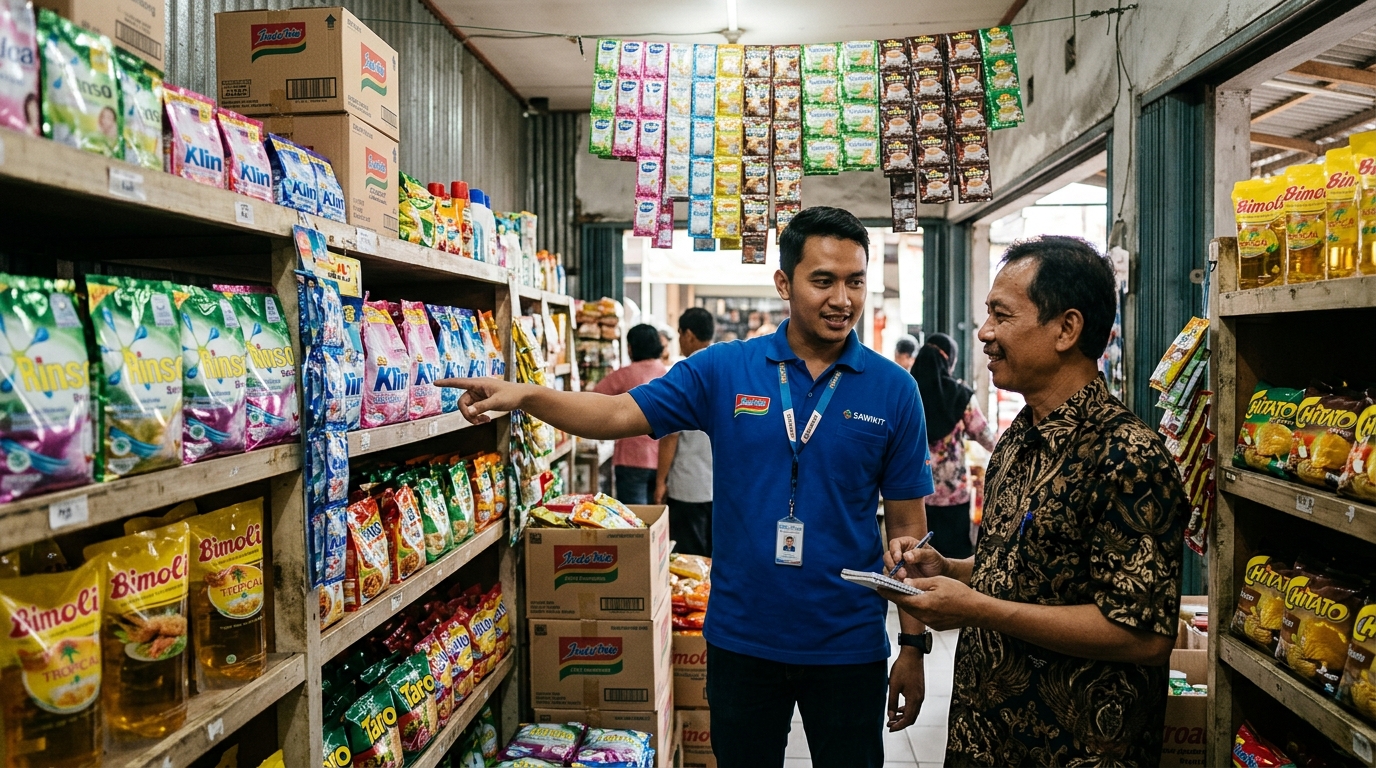
From an immediate cost-to-serve perspective, this retailer looks unattractive. From a brand-development perspective, however, the outlet is progressing exactly as one would hope. The retailer is gradually gaining confidence in the products, demand is beginning to develop, and the brand is establishing a presence in a location where consumers previously had no opportunity to buy it.
If management now imposes a Rp400,000 minimum order, the retailer may simply stop buying. The shopkeeper might not have sufficient consumer demand to justify purchasing additional stock, and tying up more working capital in an unfamiliar product could be an unreasonable risk. The distributor will have eliminated an unprofitable order, but the brand will also have lost a developing distribution point and the potential consumer demand that could have emerged from it.
This is the fundamental contradiction that makes aggressive cost optimisation so dangerous for developing FMCG brands. A distributor naturally wants every route, delivery and customer relationship to generate an acceptable financial return, while a brand owner needs sufficient distribution, visibility and product availability to stimulate demand in the first place. A mature brand with established consumer demand can often optimise its distribution network much more aggressively than a young brand that still needs to convince retailers and consumers that its products deserve a place in the market.
Building a brand requires consumers to encounter the product repeatedly, find it conveniently and eventually develop the habit of purchasing it. Advertising, promotions and consumer engagement may create awareness and interest, but those investments become considerably less effective when shoppers cannot find the product in their usual stores. In markets such as Indonesia, where traditional trade remains an important channel for many FMCG categories, individual outlets may generate relatively small orders while collectively providing extensive neighbourhood coverage and access to consumers.
This does not mean that every traditional retail outlet must be served at any cost or that numeric distribution should become an objective completely disconnected from consumer demand. It does mean that the financial performance of a developing outlet needs to be evaluated in the context of what the business is trying to achieve over time. An outlet that has been unprofitable for years despite repeated commercial support is a very different proposition from one that started buying six weeks ago and is demonstrating consistent growth.
Unfortunately, many efficiency programmes fail to make that distinction. Management identifies low-volume customers, reduces service frequency, introduces minimum orders and reallocates resources toward larger accounts. Average order values may improve, cost per delivery may decline and reported route profitability may look considerably better, but some of those improvements can simply reflect the withdrawal of service from less developed outlets. The business may have become more efficient at serving its existing successful customers while simultaneously weakening its ability to develop new ones.
Taken far enough, such an exercise can make the distribution network look healthier financially while leaving the brand with a smaller market presence and fewer opportunities for future growth.
Treat Developing Outlets Differently From Established Customers
A more intelligent approach begins by recognising that customers are at different stages of development and should not necessarily be managed according to identical commercial expectations. An established retailer that has stocked the same products for several years, generates stable consumer demand and still insists on placing numerous small orders may represent a genuine opportunity to improve efficiency. The distributor could explore reducing delivery frequency, encouraging consolidated orders or introducing a more convenient ordering process without materially damaging the availability of the brand.
A newly recruited retailer requires a different approach. The outlet may initially carry only two or three SKUs, produce relatively small orders and need regular attention from the sales representative. Some of those visits will involve introducing products, explaining their benefits, monitoring consumer response and helping the shopkeeper understand which items are beginning to sell. As demand develops, the retailer may become comfortable adding more products and holding slightly higher inventory levels, which should gradually improve order values and reduce the relative cost of servicing the account.
There can also be strategically important outlets whose direct sales do not fully reflect their commercial relevance. A shop in a busy neighbourhood, near a school or along a heavily travelled route may provide valuable exposure to the brand's target consumers, even if its initial order volumes are modest. Such outlets should not automatically receive unlimited support, because strategic value is too easily used as an excuse for poor commercial discipline. Nevertheless, where there is a credible reason to believe that an outlet can contribute to consumer awareness, availability or future sales, its role deserves consideration before service is reduced or discontinued.
The important distinction is between an outlet that is unlikely to become commercially sustainable and one that is still moving toward that point. Both may currently generate limited or negative contribution, but their future potential and the appropriate management response can be completely different.
This requires sales managers to look beyond the latest invoice and understand how individual customers are developing over time. A retailer whose order value grows steadily, whose assortment expands naturally and whose replenishment becomes increasingly predictable is demonstrating progress, even if its current contribution remains modest. Another retailer that repeatedly requires promotional support, shows little consumer demand and has made no meaningful improvement over an extended period deserves much closer scrutiny.
There is no universal period after which a developing outlet must become profitable, because the answer depends on the category, purchase frequency, margins, competitive environment and distribution model. The principle is simply that an investment in market development should be supported by evidence of progress and a realistic expectation of an eventual commercial return.
Increasing the Number of SKUs Is Usually Better Than Forcing Bigger Orders
One particularly unfortunate consequence of aggressive minimum-order policies is that sales representatives may begin pushing more inventory into stores than consumers are likely to purchase. If a retailer normally orders Rp300,000 but suddenly has to order Rp500,000 to qualify for delivery, the easiest solution for the representative may be to persuade the shopkeeper to take additional cartons of existing products. The distributor records a larger invoice and the route's average order value improves, but the retailer may now be holding inventory that takes considerably longer to sell.
This creates a problem that can remain hidden for several weeks. The retailer's working capital becomes tied up in excess stock, reorder frequency declines and the brand occupies shelf space without necessarily generating more consumer purchases. If the products have limited shelf life, the risk becomes even greater, particularly in food and beverage categories where expired or damaged inventory can quickly erode the retailer's willingness to support the brand.
A far more productive approach is to develop the assortment gradually as consumer demand emerges. Suppose a shop starts by carrying two of the brand's strongest products and those products begin selling consistently. The representative can then introduce a complementary flavour, another pack size or a different product that suits the retailer's customer base. Once the additional SKU demonstrates reasonable sell-through, the assortment can expand again, provided the retailer has sufficient shelf space and working capital to support it.
Over time, the shop may progress from two regularly selling SKUs to four, six or eight, with corresponding improvements in total order value. This is a much healthier form of growth because the additional inventory is supported by actual consumer demand rather than pressure to achieve an arbitrary minimum invoice value. It also strengthens the brand's presence in the outlet, increases the number of consumer purchasing occasions the assortment can address and makes the retailer more commercially committed to the relationship.
Of course, more SKUs are not automatically better. A poorly selected assortment can create unnecessary stockholding, reduce sales per SKU and increase the risk of returns. The objective should always be to introduce products that genuinely fit the outlet and its consumers, while gradually increasing total sales through the shop rather than merely increasing the volume of goods sold into it.
For a growing FMCG brand, this distinction between sell-in and sell-through is particularly important. A distributor can temporarily improve its sales figures by pushing additional inventory into the trade, but sustainable brand development ultimately depends on consumers purchasing the products and retailers having a reason to reorder them.
Optimise the Way You Serve Customers Instead of Simply Serving Fewer Customers
Fortunately, distribution optimisation does not have to mean abandoning small customers or weakening market coverage. In many cases, the better opportunity lies in changing how those customers are serviced rather than deciding whether they deserve to remain in the network.
For example, a retailer ordering relatively small quantities three times per week might be perfectly comfortable receiving one planned delivery instead, provided the products are replenished reliably and the new schedule does not create excessive stockholding. Consolidating deliveries can reduce transport, handling and administrative expenses while preserving the commercial relationship. Similarly, better route planning can reduce unnecessary travel, particularly when sales representatives and delivery vehicles operate in areas where customers are relatively close together.
Digital ordering also provides opportunities, especially among established outlets with predictable demand. A retailer who regularly purchases the same assortment may not need a physical visit every time an order is placed, and a simple WhatsApp message or ordering platform can be sufficient to maintain replenishment. However, replacing physical visits indiscriminately can introduce another problem if the sales representative was performing important development activities that the digital channel does not replace.
There is a substantial difference between collecting an order and developing a customer. A representative whose visit consists entirely of asking how many cartons the shopkeeper wants may be carrying out a task that can be performed more efficiently through another channel. A representative who is introducing new products, improving shelf visibility, observing competitor activity and helping a retailer develop consumer demand is providing a different type of commercial value.
For established customers, fewer visits may therefore be perfectly sensible, while newly recruited or strategically important outlets may need more personal attention until the brand has established a stronger position. The best service frequency depends not only on order values but also on the stage of development, the complexity of the assortment, the retailer's needs and the actual purpose of the visit.
It is also worth remembering that reducing visits does not necessarily reduce costs in direct proportion. If the sales representative still works the same number of hours and the delivery vehicle continues travelling through the same neighbourhood, removing a handful of stops may achieve very little financial benefit. Real savings are more likely to emerge when route changes allow the company to reduce unnecessary kilometres, consolidate deliveries, eliminate avoidable handling or increase the productive capacity of the existing team.
Good optimisation is therefore about improving the economics of serving the market, not simply reducing the number of customers being served.
The Brand Owner and Distributor Often Have Conflicting Priorities
The tension between optimisation and brand building becomes particularly apparent when the brand owner relies on an independent distributor. The brand owner naturally wants its products available in as many commercially relevant outlets as possible, supported by adequate visibility, regular replenishment and continuous market development. The distributor, meanwhile, must manage operating costs, working capital, credit risk and the profitability of the portfolio it distributes.
These objectives can reinforce each other once a brand has established sufficient consumer demand, but they can conflict sharply during the early stages of market development. An established product that retailers already know and consumers regularly request is relatively easy to distribute, while a new brand often requires more sales visits, smaller opening orders, additional explanation and patience before meaningful repeat demand develops.
If the distributor handles several competing or complementary brands, it has an obvious commercial incentive to prioritise products that sell quickly and generate attractive returns. The sales team may therefore devote more time to established products, while the developing brand receives less attention than its owner expects. From the distributor's perspective, this may be a perfectly rational allocation of resources, particularly if the brand owner expects extensive market development without providing sufficient commercial support.
This is why brand owners need to recognise that expanding distribution is an investment rather than a free service automatically included in the distributor's margin. If the objective is to recruit hundreds or thousands of additional outlets, introduce new SKUs and develop demand in territories where the brand has limited awareness, the economics of those activities need to be discussed openly.
Depending on the circumstances, the solution might involve a jointly agreed market-development budget, temporary incentives for successful outlet recruitment, merchandising support or an arrangement that compensates the distributor for clearly defined development activities. Such support should not be an unrestricted subsidy, and both parties should agree on measurable objectives, realistic timelines and the evidence required to demonstrate that genuine market development is taking place.
The important point is that the distributor should not be expected to absorb every cost of building someone else's brand while simultaneously being judged on short-term profitability. Equally, the brand owner should not accept endless investment in unproductive outlets without understanding why those outlets are failing to develop.
A successful distribution partnership requires alignment between the brand's growth ambitions and the distributor's commercial realities. Without that alignment, the brand owner may complain about insufficient market coverage while the distributor quietly redirects its resources toward more profitable products, leaving both parties frustrated by the results.
How to Put This Into Practice
For a sales manager wanting to improve route profitability without undermining brand development, the first step is to examine the economics of the existing territory using actual sales and operating data. Several weeks of activity should provide an initial indication of how many outlets are being visited, how frequently they order, what their average order values look like and how much gross margin is available to cover the associated commercial expenses.
The analysis should include relevant trade spending, delivery requirements, returns, collection performance and the actual resources required to operate the route. It should also account for unsuccessful sales calls, because a representative's time and transportation costs do not disappear simply because the shopkeeper chooses not to order that day. However, shared expenses should be allocated sensibly, and management should distinguish between costs that would genuinely be avoided by changing the service model and costs that would remain regardless.
Once the numbers are reasonably understood, I would spend time with the sales representatives and supervisors rather than immediately generating a list of customers to remove. They should be able to explain which retailers have stable consumer demand, which outlets are still developing, where visits are unnecessarily frequent and which customers regularly create avoidable expenses. Their field knowledge is particularly valuable when interpreting the performance of developing outlets, although it should be supported by actual purchasing patterns rather than accepted without question.
The next step is to identify opportunities to improve efficiency without reducing commercially valuable distribution. Established customers may be suitable for consolidated deliveries, lower visit frequency or digital ordering. Developing customers may require continued attention but should have clear objectives for improving sales, assortment and replenishment over time. Customers showing little progress despite sustained support may need a different approach, including changes to their assortment, service model or, where justified, a decision to stop active servicing.
I would also examine how management measures its salespeople, because incentive structures can easily undermine an otherwise sensible strategy. Representatives rewarded exclusively for sales value may push excessive inventory into stores, while those rewarded mainly for numeric distribution may open outlets that have little realistic commercial potential. Conversely, a team measured almost entirely on immediate profitability may avoid the very outlets that a growing brand needs to develop.
A better performance system recognises that maintaining established business, improving servicing efficiency and developing new customers are related but distinct responsibilities. Salespeople should be encouraged to increase sustainable sales, improve productive distribution and expand assortments where consumer demand justifies it, rather than simply maximising the size of the next invoice.
The results should then be reviewed regularly to determine whether the changes are genuinely improving the business. Higher average order values and lower delivery costs are positive developments, but they should not be celebrated in isolation if active distribution is falling, developing outlets are disappearing or important products are becoming less available to consumers. Similarly, a temporary decline in contribution from newly recruited customers may be acceptable if those outlets are demonstrating credible progress toward sustainable repeat sales.
The objective is to understand both the financial performance of today's distribution network and the quality of the network being developed for tomorrow.
The Real Objective Is Profitable Distribution Growth
There is no question that FMCG companies need to take distribution economics seriously. Margins are often under pressure, competition is intense and the costs associated with sales teams, warehouses, transportation and working capital can quickly undermine profitability. A business that ignores these realities in the name of brand building may eventually discover that it no longer has the resources required to support its own growth.
At the same time, a company that focuses excessively on extracting maximum short-term profitability from every customer risks making the opposite mistake. It may reduce market-development activities, discourage retailers from trying new products and gradually concentrate its distribution network around a smaller group of established customers. The immediate financial results may improve, but the brand's ability to reach new consumers and generate future demand can deteriorate.
The challenge is to manage both objectives intelligently. Mature customers should become increasingly efficient to serve, while developing customers should receive an appropriate level of investment until their sales justify a more economical servicing model. The profits generated by established business should help create the financial capacity for further distribution development, provided that development is selective, measurable and grounded in realistic commercial potential.
This is particularly relevant in markets such as Indonesia, where extensive traditional trade networks create tremendous opportunities for FMCG brands but also make distribution expensive and operationally complex. The challenge is not simply to put products into more stores or to reduce the cost of visiting those stores. It is to develop a network in which increasing numbers of retailers can sell the products successfully, replenish them consistently and become commercially sustainable customers over time.
That requires patience, discipline and a willingness to recognise that the economics of building a market are different from the economics of servicing an established one.
Before deciding that a particular outlet is too expensive to visit or that a small order is no longer worth delivering, I would therefore ask whether the customer is genuinely an inefficient part of the existing operation or whether it represents a developing distribution opportunity whose commercial potential has not yet been realised. I would also examine whether the servicing cost can be reduced without losing the customer, because improving route economics and protecting valuable distribution are not mutually exclusive objectives.
Ultimately, the purpose of optimisation should be to make the distribution network stronger and more sustainable, not merely smaller and cheaper to operate. An impressive contribution margin means relatively little if achieving it requires sacrificing the market coverage, consumer availability and retailer relationships that the company has spent years developing.
The real objective is not to operate the cheapest possible sales route or to maximise the profitability of every individual order. It is to build a distribution network that becomes increasingly profitable as the brand grows, while ensuring that today's efficiency measures do not destroy tomorrow's opportunities.
For anyone responsible for building an FMCG business, knowing when to optimise is important, but understanding when optimisation starts working against brand development may be even more valuable.
FMCG by Alex — Practical perspectives on FMCG sales, distribution, commercial strategy and brand development, with a particular focus on Indonesia and Southeast Asia.
Tools for this topic
View shopFMCG Growth Systems (Hardcover)
A tactical leadership guide for building scalable FMCG growth engines.
Related content
The 30-Store Trap: Why FMCG Growth Comes From Developing Existing Outlets, Not Just Visiting More of Them
Visiting 30 outlets a day is easy to measure, but real FMCG growth happens inside the store. Here is how field salespeople move beyond basic replenishment, overcome 'Masih ada stok, Mas,' and expand from one SKU to eight in Indonesian general trade.
Stop Riding Around With Your Salesman: How an Area Sales Supervisor Should Actually Spend a Day in the Field
A field visit only becomes valuable when something in the territory is actually better because the supervisor was there. Here is how FMCG area sales supervisors move from ceremonial ride-alongs to route quality, real coaching, and disciplined field execution.
Growth Has Stalled. The Factory Still Opens Monday.
What an Area Sales Manager can actually do when the business stops growing. Operational field tactics for routes, store availability, shelf capacity, and trade spend.
How to Build a Better FMCG Route-to-Market
Designing channel roles, distributor economics, and service levels in one RTM framework.