The Grocerant Model: Why Grocery Stores Are Becoming the New Everyday Restaurant
Grocery stores are no longer just places to buy ingredients. The grocerant model combines grocery, foodservice, ready meals, and retail theatre to capture modern meal occasions.
The Grocerant Model: Why Grocery Stores Are Becoming the New Everyday Restaurant
For decades, supermarkets were built around one simple consumer mission: buy ingredients, take them home, cook them, eat them.
That model is no longer enough.
Today's consumer does not always want ingredients. They want lunch. They want dinner solved. They want something fresh, fast, affordable, and better than another sad delivery order arriving lukewarm in a paper bag. This is where the grocerant model comes in.
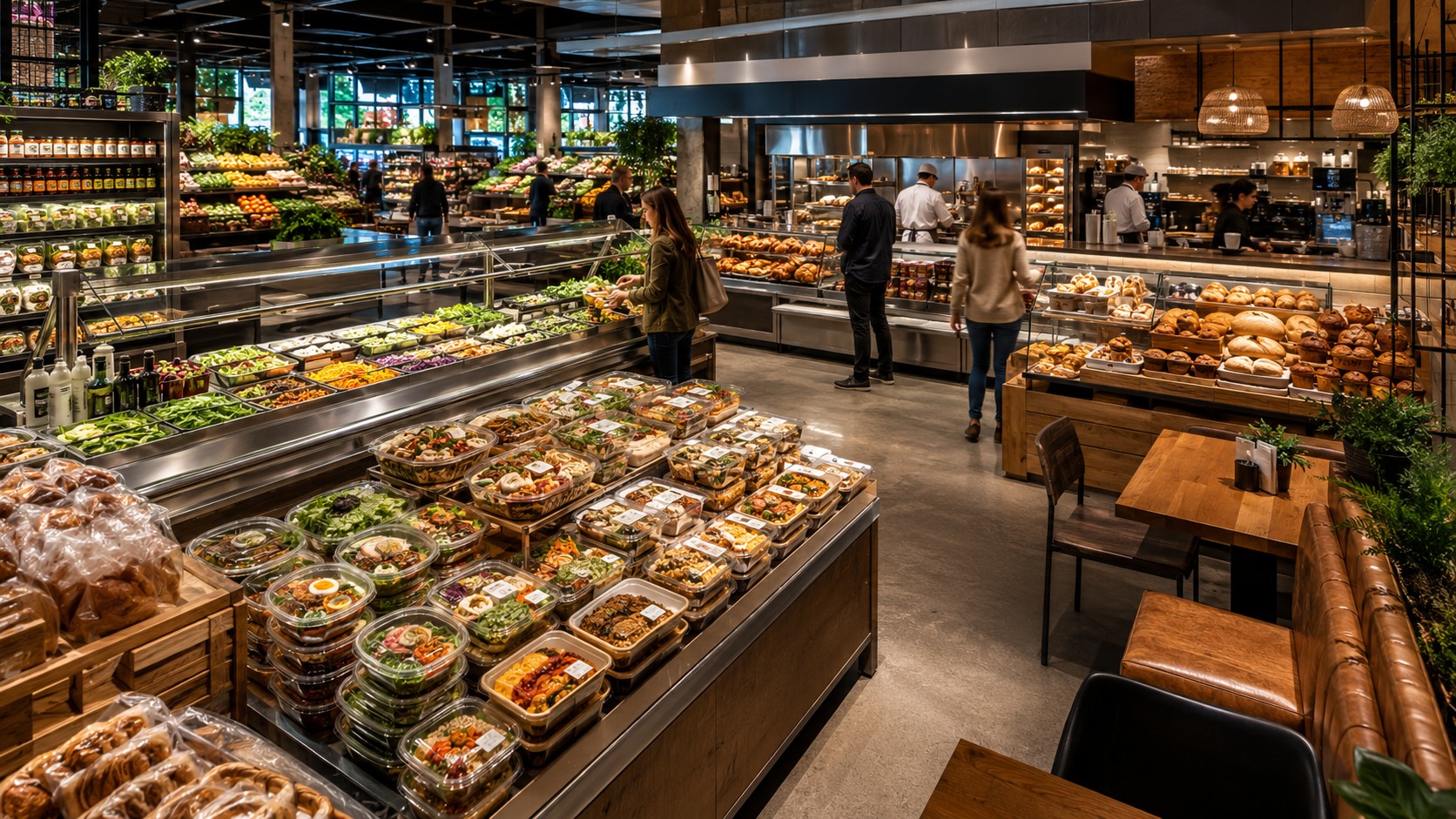
A grocerant is the combination of grocery store and restaurant. It can be a deli counter, a hot meal section, a sushi bar, a salad station, a bakery cafe, a rotisserie chicken offer, a ready-meal wall, a grab-and-go lunch range, or a full food hall inside a supermarket. The exact format can differ, but the strategic idea is the same: the retailer is no longer only selling products. It is selling meal solutions.
And that distinction matters.
From Selling Food to Solving Meals
The traditional supermarket sells components: vegetables, rice, pasta, meat, sauce, bread, dairy, snacks, and drinks. The consumer still has to decide what to cook, buy the ingredients, prepare the meal, clean up afterwards, and hope the family does not complain.
The grocerant model reduces that friction. It says: here is a roasted chicken, here are the sides, here is the salad, here is the dessert, here is the drink, and here is a better alternative to spending restaurant money on a normal weekday meal.
That is why this model sits in a powerful space between supermarkets, quick-service restaurants, food delivery, meal kits, and casual dining. It is not trying to be fine dining. It is not trying to replace home cooking completely. It is trying to win the moments where the consumer thinks: "I need food now, but I do not want to cook from scratch or pay restaurant prices."
Recent industry data supports this shift. FMI reported in 2025 that the share of consumers choosing deli-prepared foods instead of restaurant meals more than doubled from 12% in 2017 to 28% in 2025. The same report said that 53% of Americans now take a hybrid approach to meals, combining deli-prepared food with items from their own kitchen. Retail foodservice sales also reached $52.1 billion, up 1.6% over the previous 12 months. ([fmi.org][1])
That hybrid behaviour is the heart of the opportunity. Many consumers are not saying, "I never want to cook again." They are saying, "Help me finish the meal."
Why Grocerants Make Strategic Sense
The grocerant model works because it answers several retail problems at the same time.
First, it can increase visit frequency. Grocery shopping may happen once or twice a week, but breakfast, lunch, snack, and dinner happen every day. A supermarket that becomes part of the consumer's lunch routine or weekday dinner routine can earn many more visits than a supermarket that only waits for the weekly basket.
Second, it can increase basket size. A customer who comes in for a sandwich may also buy coffee, fruit, a drink, dessert, or groceries for later. A customer who buys a hot meal for dinner may add salad, wine, ice cream, bread, or household items.
Third, it gives the retailer a stronger point of differentiation. Price promotions can be copied. National brands can be sold by competitors. But a really good in-house chicken, soup, sandwich, rice bowl, salad, bakery item, or family meal bundle becomes part of the store's identity.
Fourth, it gives retailers a way to defend margin in a low-growth market. McKinsey's 2025 European grocery report described a market with low overall growth, continued cost and margin pressure, and pockets of opportunity in fresh foods, healthy foods, functional foods, convenience, and food-to-go categories. ([McKinsey & Company][2])
In other words, the supermarket cannot rely forever on selling more packs of the same products. It needs to capture more of the consumer's eating occasions.
The Real Competition Is Not Just Other Supermarkets
One of the biggest mistakes in grocery strategy is comparing only against other supermarkets. In the grocerant model, the competitive set is much wider.
The grocerant competes with McDonald's, Starbucks, local cafes, bakeries, food delivery platforms, office canteens, petrol station food, meal-kit companies, convenience stores, and the consumer's own fridge.
This is why the offer must be designed around real meal occasions.
For breakfast, the grocerant may need coffee, pastries, yogurt, fruit, breakfast sandwiches, and smoothies. For lunch, it needs sandwiches, salads, wraps, sushi, soup, bowls, and drinks. For late afternoon, it may need snacks, coffee, bakery, and dinner inspiration. For dinner, it needs hot meals, family bundles, rotisserie chicken, cooked proteins, sides, sauces, ready-to-heat meals, and meal components.
FMI also highlighted the importance of lunch and late afternoon, noting that shoppers buy deli-prepared options most frequently between noon and 5 p.m. ([fmi.org][1])
That is an important operational point. A grocerant is not one offer. It is a sequence of offers across the day.
The Power of the Signature Item
Every successful grocerant needs a reason to come back.
That reason could be a famous rotisserie chicken, excellent sushi, a premium sandwich range, fresh pizza, Indonesian rice bowls, healthy protein bowls, homemade soup, strong coffee, a bakery line, or family meal deals that become part of the weekly routine.
The signature item is not just a product. It is a memory hook. It makes the consumer think, "Let's go there, because they have that chicken," or "I'll grab lunch there because their salads are actually good."
FMI specifically points to signature items as a way to reduce decision fatigue and build repeat purchases, because a strong signature product gives the customer something familiar to trust. ([fmi.org][1])
This is especially important because many deli and prepared-food counters still suffer from weak perception. Grocery Dive, summarising FMI's findings, noted that half of consumers consider the deli-prepared foods at their primary grocery store only "somewhat appetizing." ([grocerydive.com][3])
That is both a problem and an opportunity. It means the bar is still not impossibly high in many markets. A retailer that takes taste, freshness, display, and consistency seriously can stand out quickly.
The Model Fails When Foodservice Is Treated as an Add-On
The grocerant model looks attractive from the outside, but it is operationally difficult.
A normal grocery shelf can hold packaged goods for days, weeks, or months. A hot counter cannot. A salad bar cannot. A sushi range cannot. A fresh sandwich programme cannot. Foodservice brings perishability, labour intensity, food safety risk, and daily execution pressure into the store.
This is where many retailers underestimate the model. They install counters, buy equipment, hire a few staff, create too many SKUs, and then wonder why waste is high and quality is inconsistent.
Foodservice inside retail must be managed almost like a restaurant. It needs recipe cards, production planning, batch control, HACCP discipline, allergen management, shelf-life rules, temperature logs, cleaning routines, staff training, and proper labour scheduling.
It also needs discipline in assortment. A grocerant should not try to be everything to everyone. Too much variety creates waste, confusion, and execution problems. It is usually better to have a tight core menu, clear bestsellers, rotating specials, and strong meal bundles.
The consumer does not need fifty mediocre options. The consumer needs ten good ones.
Value Is the Strategic Weapon
The grocerant model works best when the consumer clearly understands the value advantage.
If a supermarket meal costs almost as much as a restaurant meal, but offers less atmosphere, less service, and less indulgence, the concept becomes weak. But if the consumer feels they are getting restaurant-style convenience at supermarket value, the model becomes powerful.
Reuters reported in 2025 that inflation-adjusted food retail sales volumes in Eurozone supermarkets, hypermarkets, and similar stores grew by 1.5% between January and May, while food and beverage services such as restaurants and bars declined by 0.3%. Reuters also cited the rising popularity of grab-and-go meals, salads, wraps, and sandwiches as part of this shift. ([Reuters][4])
That tells us something important: the grocerant model is not only about convenience. It is also about consumer economics.
A strong value architecture might include an entry lunch deal, a core hot meal, a family dinner bundle, and a premium option for consumers who want to trade up. The pricing ladder must be obvious. The customer should immediately understand what is affordable, what is healthy, what is indulgent, and what solves dinner for the family.
The Hybrid Meal Is the Sweet Spot
The best grocerant operators understand that the biggest opportunity is often not the fully finished meal. It is the semi-finished meal.
This is where grocery has an advantage over restaurants.
A restaurant sells the meal. A grocer can sell the meal, the ingredients around the meal, the drink, the dessert, the breakfast for tomorrow, and the household items the customer forgot.
For example:
A roasted chicken can be merchandised with salad, bread, potatoes, sauces, and dessert.
Fresh pasta can be placed with sauce, cheese, salad, and wine.
Soup can be bundled with bread and fruit.
A rice bowl can sit next to extra protein, bottled drinks, and snack packs.
A family curry can be paired with rice, naan, yogurt, and ice cream.
This is not only merchandising. It is meal architecture.
The grocerant model becomes more profitable when it stops thinking in individual SKUs and starts thinking in meal missions.
In-Store Theatre Still Matters
Digital ordering, apps, and loyalty programmes all have a role, but foodservice remains highly sensory. People buy prepared food with their eyes and nose first.
If the chicken smells good, the bakery looks fresh, the salad bar is colourful, and the hot counter feels alive, the store has a chance to convert impulse into purchase. If the food looks tired, dry, badly lit, or hidden in a corner, no loyalty app will save it.
Grocery Dive reported that shoppers often discover prepared-food options by walking around the store or seeing in-store signage, with more than 60% learning about options by exploring the offer and only 19% using apps. ([grocerydive.com][3])
That should be a wake-up call. Foodservice at retail is not only a category-management exercise. It is theatre, smell, visibility, signage, packaging, and trust.
The Key Success Drivers
The winning grocerant model usually has seven things working together.
It has a clear meal occasion strategy. The retailer knows whether it wants to win breakfast, lunch, dinner, snacks, or all of them in specific formats.
It has signature products. There is at least one product or range that customers associate with the store.
It has strong operational discipline. Recipes, waste control, food safety, batch cooking, and staff training are treated seriously.
It has a smart value ladder. The customer can see good, better, and best options without confusion.
It connects prepared food to grocery. The meal solution does not stop at the counter; it pulls through drinks, sides, sauces, desserts, and pantry items.
It uses private label intelligently. Prepared food can become the living showcase for private-label sauces, bakery, coffee, drinks, desserts, and fresh products.
It measures performance properly. The retailer tracks sales per labour hour, gross margin after waste, waste percentage, attachment rate, repeat purchase, peak-time availability, and customer complaints.
Without these disciplines, the grocerant becomes an expensive deli experiment. With them, it can become a major growth platform.
What FMCG Brands Should Learn From This
The grocerant trend is not only relevant for retailers. FMCG brands should pay close attention.
As retailers become meal-solution providers, brands need to think beyond shelf placement. The question is no longer only, "How do I get listed?" It becomes, "How do I become part of the meal?"
Sauce brands, beverage brands, snack brands, dairy brands, bakery suppliers, frozen food companies, condiment brands, and health-focused brands all have opportunities to partner with retailers around meal occasions.
A beverage brand can own lunch bundles. A sauce brand can power hot meals. A dairy brand can connect to breakfast and snacking. A snack brand can become part of the office lunch deal. A frozen or chilled brand can help create ready-to-heat family solutions.
The grocerant model rewards brands that understand occasions, not just categories.
Final Thought
The grocerant model is not a gimmick. It is a response to a real consumer shift.
People are busy. Restaurants are expensive. Delivery is inconsistent. Cooking from scratch takes time. At the same time, consumers still want freshness, variety, taste, and value.
The grocery store is well positioned to answer that need, but only if it stops thinking like a warehouse of products and starts thinking like a provider of daily meals.
The future supermarket will still sell ingredients. But the better supermarket will also sell answers.
And one of the most important questions it will answer is very simple:
"What are we eating today?"
Tools for this topic
View shopFMCG by Alex Notebook
Dot-grid strategy notebook for planning weekly commercial priorities.
Trade Promotion Masterclass
Build higher-ROI trade plans with structured diagnostics and execution control.
Related content
The Dutch Protein Aisle and the Curious Case of the Category That Built Its Own Replacement
How Dutch retailers like Albert Heijn, Kruidvat, Etos, and Jumbo let pioneer sports nutrition brands build the market, then launched own-label alternatives to capture the category.