The Product Is Everywhere. So Why Is It Always Out of Stock?
Why distribution, availability, and being able to actually buy the product are not the same thing. How out-of-stocks silently destroy FMCG sales while internal dashboards stay green.
The Product Is Everywhere. So Why Is It Always Out of Stock?
Why Distribution, Availability and Being Able to Actually Buy the Product Are Not the Same Thing
There is a particularly frustrating kind of FMCG success where everything appears to be working until somebody tries to buy the product. The sales team reports strong distribution, the retailer confirms that the SKU is listed, the distributor has shipped stock and the monthly presentation contains enough green arrows to suggest that execution is under control. Then somebody visits a store and finds an empty shelf. Not occasionally empty in the understandable way that fast-selling products sometimes disappear shortly before replenishment, but empty in the more awkward sense that the company seems to have achieved distribution without producing anything a consumer can actually purchase.
This is where one of the most important distinctions in FMCG becomes obvious: distribution and availability are not the same thing. A product can be technically distributed and commercially unavailable at exactly the same time. The manufacturer's system may show that an outlet is listed, the distributor may show that stock was shipped, and the retailer may show that the SKU is active in the assortment, yet none of those facts guarantees that there is a bottle, packet or carton sitting on the shelf when the shopper arrives. Distribution tells you that the product has permission to be there; availability tells you whether it actually is.
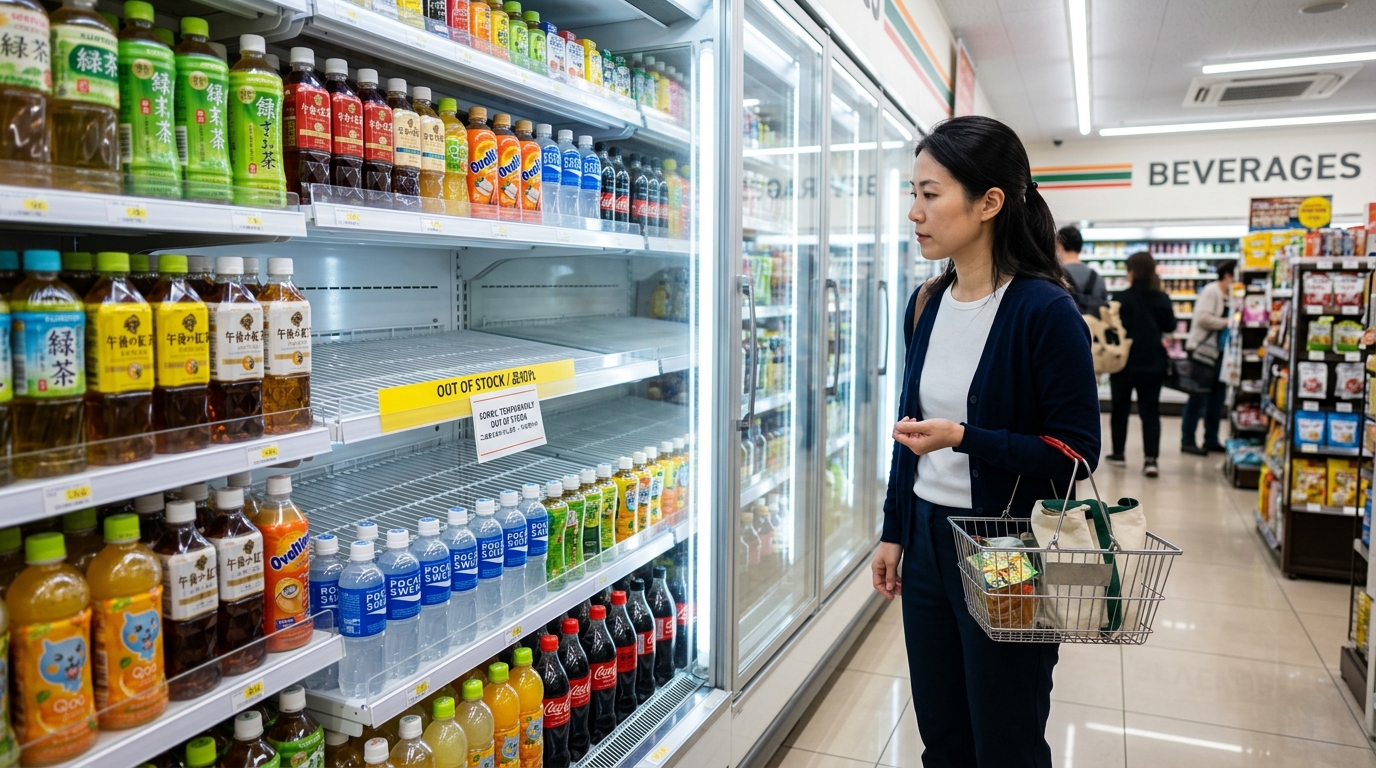
Imagine an Indonesian beverage company with excellent distribution across a national minimarket network. The product is listed in 90% of relevant stores, which looks fantastic in a sales review and, to be fair, is a real achievement. Yet a store audit finds that only 72% of those outlets actually have the product available when checked. The brand has not lost distribution; it has lost availability. To the shopper, of course, this distinction is completely irrelevant. She does not stand in front of an empty refrigerator thinking, “I am pleased to see that this SKU remains technically listed.” She buys something else.
That is the central commercial danger of out-of-stocks. Companies often experience them as operational exceptions, while consumers experience them as invitations to switch brands. The shopper may be loyal, but loyalty has limits. If the preferred shampoo is missing, she may postpone the purchase. If the preferred snack is missing, she may choose another. If she is thirsty in a minimarket in Surabaya at two in the afternoon, she is unlikely to leave empty-handed out of respect for your brand equity. She will buy something cold, which means the competitor benefits from a problem that may never even appear properly in your own sales data.
The reason is simple: a lost sale often leaves almost no trace. A shopper walks into the store intending to buy your product, discovers it is unavailable and switches to a competitor. Your system records nothing because your product was not sold. The competitor records revenue. Unless you have reliable availability data, you may never know that the demand existed in the first place. This is why out-of-stock problems can remain strangely invisible at headquarters. A weak promotion may be blamed on creative execution, a soft launch may be blamed on consumer response, and a slow region may be labelled structurally difficult when the real problem is that shoppers could not find the product often enough.
This is also why listings can create a false sense of completion. FMCG organisations love listings because they are visible milestones. The buyer accepts the SKU, the Key Account Manager updates the forecast, Marketing prepares activation and everyone feels that an important hurdle has been cleared. It has, but the listing is not the finish line; it is permission to compete. Once the SKU is approved, an entire chain still has to work properly. The retailer needs to order enough, the manufacturer's supply needs to be available, the distributor or warehouse needs to deliver it, the store needs to receive it, the stock needs to reach the shelf and the shelf needs to be replenished before it empties.
Any break in that chain produces the same result for the consumer: no product. This is where the internal blame game usually starts. Sales says Supply Chain needs to improve service levels, Supply Chain says the forecast was wrong, Demand Planning says the promotion was larger than expected, the distributor says the retailer ordered too late and the retailer says the distributor did not deliver. Somewhere in the middle of all this, the store manager says the stock is probably in the back room. The consumer, meanwhile, has already completed the only process that matters. She bought something else.
The Phantom Inventory Trap: When Systems Say Yes and Shelves Say No

One of the more annoying features of out-of-stocks is that the stock often exists. Demand has not necessarily exceeded national supply. There may be plenty of product sitting in a distribution centre, a distributor warehouse or even the store itself. The problem is that the inventory is in the wrong place, recorded incorrectly or simply not moved onto the shelf. This creates the peculiar retail phenomenon known as phantom inventory: stock that exists in the system but cannot be located by the people trying to sell it.
The retailer's system may believe six units are available, which means it does not reorder. The shopper sees zero units, because she has eyes. Both systems remain confident. The stock may be in the back room, damaged, misplaced, stolen, attached to an old display or simply recorded incorrectly. Whatever the cause, the commercial outcome is the same. Supply Chain can prove that the product exists while Sales can prove that nobody can buy it.
This is why stock accuracy and replenishment discipline matter so much. Availability is not simply about having enough inventory somewhere in the network; it is about having the right inventory in the right place at the right time. Consider a fast-moving bottled drink in a busy Jakarta minimarket. The refrigerator holds twelve bottles, and on a normal weekday the store sells eight, so the replenishment rhythm works fine. Then the weather turns hotter, nearby offices are busier than usual and the store sells all twelve bottles before lunch. National inventory may still look perfectly healthy, yet the refrigerator stays empty for the rest of the afternoon if the store is not replenished until the next day.
This is where aggregated inventory numbers become misleading. A business can have too much stock overall and still suffer severe out-of-stocks in high-demand locations. A warehouse containing a month's supply in Bekasi offers very little comfort to a shopper staring at an empty shelf in Bandung. The product exists, but the sale does not. FMCG companies sometimes spend enormous effort managing total inventory while underestimating the importance of where that inventory actually sits.
Promotions make this problem even more visible because successful marketing can create terrible execution. A retailer agrees to a strong promotion, the brand appears in the leaflet, digital media supports the offer and the price is attractive. Demand jumps, the first wave of stores sells out in two days, and the promotion has another twelve days to run. Marketing is delighted that the campaign has generated interest, Supply Chain explains that the uplift exceeded forecast, Sales reports store complaints and Finance quietly calculates how much money was spent advertising shelves that are now empty.
This is one of FMCG's more impressive contradictions: the company can create the exact consumer response it wanted and still fail to convert it into revenue. The reason is that promotional planning often focuses heavily on the expected uplift but not enough on the replenishment implications. A promotion should not only have a forecast; it should have a stock-flow plan. How much initial inventory is needed, which stores typically overperform, how quickly can replenishment happen, and what happens if demand is twice the expected level? These are operational questions, but they are also commercial questions because poor availability turns a successful promotion into a very efficient product trial for the competition.
Why National Averages Lie: Geography, Trade Channels, and Execution
Indonesia makes all of this more complicated because distribution is not a simple line from one national warehouse to one uniform store network. Geography matters, traffic matters, islands matter, distributor territories matter, and modern trade and traditional trade frequently operate through different supply models. A product can be readily available in Jakarta and surprisingly hard to find in another city even though the national numbers suggest excellent distribution. This is why national availability averages should always be treated carefully.
Suppose a brand reports 92% on-shelf availability nationally. That sounds strong. But the underlying picture might show Jakarta at 98%, Surabaya at 95%, Medan at 88% and parts of eastern Indonesia at 72%. The average looks healthy, but consumers do not shop in averages. They shop in actual stores. Availability therefore needs to be understood geographically, by channel and by outlet type, because a national percentage can hide precisely the local problems that cost the business sales.
Traditional trade adds another layer. Availability in a warung network is much harder to observe than in a centrally controlled supermarket chain. The manufacturer may know that a distributor sold product into a territory but have limited visibility over which outlets still hold stock and which have already run dry. That makes field execution especially important. Sales representatives, merchandisers and distributor teams become the eyes of the business. Technology helps, but somebody still needs to know what is happening in the outlet. A dashboard in Jakarta cannot replenish a warung in Makassar by moral support.
There is also a tendency to treat availability as binary, as though the product is either present or absent. In practice, retail is messier. A product may technically be available but commercially almost invisible. There may be two units left on the bottom shelf, the main display may be empty, the best-selling pack size may be missing or the stock may be sitting in the back room. This is why on-shelf availability is usually more useful than simple inventory availability. The consumer buys from the shelf, refrigerator, freezer, display or digital interface. Stock somewhere inside the building is not the same thing.
The same logic applies at SKU level. A beverage brand may have good overall availability because at least one pack size is present in most stores, but if the 500ml bottle generates 60% of demand and is frequently out of stock, the consumer experience is still poor. Brand-level availability can therefore look healthy while the most commercially important SKU is underperforming badly. The right question is not simply whether the brand is present, but whether the specific product the shopper wants is available at the moment she wants it.
Fill Rate vs On-Shelf Availability: The Reporting Disconnect
This is also why service level and fill rate should not be confused with on-shelf availability. A manufacturer may report a 98% service level to the retailer and assume the consumer should therefore see almost perfect availability. Not necessarily. The supplier may have delivered almost everything the retailer ordered, yet the retailer may have ordered the wrong quantities, allocated stock poorly or failed to replenish stores effectively. A 98% fill rate can coexist quite happily with far weaker on-shelf availability.
That difference matters because senior management often sees a row of green percentages and assumes they are describing the same reality. They are not. Fill rate tells you how much of the order was supplied, service level tells you how reliably demand was fulfilled under agreed rules, and on-shelf availability tells you whether the shopper could actually buy the product. They are connected, but they are not interchangeable.
The commercial value of improving availability can also be much larger than it first appears. Moving from 93% to 95% on-shelf availability does not sound dramatic. It is only two percentage points, and nobody is likely to commission an inspirational company video about it. Yet for a large brand, those two points can represent a substantial amount of incremental sales, especially if the improvement occurs in high-volume outlets and on key SKUs. The appealing part is that the demand already exists. The company does not need to create it with more advertising, another promotion or a new product. It simply needs to stop disappointing it.
That is why availability can be one of the cheapest growth opportunities inside an established business. Not every out-of-stock becomes a lost sale, of course. Some consumers delay the purchase, some visit another store and some buy another SKU from the same brand. But many substitute, and substitution can have a longer-term effect. A shopper who buys a competitor because your product was missing may discover that the alternative is perfectly good. One empty shelf has just funded a free trial for somebody else.
The problem therefore goes beyond immediate revenue. Availability protects habit, and habit is one of the most valuable things an FMCG brand owns. If a consumer regularly buys your product without thinking, you have achieved something powerful. Repeated out-of-stocks force that consumer to think again, and thought is not always your friend.
Granular Forecasting and the Ramadan Lesson
Forecasting plays a central role because poor demand estimates eventually become physical availability problems. Under-forecast demand and you risk running out; over-forecast and you create excess inventory. The challenge is that forecasts are often created at a level that is too aggregated to protect the shelf. A national forecast can be almost perfectly accurate while inventory is badly positioned regionally. The company may forecast one million units and sell one million units, yet still have excess stock in Sumatra and empty shelves in Java.
At national level, the forecast looks brilliant. At outlet level, consumers are disappointed. This is why better planning increasingly needs to understand demand by region, channel, customer, SKU and sometimes store cluster. Promotions, holidays, weather, salary cycles, Ramadan and local events all affect demand differently, and Indonesia provides more than enough variation to make national averages unreliable.
Ramadan is a good example because it changes not only how much people buy, but also where and when they buy it. Mudik moves millions of consumers geographically, which means demand can shift away from normal urban patterns and towards travel routes and hometown destinations. A product that is perfectly stocked in the places where consumers normally live may suddenly be under-stocked in the places where they temporarily are. Treating this as a simple national uplift can produce very strange inventory outcomes.
Shelf capacity creates another type of availability problem. A product can have perfect warehouse supply and still go out of stock simply because too little fits on the shelf. Suppose a fast-moving SKU sells 24 units a day but the allocated shelf space holds only 12. Unless replenishment happens several times per day, an out-of-stock is almost inevitable. This is not a forecasting problem; it is a physical-capacity problem.
That is where category management and availability meet. More facings are not only about visibility; they can also protect availability by increasing the amount of stock held at the point of sale. A fast-moving SKU with insufficient shelf capacity can spend several hours out of stock each day despite excellent supply performance upstream. If one product sells ten times faster than another but receives the same shelf capacity, somebody has prioritised visual equality over economic reality.
The Digital Shelf and Organisational Ownership
E-commerce has not solved the problem either. It has simply changed how the consumer experiences it. Instead of an empty shelf, the shopper sees “currently unavailable,” or worse, the product appears available, enters the basket and is later removed because the fulfilment location cannot find it. This can be especially damaging because online shopping creates an expectation of inventory accuracy. The consumer standing in a physical store understands that a shelf may occasionally empty. The consumer using an app reasonably assumes the software knows what is actually in stock.
For FMCG brands selling through marketplaces, quick commerce and retailer apps, digital availability therefore becomes another critical metric. Search visibility is useless if the product cannot be purchased. A sponsored product ad for an unavailable SKU is a particularly elegant way of paying for traffic that cannot convert. Marketing may still report engagement; Finance is unlikely to share the enthusiasm.
This is why digital media and stock data should increasingly talk to each other. If inventory is constrained, campaigns should be reduced, redirected or paused. If one region is well stocked and another is not, activation can potentially follow availability. The technology already exists to do much of this. What often remains missing is the organisational connection between the teams creating demand and the teams responsible for supplying it.
That organisational issue is perhaps the hardest part of availability because responsibility is spread across so many functions. Sales owns the customer relationship, Supply Chain owns product flow, Demand Planning owns the forecast, Customer Service owns fulfilment, the retailer owns replenishment, the distributor owns local execution, Merchandising owns shelf condition and Marketing influences demand. Everybody owns part of the answer, which means nobody entirely owns the consumer standing in front of the empty shelf.
This fragmentation explains why availability can remain poor even when individual departments are performing well. The factory produced on time, the warehouse shipped on time, the retailer received the goods and the store technically had stock, yet the shelf was empty. Every team can be correct about its own KPI while the overall system still fails. The useful question is therefore not whether each department completed its task, but whether the consumer could actually buy the product.
That may sound almost too simple, but simplicity is useful here. FMCG companies naturally spend enormous energy searching for growth through innovation, new channels, new markets, advertising, pack formats and promotions. Before spending heavily to create new demand, it is worth asking how much existing demand is already being lost because the product is not consistently available.
A company with 85% on-shelf availability does not necessarily need a revolutionary new growth strategy before looking carefully at the missing 15%. Some of that gap may be uneconomic to eliminate, because perfect availability requires more inventory, more frequent replenishment and more working capital. The objective is not 100% at any cost. The objective is economically sensible availability, focused on the SKUs, outlets and occasions where an out-of-stock is most damaging.
A low-volume niche SKU disappearing briefly from a small store is not the same commercial problem as the number-one SKU disappearing from the top 500 outlets on Saturday afternoon. Just as not all outlets are equal, not all out-of-stocks are equal either. The smarter business prioritises the availability gaps that matter most.
From Distribution Targets to True Commercial Reality
This is where the subject links directly back to weighted distribution. If a brand has spent years securing strong weighted distribution but then suffers poor on-shelf availability in the highest-value outlets, the company has done the expensive part of opening the right doors and failed to finish the job once it got through them. It is hard to imagine a more frustrating way to almost succeed.
The most useful way to think about distribution is therefore not as a single percentage but as a chain of commercial reality. The product first needs to be listed in the right outlets, then enough inventory has to reach those outlets, that inventory needs to be recorded accurately and replenished properly, and finally the product needs to be visible and available when the shopper wants it. Only then does the consumer get the opportunity to decide whether the brand has done a good enough job to earn the sale.
That is why saying “we have 90% distribution” should never end the conversation. It should lead naturally to the next question: how much of that distribution is genuinely available? After that comes whether the key SKUs are on shelf, whether the outlets are productive and whether they reorder. The purpose is not to create another collection of dashboards; FMCG already has enough of those. The purpose is to follow the product all the way to the consumer rather than stopping the measurement once a case leaves the warehouse.
Because in the end, the consumer does not care that the company hit its distribution target, achieved a 98% service level or has a warehouse full of stock. She cares about whether the product is there when she wants to buy it. If the shelf is empty, the competitor gets the sale, however impressive the internal reporting may look.
The product may be everywhere on the distribution report, but the consumer only shops in one place at a time.
Tools for this topic
View shopFMCG Growth Systems (Hardcover)
A tactical leadership guide for building scalable FMCG growth engines.
Related content
Stop Riding Around With Your Salesman: How an Area Sales Supervisor Should Actually Spend a Day in the Field
A field visit only becomes valuable when something in the territory is actually better because the supervisor was there. Here is how FMCG area sales supervisors move from ceremonial ride-alongs to route quality, real coaching, and disciplined field execution.
The 30-Store Trap: Why FMCG Growth Comes From Developing Existing Outlets, Not Just Visiting More of Them
Visiting 30 outlets a day is easy to measure, but real FMCG growth happens inside the store. Here is how field salespeople move beyond basic replenishment, overcome 'Masih ada stok, Mas,' and expand from one SKU to eight in Indonesian general trade.
Growth Has Stalled. The Factory Still Opens Monday.
What an Area Sales Manager can actually do when the business stops growing. Operational field tactics for routes, store availability, shelf capacity, and trade spend.
How to Build a Better FMCG Route-to-Market
Designing channel roles, distributor economics, and service levels in one RTM framework.