
Stop Riding Around With Your Salesman: How an Area Sales Supervisor Should Actually Spend a Day in the Field
A field visit only becomes valuable when something in the territory is actually better because the supervisor was there. Here is how FMCG area sales supervisors move from ceremonial ride-alongs to route quality, real coaching, and disciplined field execution.

Stop Riding Around With Your Salesman: How an Area Sales Supervisor Should Actually Spend a Day in the Field
There is a particular type of FMCG field visit that achieves almost nothing while looking impressively busy. The supervisor leaves the distributor at eight in the morning, sits next to a salesman for most of the day, visits twenty or thirty outlets, drinks several sweet coffees, shakes hands with retailers, occasionally tells the salesman to push a bit harder and returns at five in the afternoon with the comfortable feeling that a proper day’s work has been done. Everyone was outside, everyone was moving, petrol was definitely consumed and several photos may even have been taken for the WhatsApp group, so naturally it feels as if something useful must have happened. The uncomfortable reality is that movement and management are not the same thing, and a field visit only becomes valuable when something in the territory is actually better because the supervisor was there.
A good day in the field should improve the quality of a route, expose lost sales, increase distribution, correct availability problems, identify weak selling behaviour, solve distributor issues or teach a salesperson something he can repeat tomorrow without his manager standing next to him. If none of that happens, the supervisor has essentially spent the day as an unusually expensive passenger. The best field supervisors therefore do not treat fieldwork as a ceremonial ride-along. They use it as an operating tool. They go into the market with a purpose, collect evidence, coach people, fix problems and come back with actions, because they understand something that is easy to forget in the office: the real condition of a territory is rarely visible from the Excel report waiting on somebody’s laptop.
The 07:30 Distributor Check: Where the Day Is Really Won
A productive field day actually starts before the first store visit. By around 07:30, the supervisor should already be at the distributor or branch, and although this is probably the least glamorous part of the day, it can tell you more about the health of the territory than a two-hour sales meeting. Is the team present and leaving on time? Are vans or motorcycles loaded properly? Are the important SKUs in stock? Are there orders from yesterday that were not delivered? Are returns sitting in the warehouse? Are salespeople going into the market with the right product mix, or are they about to spend half the day explaining why something is unavailable? A few minutes of observation here can prevent hours of nonsense later.
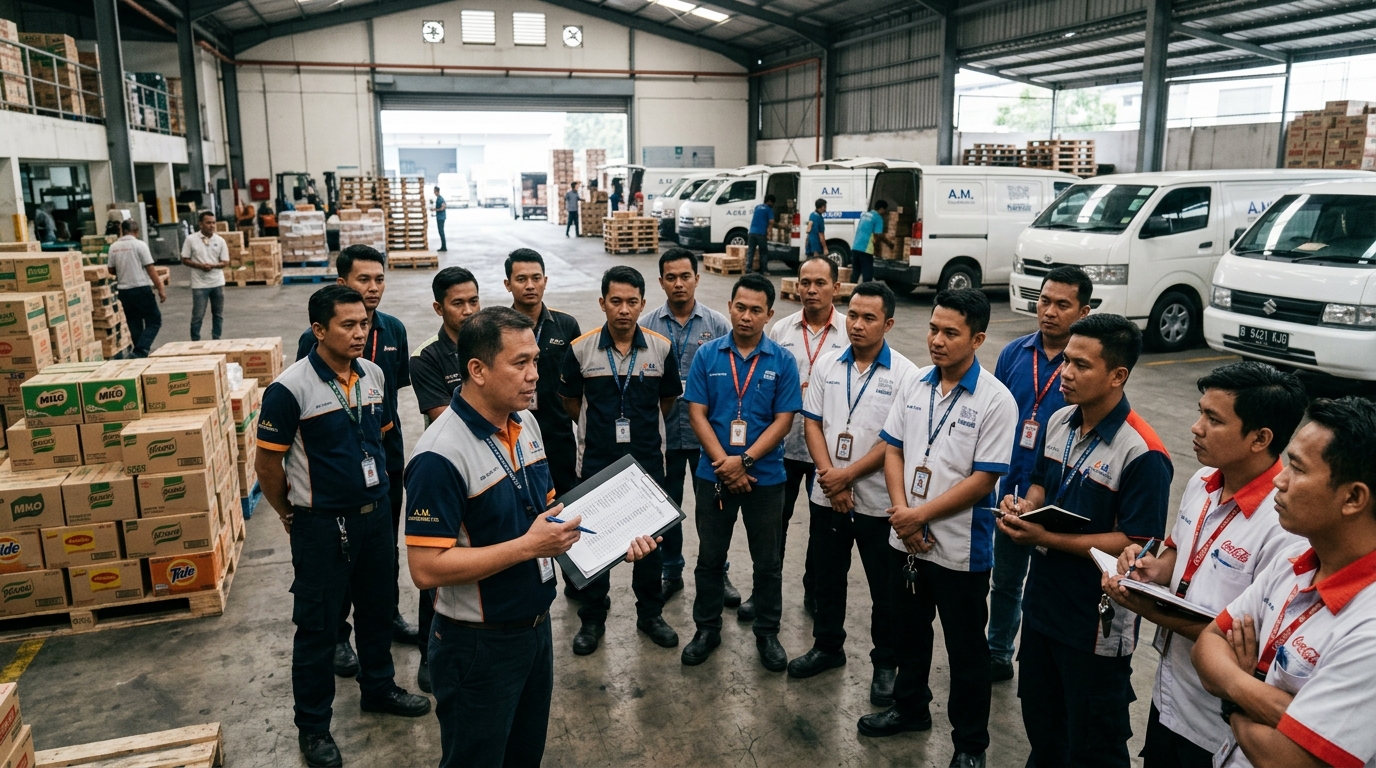
This is also the right moment to look at yesterday’s numbers, but to look at them in context rather than as decoration for a morning meeting. A salesman who achieved 95 percent of target may sound respectable until you discover that his strike rate is declining, his productive outlet count is shrinking and most of his volume came from three unusually large customers. Another salesman may only be at 88 percent but could be building a healthier territory by opening new outlets, increasing distribution and improving assortment in existing customers. One number almost never tells the full story, although many sales meetings continue to behave as if it does. A supervisor who understands the field looks beyond the headline number and asks what is underneath it.
Clear Daily Priorities Over Motivational Speeches
By eight o’clock, the morning briefing should be finished. It does not need to become a motivational seminar with inspirational quotes, applause and somebody shouting that this is our month. Ten focused minutes are usually enough if the objective is clear. The important thing is to give each salesperson one or two measurable priorities for the day. “Sell more” is not a useful instruction, and neither is “push harder,” unless the company recently diversified into motivational posters. A much better instruction would be to place a particular SKU in five outlets that do not currently stock it, reactivate three customers who have not ordered in the last month, improve average order size among the top twenty outlets or correct a specific availability problem in a priority area. Clear instructions create measurable behaviour, while vague encouragement usually creates vague results.
Observe the Routine Before You Manage
Once the supervisor joins the salesman in the field, the temptation is to start managing immediately. That is usually a mistake. At the first few outlets, the best thing the supervisor can do is observe how the salesperson actually works when he is left to his normal routine. Does he check existing stock before taking an order? Does he look at competitor products? Does he notice that the shop has space for another SKU? Does he understand the retailer’s sales pattern, or does he simply ask how many cartons are needed today and accept whatever answer he gets? Does he know which products have not been ordered recently? Does he check whether the previous delivery arrived correctly? These are basic things, but they reveal far more about sales quality than a polished answer in a Monday morning meeting.
This matters because many sales managers end up coaching the performance they imagine rather than the behaviour that is actually happening. A salesperson may insist that retailers are refusing a certain SKU because the price is too high, yet after visiting six stores the supervisor may discover that the salesman never actually offers it. Suddenly the pricing problem looks rather different. The same applies to complaints about difficult customers, slow-moving packs, competitor dominance and supposedly impossible routes. In the office, all of these problems can sound reasonable. In the field, quite a few of them fall apart within twenty minutes.
Retailers themselves are one of the most useful sources of information in FMCG, provided you speak to them like people rather than treating them as human survey forms. A few natural questions can uncover more than another spreadsheet ever will. Ask what is selling quickly, what regularly runs out, which products customers ask for, whether deliveries arrive when expected and what competing suppliers are doing differently. Very often you will hear things that never make it into the weekly report. A competitor visits twice a week while your salesperson comes once. A smaller pack is popular but constantly unavailable. A retailer stopped ordering one line because three cartons arrived close to expiry. A competitor installed a simple display rack and suddenly dominates the counter. Your own salesman keeps offering the same two SKUs even though the store could comfortably carry six. None of this is sophisticated, which is exactly why it is useful.
Route Quality Over Route Completion
The next task is to understand whether the problem is really sales, or whether it is execution. Those two things are often treated as if they are identical, even though the solution can be completely different. Suppose a product is underperforming in an area. The easiest conclusion is that the sales team needs to sell harder, but perhaps the product is frequently unavailable at the distributor, perhaps it is available but not reaching the right outlets, or perhaps it is technically listed but sitting behind a stack of instant noodles where no consumer can see it. The retailer may have the product but the price could be wrong, or the wrong pack size may be pushed into the wrong type of outlet. In all of those cases, telling the salesman to work harder does very little. A supervisor standing inside the outlet can see these issues immediately, while a spreadsheet cannot.
This is why route quality is more important than route completion. Some organisations become obsessed with whether the salesperson visited twenty-five planned outlets, as though simply entering the building were itself a commercial achievement. The more useful question is what happened in those twenty-five outlets. Were they productive calls? Was the right assortment available? Were there missed distribution opportunities? Were previously inactive stores reactivated? Did average order size improve? Did the salesperson notice new outlets nearby that should be added to the route? A route should guide the work, not imprison it. If a salesperson repeatedly drives past a cluster of growing stores because they were not included in a route designed three years ago, the correct response is not to admire his discipline. The route needs fixing.
Around lunchtime, it is useful to stop for fifteen minutes and review what the morning has actually revealed rather than blindly continuing with the original plan. Look at calls completed, productive calls, strike rate, order values, new distribution and any obvious problems that have surfaced. If the salesman is excellent at taking repeat orders but weak at opening new outlets, the afternoon should probably focus on prospecting. If the real problem is poor assortment, spend the afternoon improving SKU penetration in existing customers. If one competitor appears unusually strong in a particular neighbourhood, go there and find out why. The territory should determine the fieldwork, not the calendar entry that was created earlier in the week.
Real Coaching: Making the Salesperson Better Tomorrow
Coaching is another area where supervisors can accidentally make their salespeople worse while believing they are helping. One common mistake is taking over every difficult conversation. The salesman struggles, the supervisor steps in, closes the order and walks out feeling satisfied because the customer bought something. Commercially, the outlet visit may have worked, but developmentally the salesman has learned very little other than that his manager will rescue him whenever things become difficult. A much better approach is to let the salesperson complete the interaction and then discuss it outside the outlet. Ask what he thought went well, what the retailer was concerned about and what he would do differently next time. Give one or two specific pieces of feedback instead of delivering a twelve-point lecture beside the motorbike, and if necessary demonstrate the technique in the next outlet before making the salesperson try it himself. The supervisor’s job is not to prove that he is the best salesman in the territory. His job is to make every salesperson in the territory better.
Hunting for Lost Sales and Physical Execution
By mid-afternoon, a strong supervisor should deliberately start looking for lost sales rather than only following the business that already exists. This is often where the most valuable opportunities are hiding. Visit a good outlet that suddenly stopped buying. Visit a large store with unusually low sales. Visit an area where a competitor is visibly stronger. Look at outlets carrying only one or two of your products when similar stores are selling five or six. When you find the gap, ask why and keep asking until the answer makes sense. The salesman may not be visiting frequently enough, the distributor may have delivery problems, a promotional promise may not have been honoured, or the retailer may have received damaged stock or repeated short deliveries. Sometimes the competitor is simply doing a better job. None of these answers are comfortable, but fieldwork is not supposed to be comfortable. It is supposed to reveal what is actually happening.
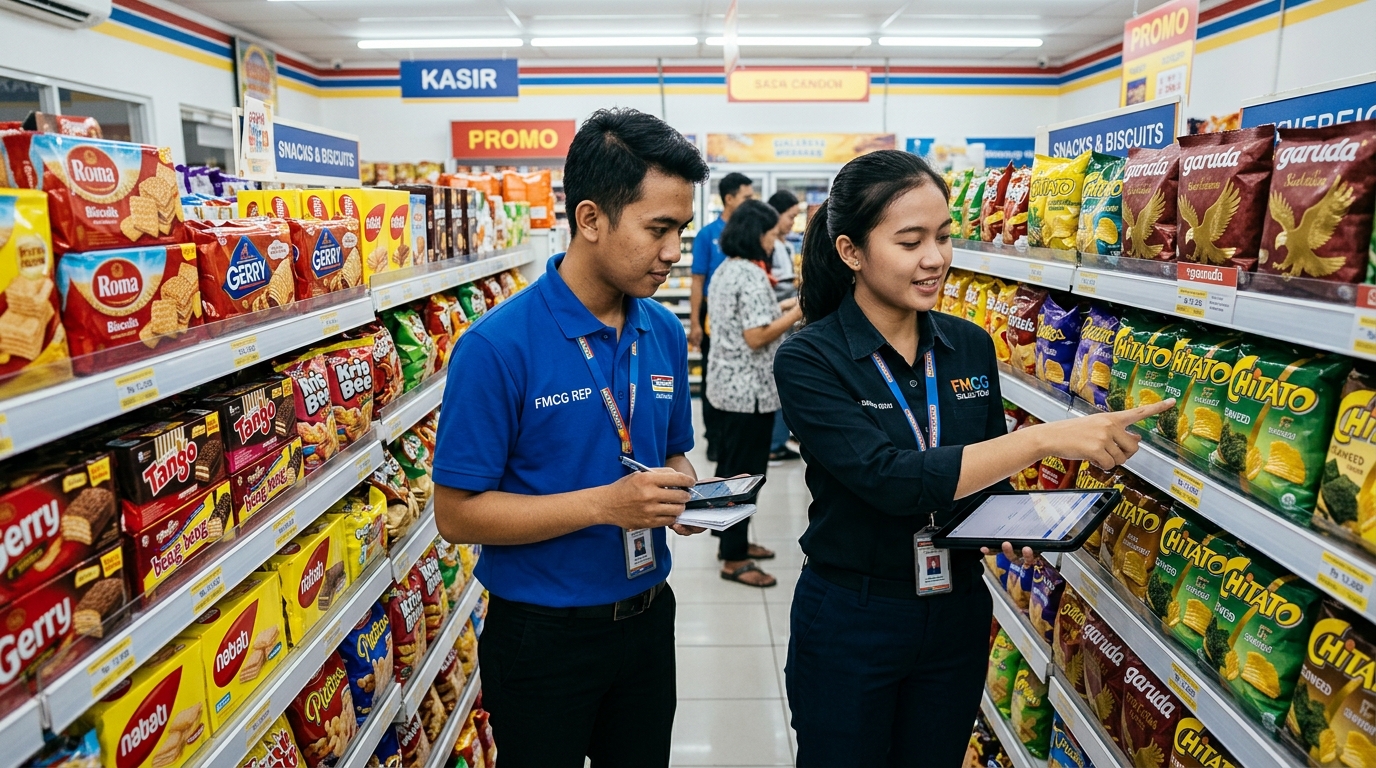
Physical execution also deserves more attention than it usually gets because sales teams are very fond of reporting that a product is available. Availability, however, can mean almost anything. A dusty pack on the bottom shelf behind the cashier technically qualifies as available, but it is unlikely to perform like a properly displayed product at eye level with a clear price. The supervisor should therefore look at the shelf, the chiller, the back room where relevant, the expiry date, the price, the facings and the competitor presence. If a salesperson says the product is there, ask him to show you exactly where it is. The difference between theoretical distribution and useful distribution is often painfully obvious once you are standing in front of the shelf.
Returning to the Distributor: Closing the Operational Loop
By around four o’clock, it is time to return to the distributor, but the day is not finished. In fact, some of the most useful learning comes from comparing what happened in the field with what happened operationally. Check the orders, the rejected orders and anything that could not be delivered. Compare what the salesperson attempted to sell with what the distributor actually had available. Look at returns and damaged stock. If the sales team keeps being blamed for weak distribution while the warehouse has been out of a key SKU for nine days, you have discovered a management problem rather than a salesman problem. This is exactly why field supervision cannot be reduced to simply watching somebody take orders.
The day should end with a short coaching review and a clear action for tomorrow. There is no need to produce an essay about the salesperson’s personality. Identify something that worked, something that needs improvement and something measurable that should happen next. A salesman may have excellent retailer relationships but weak SKU penetration, in which case tomorrow’s target could be ten additional listings of a priority product. Another may have good distribution but a weak productive-call ratio, so his focus should be improving strike rate rather than simply making more visits. Specific behaviour can be improved; general encouragement usually cannot.
The supervisor should also complete his own field report, but this does not need to become another administrative monument. A three-page form with fifty-seven boxes does not automatically create insight. The report should answer a few useful questions: what did we learn today, where are we losing sales, what did we fix immediately, what requires action from the distributor or ASM, and what should we check again tomorrow or next week? Calls planned and completed, productive calls, strike rate, new outlets, SKU distribution gains, out-of-stocks, average order value and competitor activity are all worth tracking, but the numbers only matter when they lead to action. If seven out-of-stocks were found and only five were corrected, somebody should own the remaining two. If twelve outlets were missing a priority SKU, there should be a plan to close that gap. If five retailers complained about late delivery, the problem should not quietly disappear into the report.
This is ultimately the difference between fieldwork and sightseeing. A good field supervisor should return at the end of the day with a slightly better territory than the one he left in the morning. Perhaps five more stores carry the right SKU, perhaps a weak salesman has learned a better way to sell, perhaps a broken route has been redesigned, or perhaps a distributor has finally been confronted with a service issue everybody had been quietly tolerating. None of those improvements need to be dramatic. FMCG businesses are rarely transformed by one brilliant speech at the annual sales conference. They are usually improved through hundreds of small corrections made every day in warehouses, vans, warungs, minimarkets, wholesalers and neighbourhood stores.
That is why good field management matters so much. The supervisor does not need to spend the day proving that he can sell better than his salesman. He needs to understand the territory better than anyone else, identify what is preventing growth and make sure tomorrow’s execution is better than today’s. If the field day achieves that, it was worthwhile, and if it does not, then at least the coffee was probably good.
A Simple Field Working Sheet
A practical supervisor does not need a complicated dashboard in the field. A one-page working sheet is enough if it forces the right observations and creates follow-up. Track calls planned versus completed, productive calls, strike rate, average order value, new productive outlets, out-of-stocks found and corrected, missing priority SKUs, new SKU placements and important competitor activity. Add a short section for problems requiring distributor or ASM action and another for the salesperson’s coaching priority.
The exact format matters less than the discipline behind it. At the end of the day, the supervisor should be able to look at that page and explain clearly what changed because he went into the market, what still needs to change and who owns the next action. That is a much better measure of field productivity than kilometres driven, photos taken or the number of stores somebody managed to walk into.
Tools for this topic
View shopFMCG Growth Systems (Hardcover)
A tactical leadership guide for building scalable FMCG growth engines.
Commercial Execution Tee
Soft cotton tee celebrating disciplined FMCG execution.
FMCG by Alex Notebook
Dot-grid strategy notebook for planning weekly commercial priorities.
Related content
The 30-Store Trap: Why FMCG Growth Comes From Developing Existing Outlets, Not Just Visiting More of Them
Visiting 30 outlets a day is easy to measure, but real FMCG growth happens inside the store. Here is how field salespeople move beyond basic replenishment, overcome 'Masih ada stok, Mas,' and expand from one SKU to eight in Indonesian general trade.
Growth Has Stalled. The Factory Still Opens Monday.
What an Area Sales Manager can actually do when the business stops growing. Operational field tactics for routes, store availability, shelf capacity, and trade spend.
The Product Is Everywhere. So Why Is It Always Out of Stock?
Why distribution, availability, and being able to actually buy the product are not the same thing. How out-of-stocks silently destroy FMCG sales while internal dashboards stay green.
How to Build a Better FMCG Route-to-Market
Designing channel roles, distributor economics, and service levels in one RTM framework.