
The 30-Store Trap: Why FMCG Growth Comes From Developing Existing Outlets, Not Just Visiting More of Them
Visiting 30 outlets a day is easy to measure, but real FMCG growth happens inside the store. Here is how field salespeople move beyond basic replenishment, overcome 'Masih ada stok, Mas,' and expand from one SKU to eight in Indonesian general trade.

The 30-Store Trap: Why FMCG Growth Comes From Developing Existing Outlets, Not Just Visiting More of Them
It's five o'clock on a Thursday afternoon somewhere in Bekasi. The traffic is dreadful, your shirt has been soaked in sweat since lunchtime, your motorcycle has developed a worrying mechanical noise, and you've finally finished visiting the 30 outlets on today's route. You've discussed the weather, the rising cost of living, the latest neighborhood gossip and, in one particularly memorable warung, the shopkeeper's ongoing disagreement with his brother-in-law. You've probably consumed more sweet coffee than any doctor would recommend, and your sales application confirms that you've completed every scheduled visit. Your supervisor should be delighted.
Unfortunately, there's a rather awkward detail buried in those impressive activity numbers. Only 12 of the 30 stores actually placed an order. You've achieved a productive-call rate of 40%, which may or may not be acceptable depending on your territory, the frequency of your visits and the type of outlets you're servicing. What matters is understanding why the other 18 stores didn't buy anything and, perhaps more importantly, whether you're doing enough to develop the stores that did.
This is where many FMCG sales organizations make a fundamental mistake. They become obsessed with how many outlets their salespeople visit and how many of those visits generate an invoice, without paying nearly enough attention to what is happening inside the outlets themselves. A salesman can visit the same 30 stores every week, collect modest replenishment orders for the same three products and faithfully hit his call target for months without making much progress in developing the business. Meanwhile, the retailers may be selling dozens of competing products in categories his company could quite comfortably supply.
The opportunity isn't necessarily to find another 30 stores. It may be to become a considerably more important supplier to the 30 you already serve.
First, Understand Why the Retailer Isn't Ordering
Anyone who has spent time selling consumer products in Indonesia's general trade knows the familiar phrase "Masih ada stok, Mas." The shopkeeper still has stock, thank you very much, and apparently sees no particular reason to buy more today. For an inexperienced salesman, this often ends the conversation. He marks the outlet as unproductive, climbs back onto his motorcycle and continues to the next shop, relieved that at least the visit didn't take too long.
An experienced salesman knows that having stock and having sufficient stock are two entirely different things. A shopkeeper might have 20 coffee sachets hanging beside the counter, but if he's selling ten a day and the next delivery is four days away, he's heading for an out-of-stock situation long before the salesman returns. On the other hand, if he's selling only two sachets a day, there's little justification for pushing another carton onto his shelves. The difference can only be established by understanding how quickly products are moving, what inventory is actually available and when the retailer can realistically expect another delivery.
This doesn't require an elaborate analytics platform or a degree in supply-chain management. A few sensible questions, a quick look at the shelves and some basic arithmetic will usually give you a reasonable starting point. Ask how many units the retailer sells on an average day, check how much stock remains, account for any inventory in the back room and calculate what he'll probably need until the next replenishment. If the store sells ten sachets daily, has 15 remaining and won't receive another delivery for five days, there's a reasonable case for suggesting additional stock. If the wholesaler has already delivered three cartons that morning, there's probably less of one.
The point is that you're no longer asking the retailer whether he wants to buy something. You're helping him work out what he needs to avoid losing sales. That changes the relationship from somebody trying to push cartons into a store to somebody helping the owner manage his business. It also makes your suggested order considerably more credible than simply asking for another two cartons because your monthly target is looking uncomfortable.
Of course, there will be retailers who genuinely cannot afford another order, have accumulated too much inventory or are unhappy because the previous delivery arrived late. Those issues require different solutions, and a good salesman should be able to distinguish between them. Pressuring a cash-strapped shopkeeper into taking unnecessary stock might improve today's invoice total, but it can damage the relationship and make the next sale considerably harder.
Getting Your Foot in the Door Is Only the Beginning
One of the biggest missed opportunities in field sales is the assumption that once an outlet has started buying, the job is largely done. You've opened the account, introduced the product and secured a repeat order, so it's time to move on to the next prospect. Unfortunately, that approach leaves an enormous amount of potential business sitting on the shelf, usually in the form of competing brands that the retailer is perfectly happy to continue selling.
Imagine you're introducing a new range of affordable powdered milk products to traditional retail outlets in East Java. Your company has eight different SKUs, covering several pack sizes, flavors and consumer needs. The enthusiastic salesman, armed with his product catalogue and a sales target, walks into a small warung and attempts to convince the owner to take all eight products immediately. He talks about the brand's quality, the marketing campaign, the available trade promotion and the impressive distribution ambitions announced by headquarters.
The shopkeeper, who has never heard of the brand and has limited space and working capital, quite reasonably wonders why he should invest his money in eight unfamiliar products when he doesn't even know whether his customers will buy one.
A better approach is to start with the product most likely to succeed in that particular outlet. Perhaps it's a low-priced milk powder sachet that fits the purchasing power of the surrounding neighborhood, competes in an established category and requires relatively little initial investment. You explain the retail margin, recommend a manageable opening quantity, agree on a sensible display position and give the product an opportunity to prove itself.
Then you return and find out what actually happened.
If the retailer sold most of his opening stock, that's encouraging. You now have something substantially more persuasive than a product presentation: actual evidence that his customers are willing to buy your brand. Rather than immediately trying to triple the order, you make sure the product is being replenished consistently and that its sales are repeatable. A strong first week is useful, but several consecutive replenishment cycles tell a much more convincing story.
Once the first SKU has demonstrated reliable movement, you have earned the right to introduce the second.
This is the point where effective field sales becomes genuine account development rather than endless order taking.
One SKU Becomes Two, Then Four, Then Eight
The most successful FMCG salespeople understand that expanding the assortment within an existing outlet is a gradual process. Retailers become more willing to allocate shelf space and working capital to your products as those products demonstrate that they can sell. The first SKU is therefore not simply a transaction; it's the beginning of a relationship that can become considerably more valuable over time.
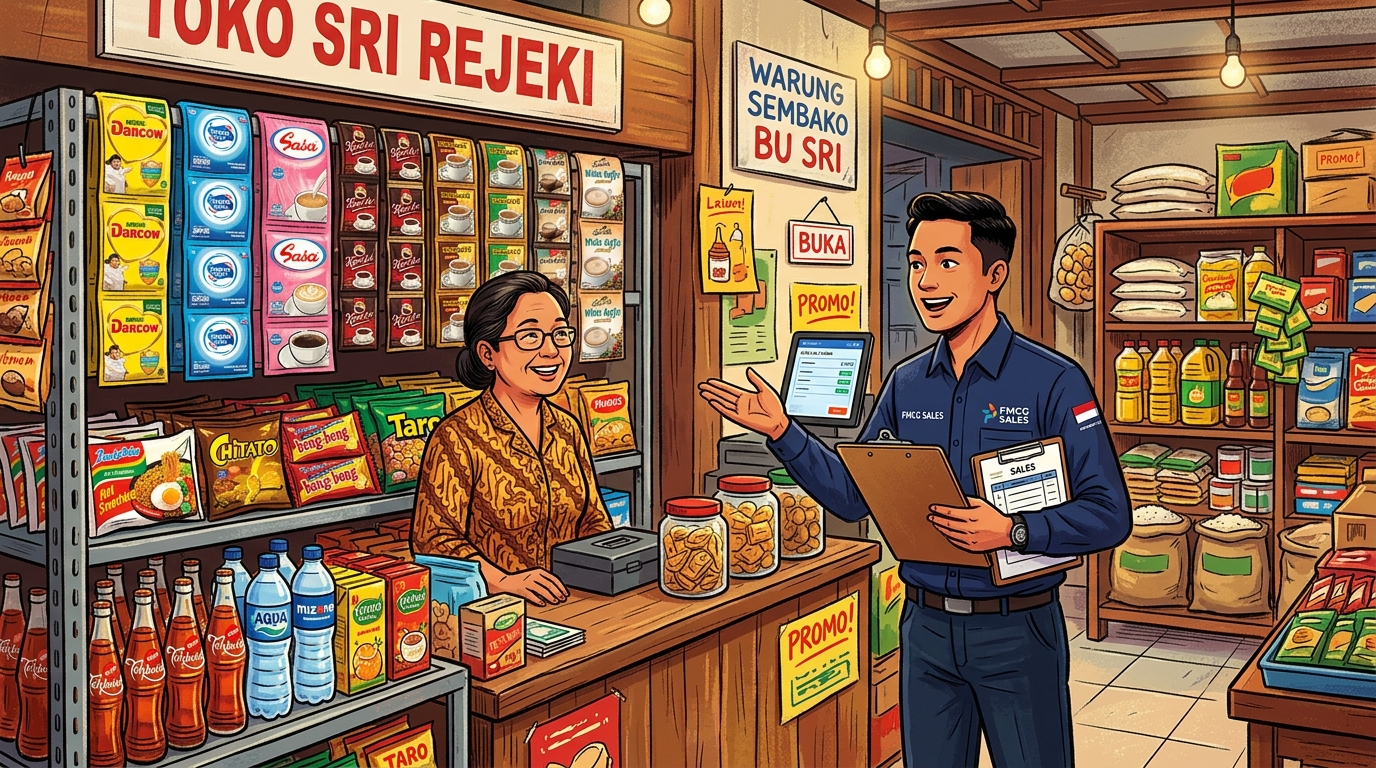
Let's stay with our powdered milk example. During the first few weeks, the retailer begins selling your entry-level sachet and discovers that customers are returning to buy it again. The product isn't necessarily flying off the shelves, but it's moving consistently, the margin is acceptable and replenishment has been reliable. At this stage, the salesman might suggest adding a second SKU, perhaps another flavor or a slightly larger pack size aimed at customers with different purchasing habits. Crucially, the recommendation should be based on what the shop's customers are likely to buy, not whichever product the company is currently most desperate to push.
If the second SKU also performs well, the next opportunity might be to introduce a family-sized pack, a complementary product or another variant that addresses a different consumer occasion. Over the following months, the assortment can expand from two products to four, perhaps eventually to six or eight, provided that each additional SKU earns its place through genuine consumer demand.
There is no magic number of weeks between introductions, and certainly no rule that every outlet must eventually carry the entire catalogue. A high-volume neighborhood minimarket may justify a much broader assortment than a tiny roadside kiosk, while some specialist outlets will never be suitable for more than one or two products. The objective is to build the broadest commercially sensible assortment for each store, not to achieve distribution figures that look impressive in a presentation but generate negligible sales.
This distinction matters because every new SKU competes for something the retailer has in limited supply: cash, shelf space and attention. Introducing another product is justified when it creates additional sales or profit opportunities, serves a different customer need or strengthens the overall category. It is considerably less useful when it simply divides the same demand between two almost identical products, leaving the shopkeeper with twice as much inventory and no meaningful increase in revenue.
A good salesman builds the assortment one successful product at a time. He doesn't dump the catalogue on the counter and hope for the best.
The Mathematics of Growing an Existing Account
Consider an illustrative outlet selling an average of 12 units of your first SKU each day. At an assumed wholesale selling price of IDR 3,000 per unit, that represents approximately IDR 1,080,000 in monthly purchases over a 30-day period. It's a modest account, but the product is moving and the retailer is ordering regularly.
After a period of consistent sell-through, you introduce a second SKU that develops demand of eight units per day. A third product eventually reaches six units daily, while a fourth achieves five. Assuming the same selling price across all four products, the account could now be purchasing around IDR 2,790,000 per month rather than IDR 1,080,000.
That's almost 2.6 times the original monthly sales value from the same outlet, without adding another shop to the route.
Naturally, reality is rarely this tidy. Different SKUs have different prices, margins, pack sizes and rates of sale. Some new products will cannibalize existing sales, while others will fail to attract meaningful consumer demand. These figures are an illustration of the potential, not a promise that every additional SKU creates entirely incremental revenue. The salesman should monitor total category sales and retailer profitability rather than simply celebrating the arrival of another product on the shelf.
Still, the commercial logic is compelling. If you have 100 existing outlets buying only one or two SKUs, developing a suitable broader assortment in those accounts can create substantial additional turnover without the time and expense involved in opening 100 new outlets. It can also improve delivery economics, strengthen customer relationships and make your brand more relevant to retailers.
That doesn't mean you should stop opening new stores. Numerical distribution remains important, especially while building a young brand. But numerical distribution tells only part of the story. The number of outlets stocking your products matters, while the number of relevant SKUs stocked within those outlets, their availability and their actual rate of sale determine how productive that distribution becomes.
A salesman who opens ten new accounts but never develops them may eventually contribute less than a colleague who opens five and systematically builds each one into a strong, repeat-ordering customer.
Don't Introduce Your Next SKU Until You've Learned Something From the Previous One
There's a temptation, especially when management introduces an aggressive distribution target, to treat every new SKU listing as a victory. The salesman persuades the shopkeeper to take one pack of a new product, enters the distribution achievement into the system and moves on. Headquarters celebrates another successful launch, while the product remains on the shelf for the next six months until somebody notices that the packaging is fading.
That isn't meaningful distribution. It's inventory relocation.
Before introducing another SKU, a salesman should understand how the existing products are performing. Which ones are moving quickly? Which sizes or flavors are most popular? Are customers purchasing the products repeatedly or was the initial order driven by curiosity or a temporary promotion? Has the retailer experienced any complaints, quality issues or delivery problems? Are products visible and correctly priced, or are they buried behind competing brands?
These questions don't need to turn every shop visit into a formal retail audit, but they should be part of the salesman's normal conversation. The answers provide a much better basis for introducing the next product than simply following the order in which the SKUs appear in the catalogue.
If a small warung is selling your chocolate milk sachet successfully, perhaps a vanilla variant is the logical next introduction. If the neighborhood consists largely of families purchasing larger quantities, a family pack may offer better potential. If the retailer's customers are extremely price-sensitive, another premium variant could be entirely inappropriate, regardless of how enthusiastically your marketing department describes it.
The right assortment develops from the consumer upward, not from headquarters downward.
And remember that a product which performs poorly in one outlet may be perfectly suitable for another. Field sales requires judgment, local knowledge and the ability to recognize differences between stores, even when they belong to the same general-trade classification.
Your Best Source of New Business May Already Be Standing Behind the Counter
Retailers know things that your market research department might take months to discover. They hear customers asking for particular products, notice when purchasing habits change and understand which price points are becoming difficult for their regular shoppers. They also know which competing brands are selling well, which products customers complain about and which promotional gimmicks actually influence purchasing decisions.
Unfortunately, many salespeople spend so much time talking about their own products that they forget to listen.
Suppose a shopkeeper tells you that customers increasingly ask for smaller packs because household budgets are tight. That's useful information. If your company offers a smaller format, you have a natural opportunity to introduce it. If customers are repeatedly asking for a larger family pack, that might justify broadening the assortment in the opposite direction.
Perhaps the retailer mentions that a competitor's new flavor is selling surprisingly well. Rather than launching into a speech about why your brand is superior, investigate what makes that product attractive. Is it the price, packaging, taste, promotional support or simply the fact that somebody bothered to put it near the cashier?
The answers can help you identify which additional SKUs from your own portfolio have a realistic chance of succeeding.
They may also reveal opportunities beyond your immediate product range, providing useful feedback to your supervisor or company about gaps in the assortment. A manufacturer or distributor that consistently listens to field intelligence has a considerable advantage over one that relies entirely on market reports and PowerPoint forecasts.
Good field salespeople aren't just selling. They're gathering commercial intelligence every day, often from the people closest to the final consumer.
The Shelf Is Where Your Sales Strategy Meets Reality
Securing an order for an additional SKU is only half the job. The product still needs to be displayed, priced and made available where consumers can find it. A retailer might agree to stock your new beverage, but if the bottles remain in a carton beneath the counter while three competing brands occupy the refrigerator at eye level, the probability of spectacular sales is limited.
Traditional trade merchandising doesn't always offer the neat planograms and generous display budgets associated with modern retail. Space is cramped, categories are mixed together and shopkeepers have their own ideas about where products belong. Yet even small improvements can make a difference.
A salesman should check whether the product is visible, whether the price is clear and whether the retailer understands which customers are most likely to buy it. If you're introducing a new flavor, placing it beside a successful existing SKU may make more sense than hiding it in an unrelated corner. If you're introducing a complementary product, consider whether there's a natural opportunity to display both together.
The trick is to make the growing assortment easier to sell, not simply larger.
As your products establish themselves, you may also earn better positioning within the store. Retailers are usually more receptive to merchandising suggestions from suppliers whose products generate regular turnover and reasonable margins. That trust should be developed gradually, just like the assortment itself.
Of course, any display arrangements must respect the retailer's preferences and your company's commercial policies. Promising expensive equipment or unauthorized incentives in exchange for shelf space is a particularly efficient way to create problems for yourself later.
Not Every Unproductive Call Is a Failed Call
Let's return to our salesman in Bekasi and his 18 stores that didn't order. The temptation is to assume that he needs to become more persuasive, work harder or perhaps undergo another sales training session involving motivational slogans and a surprisingly large number of PowerPoint slides.
But imagine we examine those calls properly. Five retailers genuinely have sufficient stock because their delivery cycles don't align well with the visit schedule. Four have stock, but the salesman never checked whether it would last until the next delivery. Three are dealing with cash-flow difficulties, two have unresolved service complaints, two have assortment gaps that nobody has investigated and another two were closed or had no decision-maker available.
Suddenly, the problem looks considerably more interesting.
The four outlets with uncertain stock positions are obvious candidates for better inventory assessment and suggested orders. The two stores with assortment gaps might represent opportunities to introduce additional SKUs rather than merely asking for another carton of whatever they're already buying. The outlets with delivery complaints need practical service recovery, while those with genuine excess stock may require different visit frequencies.
In other words, the answer isn't necessarily more visits. It's better preparation, better conversations and a more deliberate approach to developing every account.
Suppose our salesman improves his immediate productive-call rate from 12 out of 30 to 16 out of 30 by identifying justified replenishment opportunities and resolving operational problems. That's an improvement from 40% to roughly 53%. Useful progress, certainly, but the larger opportunity may still be hiding in the 12 stores that already buy regularly.
How many SKUs do those stores carry? Which products have established reliable sell-through? Which additional items from your portfolio would genuinely suit their customers? How much more business could those outlets generate over the next three or six months if the salesman developed them systematically?
Those questions deserve as much management attention as the number of stores visited.
A Territory Should Become More Valuable With Time
Think about two salesmen managing similar territories. Both begin with 100 active outlets and an average of two SKUs per store. Both visit their customers regularly, maintain reasonable relationships and achieve acceptable replenishment rates.
The first salesman continues doing what he's always done. He takes repeat orders for the existing products, occasionally introduces a promotion and opens a few new outlets when instructed to do so. Six months later, most of his customers are still purchasing the same two SKUs.
The second salesman takes a more deliberate approach. He identifies the strongest-performing products in each outlet, works to establish consistent replenishment, and gradually introduces suitable additional SKUs once the existing assortment has demonstrated traction. He doesn't force every product into every store, and he recognizes that some outlets have limited potential. But he consistently looks for opportunities to increase the commercial value of each relationship.
Six months later, perhaps his average active assortment has increased from two to four SKUs per outlet. Not every new SKU will have succeeded, and the increase in revenue won't necessarily match the increase in SKU count. Nevertheless, if the additions are genuinely incremental and the existing products continue selling, his territory has become substantially more productive without requiring a corresponding increase in the number of stores visited.
This is why effective FMCG sales management should look beyond simple numeric distribution. Weighted distribution where meaningful, average active SKUs per outlet, repeat-order frequency, sales per productive outlet, availability, gross margin and stock movement all help build a more complete understanding of territory performance.
Even average SKU penetration needs to be interpreted carefully. Eight slow-moving SKUs sitting on a shelf are not necessarily better than four products that sell through reliably every week. The objective isn't to fill the store with as much of your catalogue as possible. It's to earn a progressively larger, profitable share of the retailer's business by supplying products his customers actually want.
A healthy territory should mature over time. Existing customers should become more productive, the assortment should become better suited to local demand, service levels should improve and retailers should increasingly regard your company as a reliable supplier rather than just another salesman appearing at the door.
That's how lasting distribution is built.
And Please, Stop Treating Month-End as an Excuse to Fill Every Storeroom
Anyone who has worked in FMCG long enough knows what happens when the final week of the month arrives and the sales target remains stubbornly out of reach. Suddenly, products that were selling at a perfectly sensible rate are apparently capable of moving twice as quickly. Retailers are encouraged to take another few cartons, promotional schemes become increasingly creative and sales managers discover a remarkable ability to explain why everything will be fine next month.
Sometimes an unusually large order is completely justified. Perhaps a holiday is approaching, a major local event will increase demand or the customer is preparing for a genuine promotional opportunity. But increasing orders merely to bring forward future sales creates predictable problems.
The retailer ends up with excessive inventory, working capital becomes tied up in slow-moving products and the next replenishment order is delayed. If the products have limited shelf life, the situation becomes even less attractive. Meanwhile, the sales organization congratulates itself on a strong month and then spends the following month wondering why everybody suddenly stopped buying.
The same problem arises when salesmen are encouraged to introduce too many new SKUs before the previous ones have gained traction. A retailer may accept an initial order to maintain a good relationship, particularly if a discount is involved, but that doesn't mean consumers will purchase the products.
A disciplined salesman protects the retailer's ability to make money. He introduces products at a pace the store can absorb, monitors their performance and recommends replenishment based on realistic demand. He understands that the quality of distribution matters more than the number of cartons pushed into the channel.
After all, the ultimate purpose of FMCG distribution is to get products into consumers' hands, not to create an increasingly expensive collection of cardboard boxes in the back rooms of neighborhood shops.
What I Would Change Tomorrow Morning
If I were managing a field sales team tomorrow, I wouldn't begin by demanding another five visits per day or telling everybody to be more aggressive. I'd start by examining how well each salesman understands the outlets already on his route. Does he know which SKUs each store carries, which products sell consistently and which have been sitting on the shelf for weeks? Does he understand how frequently the customer needs replenishment, what the retailer's main objections are and which additional products from our portfolio might be commercially suitable?
I'd also want every salesman to identify a manageable number of existing accounts with genuine assortment-development potential. Not necessarily the biggest stores or those with the friendliest owners, but outlets where our current products are selling reliably and where additional SKUs could address an identifiable customer need. The next step would be to introduce one carefully chosen product, support its launch properly and monitor the resulting sales before recommending another.
For new accounts, I'd encourage the team to begin with a focused assortment rather than attempting to sell everything at once. Win the first order, help the retailer achieve sell-through, earn the second order and establish trust. Once those foundations exist, gradually broaden the range. The pace should reflect the outlet's actual performance, not an arbitrary timetable imposed by headquarters.
And for the stores that repeatedly fail to order, I'd want clear explanations rather than generic entries such as "no stock needed" or "customer not interested." There's a considerable difference between a retailer who has sufficient inventory, one who doesn't understand the product proposition and one who's stopped ordering because the distributor has repeatedly failed to deliver what was promised.
None of this is revolutionary. It is simply the discipline of understanding customers, managing inventory sensibly and developing business relationships over time. Yet it's remarkable how frequently these fundamentals disappear beneath mountains of sales reports, promotional targets and daily activity dashboards.
The Real Measure of a Good Field Salesman
FMCG field sales isn't a glamorous occupation. You spend long days in traffic, deal with difficult weather, occasionally encounter retailers whose expectations have very little relationship with commercial reality, and somehow remain responsible for sales targets that always seem to increase faster than your salary.
But the job is considerably more important than many people sitting in comfortable offices appreciate. A company can spend millions developing a product, creating attractive packaging, negotiating with distributors and commissioning elaborate advertising campaigns. None of it delivers much value if the product isn't available in the stores where consumers want to buy it, or if those stores don't carry enough of the right assortment to satisfy demand.
The field salesman is the person who turns all that investment into something tangible. He wins the first listing, helps the retailer sell through the opening stock, establishes a reliable replenishment pattern and gradually introduces additional products as the relationship develops. Over time, a shop that began by buying one carton of one SKU can become a valuable customer purchasing a carefully selected range of products every week.
That's a much more rewarding achievement than simply persuading somebody to take an oversized opening order that will spend the next three months gathering dust.
So when you've visited your 30 stores tomorrow, don't judge the day exclusively by the number of completed calls or even the number of invoices generated. Ask yourself whether you've strengthened those customer relationships, improved product availability, identified opportunities to expand the assortment and made the outlets on your route more productive than they were last month.
If you can consistently achieve that, you're not merely taking orders. You're building distribution, developing market share and creating a territory that becomes more valuable with every passing month.
And if, six months from now, the shopkeeper who originally agreed to stock just one of your products is happily reordering six different SKUs because his customers keep buying them, you've accomplished something far more meaningful than ticking another box in the sales application.
You've built a customer worth keeping.
Tools for this topic
View shopFMCG Growth Systems (Hardcover)
A tactical leadership guide for building scalable FMCG growth engines.
Related content
Stop Riding Around With Your Salesman: How an Area Sales Supervisor Should Actually Spend a Day in the Field
A field visit only becomes valuable when something in the territory is actually better because the supervisor was there. Here is how FMCG area sales supervisors move from ceremonial ride-alongs to route quality, real coaching, and disciplined field execution.
The Product Is Everywhere. So Why Is It Always Out of Stock?
Why distribution, availability, and being able to actually buy the product are not the same thing. How out-of-stocks silently destroy FMCG sales while internal dashboards stay green.
Growth Has Stalled. The Factory Still Opens Monday.
What an Area Sales Manager can actually do when the business stops growing. Operational field tactics for routes, store availability, shelf capacity, and trade spend.
How to Build a Better FMCG Route-to-Market
Designing channel roles, distributor economics, and service levels in one RTM framework.