
Your Container Has Arrived. Your Customers Haven't: The Real Guide to Entering Indonesia's FMCG Market in 2027
Indonesia is one of the world's most attractive consumer markets, but getting a product into the country is considerably easier than getting consumers to buy it. From navigating BPOM and halal regulations and selecting distributors to understanding retail margins, building nationwide distribution and deciding when local manufacturing makes sense, entering Indonesia in 2027 requires much more than an enthusiastic export manager and a container full of optimism.
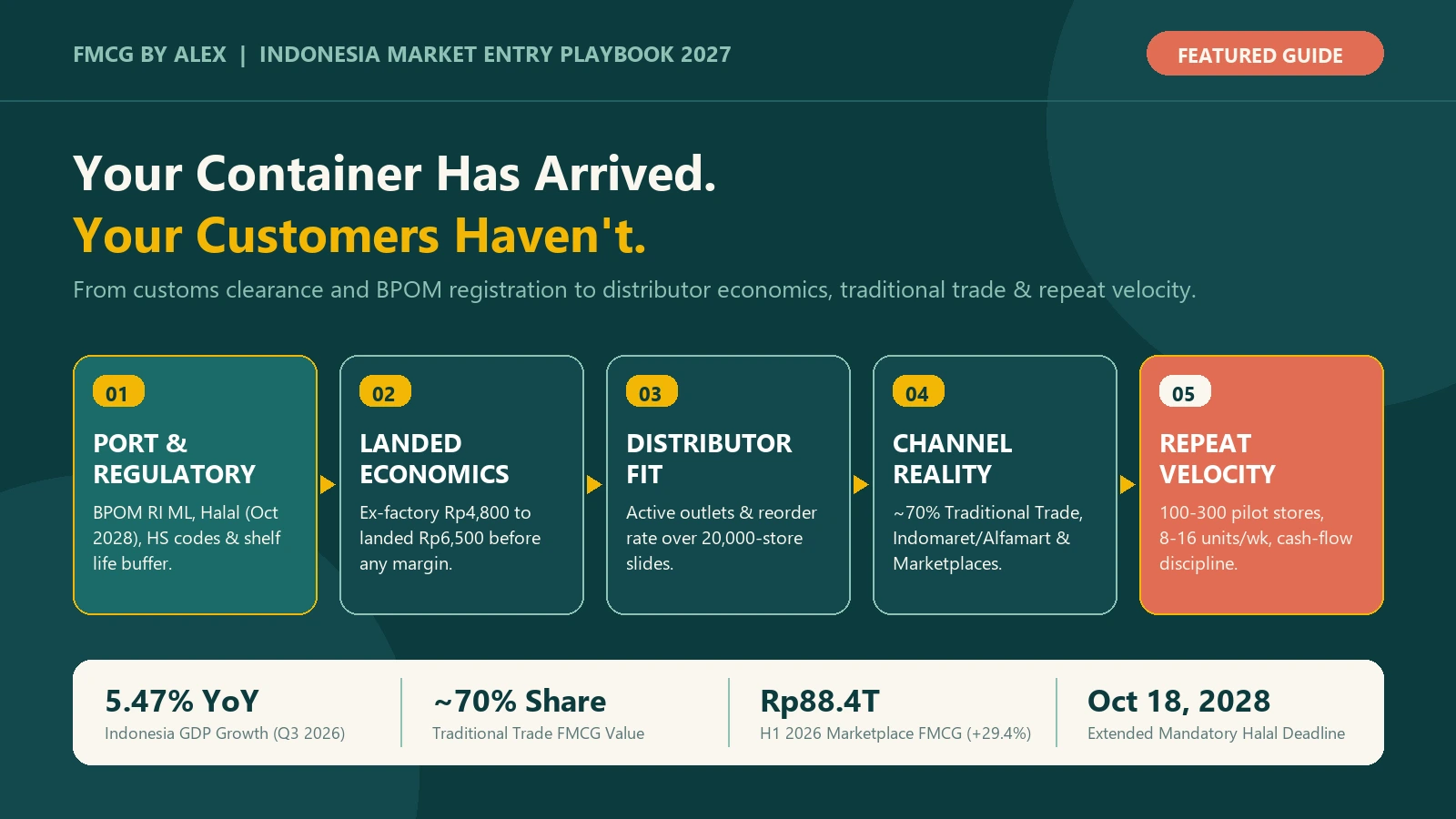
There is a particular moment in international business development when an overseas manufacturer decides that Indonesia should become its next big market. It usually happens somewhere between a promising conversation at an international trade exhibition and a presentation showing a population of more than 280 million people, steady economic growth and an apparently endless appetite for consumer products. The commercial director returns home enthusiastic, the export manager starts preparing samples, and somebody in finance calculates what capturing just 0.1% of the Indonesian market might mean for the company's annual turnover. Suddenly, everyone is discussing the possibility of adding several million dollars in revenue, and the managing director is wondering whether it might be time to visit Jakarta. On paper, the opportunity looks magnificent, particularly when the sales forecast consists of multiplying a very large population by a relatively small market share and an attractive selling price. Unfortunately, Indonesian consumers have not attended the presentation and are under no obligation to cooperate with its conclusions.
The first container eventually arrives, and the manufacturer discovers that selling products in Indonesia involves rather more than arranging international transportation. The importer is concerned about customs clearance, landed costs and working capital, the distributor wants sufficient margin to justify its investment, and the supermarket buyer has an entirely different opinion about what consumers will pay. The product registration process may have taken longer than anticipated, some packaging details need adjusting, and the first promotional campaign is consuming money considerably faster than it is generating repeat purchases. Meanwhile, the sales team proudly reports that hundreds of outlets have accepted the new product, although the next round of orders is proving somewhat less enthusiastic. Six months later, the manufacturer is asking why sales are disappointing, the distributor is requesting additional marketing support, and both parties are beginning to suspect that the other one does not fully understand the business. None of this means Indonesia is a bad market. Quite the opposite, but it does illustrate the fundamental difference between entering a country and developing a profitable consumer goods business within it.
Why Macroeconomic Growth Alone Does Not Sell Imported Products
Indonesia certainly provides plenty of reasons for international FMCG manufacturers to pay attention. The country's economy expanded by 5.47% year-on-year in the third quarter of 2026, according to Statistics Indonesia, while household consumption grew by approximately 5.04%. Domestic consumption remains a major component of economic activity, supporting enormous markets for food, beverages, personal care products, household necessities and other everyday consumer goods. Yet these economic figures tell us surprisingly little about whether an individual manufacturer can sell another imported chocolate bar, breakfast cereal or bottle of shampoo. Economic growth does not benefit every consumer equally, and consumer spending patterns vary considerably between income groups, regions and product categories. A country can experience healthy overall consumption growth while shoppers become more selective, trade down to cheaper brands or reduce the quantities they purchase in particular categories. In fact, Indonesian FMCG research during 2026 showed continued pressure on purchasing volumes even as market value and spending per shopping trip developed differently across retail channels. A manufacturer that looks only at population growth and macroeconomic indicators may therefore overlook what consumers are actually doing with their shopping budgets.
Category Reality and Affordability Come Before Population Math
The first serious exercise in entering Indonesia should consequently be understanding the category rather than admiring the country's population. Manufacturers need to examine how Indonesian consumers currently satisfy the need their product addresses, which brands they purchase, what those products cost, where consumers buy them and how frequently purchases are repeated. An Australian company exporting premium breakfast cereals, for example, might discover a commercially attractive group of urban consumers who already enjoy Western-style breakfasts and are prepared to spend more on imported products. That could be an excellent opportunity for selected supermarkets, specialist retailers, online marketplaces and hotels, but it would be rather ambitious to assume that millions of Indonesian households are waiting to abandon their traditional breakfasts. Similarly, a European confectionery manufacturer needs to understand local taste preferences, pack sizes, climate-related storage requirements and the purchasing occasions associated with its category. Chocolate that performs beautifully in an air-conditioned supermarket may present a rather different commercial proposition when it spends several hours in a delivery vehicle or sits in a small neighbourhood store without temperature control. The product may still succeed, but its route to market must reflect how Indonesians actually purchase and consume it.
Affordability is another consideration that frequently receives less attention than it deserves. International manufacturers tend to compare their products against competitors in their home markets, where consumers may have different incomes, shopping habits and expectations of value. An imported household cleaner that sells for the equivalent of Rp60,000 may appear reasonably priced compared with similar products in Europe, but Indonesian shoppers will compare it with the alternatives available in their local stores. If a trusted domestic product costs substantially less and performs adequately, the imported brand needs a convincing reason for consumers to pay the difference. Better ingredients, superior performance, distinctive fragrances, strong brand recognition or genuinely useful product characteristics may justify a premium, but simply being imported is rarely a sufficient long-term proposition. Packaging can also make an enormous difference. A manufacturer accustomed to selling large family packs may discover that smaller units allow consumers to purchase the product at more accessible price points, although smaller packaging can increase costs per kilogram and complicate production. Indonesia's long-established demand for affordable pack sizes and sachets illustrates how important accessible purchasing prices can be, but the correct format still depends on the category, intended consumer and economics of distribution. There is little point creating a cheaper-looking pack if its production and handling costs destroy the margin before it reaches the shelf.
Choosing a Commercial Presence: Importer-Distributor vs. PT PMA
Once the manufacturer understands the potential consumer, the next challenge is deciding how to establish a commercial presence. For many companies, working with an Indonesian importer and distributor is the most practical starting point because it provides access to local regulatory knowledge, commercial relationships, infrastructure and experienced personnel without immediately establishing an entire subsidiary. A capable partner can manage importation, handle the relevant product registration arrangements, arrange warehousing and introduce products to suitable retail customers. Depending on its capabilities, it may also provide merchandising, promotions, sales reporting and regional distribution. This arrangement can significantly reduce the complexity of market entry, but it transfers considerable influence over the brand's development to an external company. The manufacturer is relying on that partner to represent its products effectively, manage inventory responsibly and invest sufficient commercial effort in establishing consumer demand. Finding the right distributor is therefore one of the most consequential decisions in the entire process, and it deserves considerably more attention than simply choosing the company that expresses the greatest enthusiasm during the first meeting.
Indonesia has no shortage of businesses describing themselves as national distributors, although the definition of national coverage can vary somewhat. One company may operate an extensive network of branches, sales representatives, warehouses and regional partners, while another primarily supplies Jakarta and arranges occasional shipments to customers elsewhere. Both can be useful businesses, but their capabilities are not interchangeable. A distributor specialising in premium imported foods may have excellent relationships with high-end supermarkets, hotels and speciality retailers while knowing relatively little about the traditional wholesale trade. Another may serve thousands of smaller outlets through an established general-trade network but have limited experience negotiating with major modern retail chains. I would therefore pay much closer attention to the distributor's actual category experience, active customer base, sales organisation and financial capacity than to the impressive geographic coverage displayed in its company presentation. It is worth understanding which brands it already represents, whether those brands complement or compete with the proposed products, how many active outlets it supplies and what proportion of those customers reorder regularly. Its average order values, inventory turnover, collection periods and ability to provide reliable sales information are equally revealing. A distributor with an attractive corporate website and a very enthusiastic managing director can still be the wrong partner if its existing business model does not fit the product.
Commercial agreements should reflect these practical realities rather than relying entirely on goodwill and ambitious promises. Manufacturers naturally want commitment, while distributors want protection for the time and money they invest in introducing a new brand. Problems often arise when an overseas supplier awards exclusive nationwide rights before the local partner has demonstrated an ability to develop more than a few accounts. A contract that initially appears to provide immediate access to Indonesia can become restrictive when the distributor concentrates on its existing customers and has little incentive to expand into additional regions or channels. A more sensible arrangement connects territorial or channel exclusivity to measurable performance, including minimum purchasing commitments, active distribution, reporting standards, marketing responsibilities and periodic reviews. The parties should also agree how customer relationships, trademarks, product registrations and remaining inventory will be handled if the partnership ends. Registration ownership and the procedure for changing the local registration holder require particular attention, because a manufacturer cannot simply assume that replacing its distributor automatically allows products to continue entering Indonesia under the previous arrangement. These details may seem excessively legalistic while everyone is still excited about the opportunity, but disagreements become considerably more expensive once an established business and substantial inventory are involved.
Some manufacturers may prefer to establish their own Indonesian company, particularly when they intend to develop multiple brands, employ local commercial teams or invest in manufacturing. A foreign-owned limited liability company, commonly known as a PT PMA, can provide greater operational control, although the applicable business classifications, foreign-investment conditions and licensing requirements must be examined carefully. Under the investment framework applicable in late 2026, the general minimum paid-up capital requirement for many PT PMA structures is Rp2.5 billion, while the overall planned investment value generally must exceed Rp10 billion for the relevant business activity and project location, subject to the applicable regulations and exceptions. These requirements should not be confused with one another or with the actual cash needed to develop the business. Establishing a company also brings accounting, administration, tax compliance, staffing and other operational responsibilities that must be financed whether sales are encouraging or disappointing. For a manufacturer with one imported product and no established customers, such an investment may be premature. For a business with a substantial product portfolio and a long-term Indonesian strategy, however, greater local control could be commercially worthwhile. Joint ventures, licensing arrangements and partnerships with local manufacturers provide additional alternatives, and the appropriate choice depends on the company's ambitions, financing capacity and willingness to manage operations directly.
BPOM Registration, Halal Certification, and Shelf-Life Discipline
Whatever structure is selected, the regulatory work should begin long before anyone starts booking shipping containers. Indonesia has specific requirements governing the importation, registration, labeling and commercial distribution of numerous consumer products, and the applicable rules depend on the category, ingredients, manufacturing process, country of origin and intended use. Imported packaged processed foods generally require the appropriate registration and distribution authorisation through BPOM, Indonesia's National Agency of Drug and Food Control, before they may be commercially circulated. Registered imported processed foods commonly carry the BPOM RI ML identification, while domestically produced registered processed foods use the MD designation. The registration process can involve technical specifications, ingredient declarations, manufacturing and food safety documentation, evidence supporting shelf life and the proposed packaging artwork. Indonesian-language labeling requirements must also be considered, along with nutrition information, importer details and the rules governing marketing claims. Product categories outside processed foods can have entirely different regulatory requirements, so it would be a mistake to apply the same checklist to cosmetics, household chemicals, supplements and packaged snacks. A company preparing a 2027 launch should identify the specific regulatory pathway for each SKU and engage competent local advisers rather than assuming that approvals obtained in Europe, Australia or another Asian country will automatically be accepted.
Halal certification deserves particular consideration because it affects product development, sourcing, commercial positioning and long-term market access. In October 2026, Indonesia introduced Government Regulation No. 40 of 2026, extending the implementation deadline for mandatory halal certification of relevant imported food and beverage products to 18 October 2028, with the applicable recognition arrangements also taken into account. This provides affected overseas manufacturers with additional preparation time, but it does not mean the subject can safely be postponed until the last minute. The regulatory treatment depends on the product category and the relevant obligations, while retailers, distributors and consumers may already regard halal status as commercially important. Manufacturers should examine ingredients, processing aids, production facilities, certification arrangements and the documentation needed to support their products. Import licensing, customs classification, applicable duties and taxes must be reviewed with equal care. A product's Harmonised System classification can determine whether particular import restrictions, approvals or tariff rates apply, while preferential trade agreements may affect duties where the relevant origin and documentary conditions are satisfied. The sensible approach is to have these questions resolved before finalising the commercial price, because discovering an unexpected import requirement after a distributor has promised the product to major retailers is an unpleasant way to begin a business relationship.
Shelf life adds another dimension that is easily underestimated during international market entry. A snack with twelve months of total shelf life does not arrive at an Indonesian retailer with twelve months remaining. Manufacturing schedules, transportation, customs clearance, local warehousing and secondary distribution all consume time, while some retail customers impose minimum remaining-shelf-life requirements of their own. A product that spends two months reaching the distributor and another month waiting for its first major customer order may already have lost a meaningful proportion of its commercially useful life. This becomes particularly important when manufacturers ship large quantities to achieve lower freight costs without properly considering how quickly those products can be sold. Theoretically attractive shipping economies can disappear when goods approach expiry and require heavy discounts or disposal. Manufacturers should therefore connect shelf-life assumptions to demand forecasts, production schedules, inventory policies and distribution agreements from the beginning. A container may be cheaper to ship per unit than a smaller consignment, but only if the business can sell the contents before they become an expensive warehouse decoration.
Value-Chain Pricing: How a Rp4,800 Snack Bar Becomes Rp15,000 at Retail
Pricing is where many otherwise promising Indonesian market-entry plans encounter their first serious commercial difficulties. Manufacturers often begin with their ex-factory selling price, add an approximate freight allowance and compare the result with Indonesian supermarket prices. Unfortunately, the consumer pays the final retail price after international transportation, insurance, import duties, customs handling, local logistics, importer margins, distributor margins, retailer margins and taxes have all been considered. Promotional funding, marketplace charges, merchandising, inventory financing and wastage can further reduce profitability. Each participant in the distribution chain performs a commercial function and needs sufficient margin to support it, so simply demanding that everyone accept less money is unlikely to provide a sustainable solution. The challenge is to structure the entire value chain around a consumer price that the market will support while still leaving sufficient economic incentive for the manufacturer and its local partners.
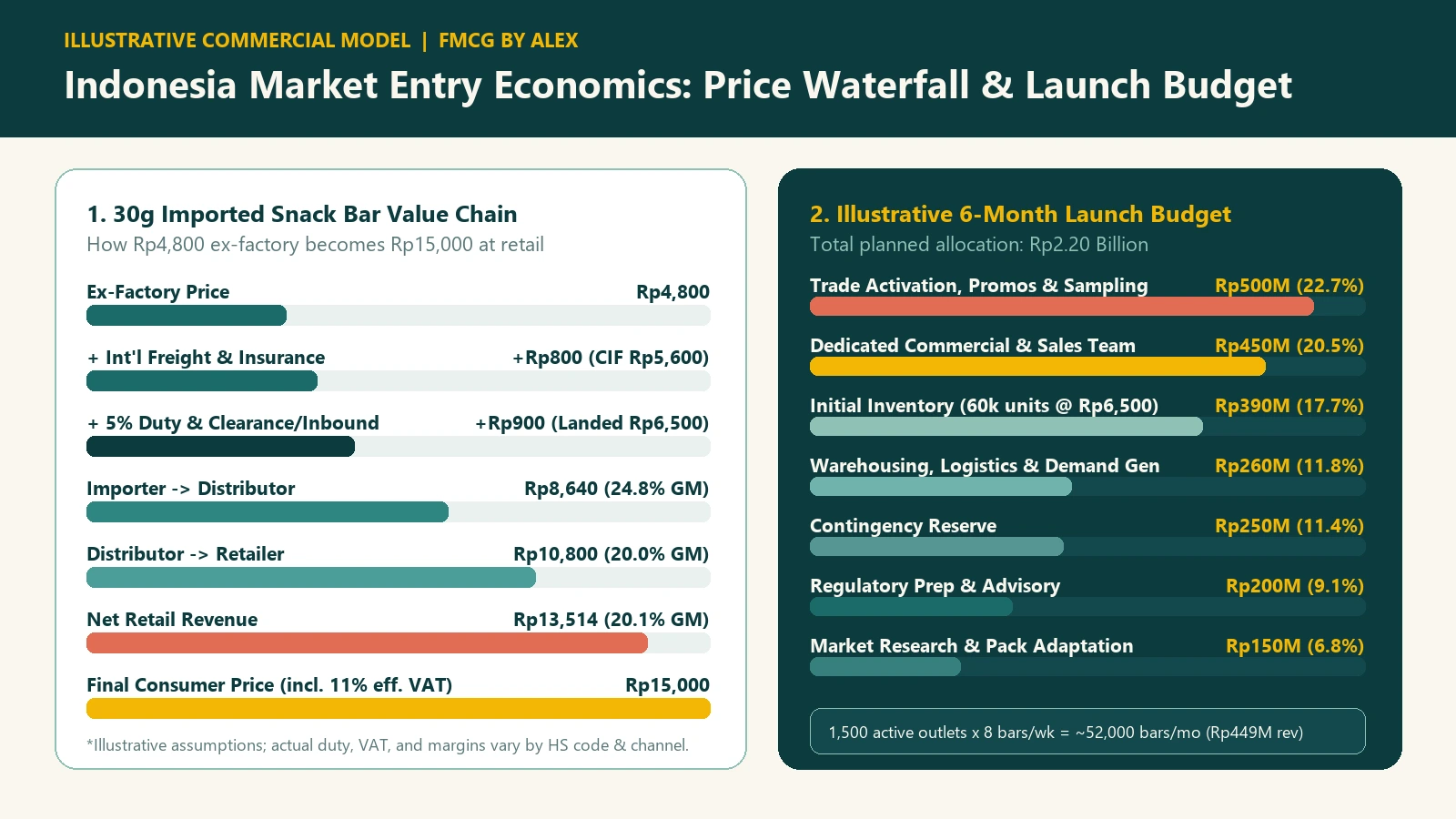
Consider a fictional European company planning to introduce a 30-gram premium snack bar. Suppose its ex-factory price is equivalent to Rp4,800 per unit, with international freight and insurance adding Rp800 and producing an illustrative customs value of Rp5,600. If the applicable import duty were 5%, that would add Rp280, while allocated customs clearance, port handling and domestic inbound transportation might add another Rp620. The resulting economic landed inventory cost would be approximately Rp6,500 per bar, excluding recoverable VAT and other creditable taxes. These amounts are illustrative assumptions rather than quotations or a claim that every imported snack attracts a 5% duty, because the actual calculation depends on the product classification, origin, shipment size and logistics arrangements. Even so, the example provides a useful starting point for understanding how quickly costs accumulate before the importer has earned anything. If that importer sells the product to a distributor for Rp8,640 before VAT, the gross profit is Rp2,140 per bar, equivalent to approximately 24.8% of the selling price. That margin still needs to support inventory financing, overhead, sales activities, possible marketing contributions and the risk of unsold stock.
The distributor might subsequently sell the product to a retailer for Rp10,800 before VAT, generating a gross margin of 20%. If the retailer sells it to consumers for Rp15,000 including an assumed effective VAT of 11%, net retail revenue would be approximately Rp13,514, leaving the retailer with a gross margin of roughly 20.1% before operating expenses. Indonesia's statutory VAT rate is 12%, but the use of an alternative tax base produces an effective 11% rate for many taxable non-luxury goods under the rules applicable in late 2026. Actual VAT treatment still depends on the product, and certain categories may be exempt or subject to different arrangements. Recoverable input VAT should be treated correctly in the financial model rather than automatically regarded as a permanent product cost, although the timing of VAT payments and recovery can affect working capital. At the assumed Rp15,000 retail price, our snack bar has already provided revenue to the manufacturer, paid for international and domestic logistics, contributed customs duties, compensated the importer and distributor, supported the retailer's margin and generated tax obligations. We have not yet paid for a single consumer sampling campaign, retail promotion or particularly enthusiastic marketing executive.
Now imagine that a supermarket buyer requests a promotional discount, additional display support and a launch campaign. The distributor may need to finance the promotion before receiving reimbursement, while the importer could be carrying several months of inventory and waiting for customer payments. Even a product with apparently attractive gross margins can become disappointing once all the commercial expenses are included. The obvious question is whether consumers are prepared to pay Rp15,000 for the snack bar when familiar competing products offer different sizes, prices, flavours and brands. If the answer is no, management needs to consider product reformulation, packaging changes, production efficiencies, alternative channels or a different consumer segment. Reducing the manufacturer's selling price may be an option, but it must be evaluated against the supplier's own profitability and long-term ability to support the brand. Currency movements also matter, particularly when the supplier invoices in euros or US dollars while local revenues are earned in rupiah. A pricing model that works perfectly at one exchange rate can become uncomfortable when the currency moves against the importer, so sensible forecasts should include realistic foreign-exchange and cost scenarios rather than relying entirely on the assumptions that make the spreadsheet look most attractive.
Traditional Trade, Modern Retail, Geography, and Online Marketplaces
Having established a commercially viable price, the manufacturer must decide where consumers will actually encounter the product. Indonesia's retail landscape combines large modern retail chains, rapidly developing digital channels and an enormous traditional-trade network that remains central to everyday consumer purchasing. According to Worldpanel research covering the second quarter of 2026, traditional trade accounted for approximately 70% of Indonesian FMCG market value, illustrating how important neighbourhood retailers, traditional markets and associated wholesale networks remain. Modern supermarkets, hypermarkets and minimarkets serve important consumer groups and are often attractive initial channels for imported brands, particularly where shoppers are accustomed to purchasing premium or international products. Indomaret and Alfamart have developed extensive minimarket networks, creating opportunities for suppliers capable of meeting their commercial and operational requirements. However, modern retail listings are neither automatic nor necessarily the most profitable option for every product. Buyers evaluate expected sales, margins, price positioning, category contribution, promotional support and the limited shelf space available in each store. An unfamiliar imported brand must provide a convincing reason for the retailer to allocate space that could otherwise be occupied by an established product generating reliable sales.
Traditional trade operates according to a somewhat different set of commercial priorities. A neighbourhood warung may have limited space, modest working capital and a strong preference for products that sell quickly and generate dependable margins. The retailer is often closer to its regular customers than a large manufacturer could ever hope to be, and it generally knows which products people request, which prices are acceptable and which unfamiliar items are likely to remain on the shelf. For an imported snack bar, persuading the retailer to purchase a few units is only the beginning. The real challenge is generating sufficient consumer demand for those units to sell and be reordered regularly. A company pursuing mass-market coverage must also consider the practical economics of serving thousands of smaller outlets. Sales representatives need to visit customers, collect orders, arrange merchandising and support payment collection, while delivery vehicles, warehouses and administrative systems must make the necessary replenishment possible. When average orders are small, the cost of serving an outlet can exceed the gross profit earned from its purchases. Distributors may therefore rely on wholesalers, subdistributors, motorised sales teams or a combination of direct and indirect coverage models to serve different customer groups efficiently. The correct arrangement depends on outlet density, order size, delivery frequency, product characteristics and regional infrastructure.
This explains why a distributor's claim to have access to 20,000 stores is much less interesting than the number of productive outlets it serves and the sales generated by those outlets. A company may report that it has placed products in thousands of stores, but if many of those retailers never reorder, the apparent distribution achievement has little lasting commercial value. Manufacturers should distinguish numerical distribution, which measures the number or proportion of outlets carrying a product, from weighted distribution, which considers the relative importance of those outlets within the relevant category. Both measures are useful, but they tell different stories. A premium product available in a relatively small number of high-performing outlets may generate better sales and profitability than a similar product scattered across thousands of unsuitable stores. Equally, a genuinely affordable everyday product may require broad traditional-trade coverage to achieve its intended scale. The distribution strategy should therefore follow the product's positioning and consumer demand rather than the sales director's enthusiasm for impressive outlet counts. Opening stores may create opportunities, but selling products repeatedly through those stores is what eventually pays the bills.
Geography complicates matters further because Indonesia is not a single commercial territory that happens to contain many islands. Greater Jakarta offers enormous population concentrations, sophisticated retail infrastructure and access to many distributors, making it a logical starting point for numerous brands. However, the commercial opportunities in Surabaya, Bandung, Semarang, Medan, Makassar, Palembang, Yogyakarta and Bali deserve consideration according to the product category and target consumer. East Java, for example, combines major urban centres with extensive wholesale and traditional-trade networks, while Central Java has different consumer characteristics, pricing expectations and distribution patterns. Bali provides opportunities for selected imported food, beverage and personal care brands through hospitality, tourism, modern retail and international residents, although success in tourist-oriented outlets should not be mistaken for proof of demand throughout Indonesia. Regional expansion should take account of household purchasing power, market size, competitor presence, wholesale infrastructure, customer concentration and the cost of supplying the territory. For some products, the best approach will involve developing strong positions in Jakarta and selected Java cities before expanding elsewhere. Others may find their most attractive initial opportunities through specialist distributors or Horeca customers in a smaller number of locations. The sensible objective is profitable market coverage, not colouring every Indonesian province on a PowerPoint map as quickly as possible.
Online sales have become increasingly important within this distribution picture. Research by Compas showed that FMCG sales across the major Indonesian marketplaces covered by its analysis reached approximately Rp88.4 trillion during the first half of 2026, representing growth of about 29.4% compared with the corresponding period in 2025. The figures cover major platforms including Shopee, ShopTokopedia, Lazada and Blibli, rather than every possible form of online FMCG retail. For international brands, marketplaces can provide an accessible opportunity to introduce products, test consumer response, explain their benefits and reach customers beyond the immediate areas covered by physical distributors. Online activity can also support brand awareness that eventually benefits retail sales, particularly when consumers discover a product digitally before purchasing it in a supermarket or convenience store. However, the assumption that online distribution eliminates most commercial costs is rather optimistic. Marketplace commissions, advertising, promotions, platform vouchers, fulfilment, shipping subsidies and returns can consume a significant proportion of the transaction value. A brand generating impressive gross merchandise sales may discover that the contribution after these expenses is considerably less exciting, especially when aggressive discounting has been necessary to attract customers.
The strongest route-to-market strategy will often combine several channels, each with a clearly defined commercial purpose. Modern retail can provide credibility and physical visibility, marketplaces can encourage discovery and repeat ordering, traditional distribution can support broader consumer reach, and Horeca customers can introduce suitable products in relevant consumption occasions. A beverage manufacturer, for example, might initially build awareness through cafés, restaurants, hotels and selected premium supermarkets before expanding into convenience retail and broader distribution. A household cleaning brand could follow a different path, concentrating on marketplaces and selected supermarkets while establishing whether demand and pricing justify wider retail coverage. The objective is not to be everywhere immediately but to understand where the product can generate repeat purchases profitably. Different channels may require different packaging, price structures, trade terms and promotional programmes, and the company must prevent those differences from creating unnecessary conflict between distributors and customers. An online store selling the same product permanently below the price paid by physical retailers will eventually attract complaints, particularly when those retailers are being asked to invest time and shelf space in establishing the brand.
Controlled Launch, Sales Velocity, Launch Budgets, and Working Capital
For most new entrants, I would favour a controlled commercial launch over an immediate nationwide introduction. A manufacturer may be tempted to announce a major Indonesian expansion, appoint a national distributor and ship several containers to support an ambitious first-year sales target. The initial invoices look impressive, but much of that revenue may represent inventory entering the distribution pipeline rather than products leaving stores in consumers' shopping baskets. A more useful approach begins with researching the target category, confirming regulatory readiness, validating retail prices and selecting a limited number of appropriate outlets. Depending on the product, that could mean launching through 100 to 300 carefully chosen stores, supported by targeted sampling, merchandising and a manageable online presence. Those numbers are examples rather than a universal requirement, since a highly specialised premium product may need far fewer accounts while a mass-market product could require a broader test. The important consideration is whether the pilot is sufficiently controlled to generate reliable information about consumer demand, retail performance, replenishment and operating costs without committing the entire marketing budget before the company knows what works.
The first six months should then be treated as a structured commercial development programme rather than a race to announce outlet numbers. During the initial period, management needs to understand which products consumers purchase, which flavours or pack sizes perform best, whether prices are sustainable and what retailers say about customer response. As actual sales information becomes available, the distributor can concentrate attention on stronger outlets and improve replenishment planning. Marketing expenditure should be evaluated against incremental sales and repeat purchasing rather than judged entirely by campaign reach or the number of people who accepted a free sample. If the results are encouraging, distribution can expand progressively into additional accounts, supported by stronger sales planning, merchandising and inventory control. If particular products or channels underperform, management should investigate the reasons before committing more money. A product may need better positioning, a different price, improved visibility or a revised packaging format, but there will also be situations where the product simply does not offer consumers a compelling enough reason to switch. Recognising that early is considerably cheaper than financing another six months of disappointment.
Our fictional imported snack bar provides a useful way to connect these commercial decisions to a realistic sales forecast. Suppose the business eventually reaches 1,500 genuinely active retail outlets, with each selling an average of eight bars per week. Using approximately 4.33 weeks per month, that would represent nearly 52,000 bars purchased by consumers monthly. At the assumed importer selling price of Rp8,640 per unit, equivalent replenishment orders would produce approximately Rp449 million in monthly importer revenue before VAT, assuming that consumer sales are reflected in downstream replenishment and that inventory levels remain broadly stable. With an economic landed inventory cost of Rp6,500 per unit, the importer would generate approximately Rp111 million in monthly gross profit before operating expenses, marketing contributions, financing costs and potential losses. That may support an attractive business under a sufficiently efficient operating structure, but it is hardly evidence that everyone involved is about to retire early. The importer still needs to finance inventory, maintain warehousing, manage administration and contribute to commercial development, while the distributor and retailer also require adequate returns.
The economics become much more interesting when sales velocity improves. If the same 1,500 outlets increase their average weekly sales from eight bars to sixteen, consumer sales and the associated replenishment requirement approximately double without necessarily doubling the number of stores or the fixed commercial infrastructure. If those outlets sell only two bars per week, however, the brand may struggle to justify the cost of maintaining such extensive coverage. This relationship between active distribution, sales velocity and net contribution should sit at the centre of the market-entry forecast. Sales managers need to understand how many productive outlets they are expected to develop, how much each outlet should sell and what commercial support is required to achieve those figures. Regional managers can then translate the national plan into territory objectives, while distributors can establish sales representative targets, customer coverage schedules and replenishment requirements. Production and procurement teams should receive the same forecast so they can plan manufacturing capacity, raw materials and packaging supply. A successful sales promotion is far less impressive when the distributor runs out of stock halfway through the campaign because the factory has not reserved the necessary production capacity.
This also explains why a proper market-entry budget needs to cover much more than registration fees and promotional advertising. Imagine our fictional snack-bar manufacturer and importer agreeing to allocate Rp2.2 billion to a six-month launch and initial expansion programme. An illustrative plan might reserve Rp150 million for market research, product adaptation and packaging work, Rp200 million for regulatory preparation and related professional services, and approximately Rp390 million for initial inventory funding based on 60,000 units at the assumed Rp6,500 landed cost. A further Rp500 million might support trade activation, retailer promotions, sampling and merchandising, while Rp450 million covers the dedicated commercial personnel or external sales resources needed to develop the business. Additional warehousing, logistics and demand-generation activities could account for Rp260 million, with Rp250 million retained as a contingency. These figures are hypothetical planning allocations rather than market quotations, and in a real budget they would need to be adjusted to the product, commercial model and contractual responsibilities of each party. The cash-flow forecast should also distinguish inventory funding from operating expenditure and avoid counting costs twice when transferring them between the budget, profit-and-loss statement and working-capital schedule.
Working capital can become one of the most difficult aspects of a new Indonesian FMCG operation because the timing of cash movements rarely matches the excitement of the sales forecast. An overseas manufacturer may require payment before shipment, international transport and clearance may consume several weeks, and the importer may hold products in its warehouse before major retail customers begin ordering. Once goods have been delivered, payment terms can extend the period before the importer receives the cash needed to finance replenishment. A business can therefore generate accounting profits while simultaneously experiencing considerable pressure on cash flow. Large initial orders are especially dangerous when they create the illusion of demand while substantial quantities remain in warehouses or retail channels. Forecasting should distinguish primary sales from the manufacturer to the importer, secondary sales through the distribution network and actual consumer purchases wherever reliable data is available. Management also needs to account for promotional stock, seasonal demand, expected returns, shelf-life restrictions and the possibility that customers will pay later than agreed. The financial model becomes much more useful when it shows when cash must be committed and recovered, rather than merely predicting an attractive profit at the end of the year.
Connecting Sales Planning to Production and Local Manufacturing
As the business develops, the relationship between sales planning and production becomes increasingly important. Manufacturers frequently prepare annual revenue targets without giving enough consideration to the consequences for manufacturing schedules, procurement and inventory. A forecast calling for a major increase in Indonesian sales should identify whether that growth comes from additional outlets, higher sales per store, new products, larger orders from existing customers or expansion into new channels. Each driver has different operational implications. Opening another thousand stores may require more opening inventory, sales representatives and distribution capacity, while increasing sales in existing accounts may place greater emphasis on replenishment frequency and production responsiveness. New product introductions require packaging development, regulatory approvals and initial stock commitments, while the deletion of underperforming products should free up manufacturing and warehouse capacity. Seasonal patterns also matter, especially around Ramadan, Eid and other important consumption periods, when purchasing behaviour, promotional activity and logistics requirements can change significantly. A manufacturer that understands these relationships can develop a forecast that connects commercial ambition to operational reality, avoiding the uncomfortable situation in which sales has promised products that production cannot supply or production has manufactured goods for demand that never materialised.
Eventually, successful imported brands should also examine whether local manufacturing could improve their competitive position. Importation can remain commercially attractive for premium products, specialised categories and relatively modest volumes, particularly where foreign origin forms an important part of the brand's appeal. However, low-value or bulky products can become expensive to transport over long distances, and certain categories may benefit from shorter lead times, local packaging procurement or formulations adapted specifically for Indonesian consumers. Ready-to-drink beverages provide an obvious example because shipping large quantities of finished liquid internationally may be substantially more expensive than manufacturing closer to the end market. Contract manufacturing can offer an alternative to establishing a dedicated factory, allowing a brand owner to work with an Indonesian producer while retaining control over product specifications and commercial strategy. The economic attraction depends on manufacturing costs, minimum production quantities, ingredient availability, quality requirements, equipment needs and the extent to which the product can be reproduced consistently. Local production should never be assumed to be cheaper without a detailed comparison, since certain raw materials or packaging components may still need to be imported and the manufacturer will naturally require its own commercial margin.
The decision becomes more interesting when local manufacturing is considered alongside product development rather than merely as a way to reduce freight costs. A company may begin by importing its existing international products, discover that Indonesian consumers prefer particular flavours or purchasing formats, and eventually develop variants specifically for the local market. A snack manufacturer could introduce smaller packages designed for everyday consumption, while a beverage company might adjust sweetness levels, pack sizes or flavour profiles based on actual consumer feedback. Such changes must be balanced against the brand's identity and the characteristics that make it attractive in the first place. A premium imported chocolate brand, for example, may find that its overseas manufacturing origin is an essential part of its proposition, making local production less commercially attractive despite possible logistics savings. Another brand may discover that locally manufactured products allow it to reach a much broader consumer base without compromising quality or profitability. The correct decision emerges from a comparison of consumer demand, total delivered cost, manufacturing capabilities, required investment and strategic positioning. Local production should follow a demonstrated commercial opportunity rather than becoming an automatic objective simply because the business has reached a certain age.
Beyond the First Container: Building a Profitable Indonesian Business
Throughout this process, manufacturers should remember that the first shipment is a relatively poor measure of market-entry success. The export department may celebrate when a distributor orders 100,000 units, and the finance department may record an encouraging increase in international revenue, but those figures say little about whether Indonesian consumers have developed an interest in the product. The first order demonstrates that a commercial partner believes there is an opportunity. Subsequent orders become more meaningful when supported by evidence that products are moving through retailers and being purchased repeatedly. A distributor can report thousands of listed stores while many of those outlets hold the same inventory for months, and a manufacturer relying exclusively on primary sales figures may not recognise the problem until its next expected order fails to arrive. Meaningful performance reviews should therefore examine active distribution, sales velocity, reorder frequency, inventory turnover, promotional effectiveness, contribution margins and the cost of serving customers. They should also investigate why certain regions and channels outperform others, because those differences often provide the most useful guidance for subsequent expansion.
The quality of the manufacturer-distributor relationship is tested particularly strongly when results differ from expectations. A capable distributor should provide information about customer demand, competitor activities, retail performance and the operational issues encountered by its sales organisation. The manufacturer should respond with realistic commercial support, dependable supply, suitable products and a willingness to adapt when the evidence justifies it. Neither party benefits when every disappointing sales result becomes an argument about who should pay for another promotion. A distributor cannot reasonably be expected to finance unlimited stock, generate consumer awareness and absorb every commercial risk while the manufacturer remains concerned only with export invoices. Equally, the manufacturer should not continue providing marketing funds indefinitely without understanding where those funds are going and what results they produce. Productive partnerships require transparency, commercially sensible expectations and recognition that both businesses need to earn an adequate return. This is particularly important when the relationship involves exclusivity, substantial inventory commitments or long-term investment in local market development.
There is also a broader strategic lesson in the way successful Indonesian FMCG businesses evolve. Market entry should not be treated as a single event with a launch date, ceremonial photographs and a target for the first twelve months. It is a process through which the manufacturer gradually understands its consumers, improves the product offering, develops distribution capability and builds the financial foundation for expansion. The first hundred productive outlets provide information that helps management decide whether and how to reach the next thousand. The first thousand help establish whether the proposed commercial model can support a larger network, while stronger consumer demand may eventually justify investment in regional warehouses, dedicated sales teams, wider assortments or local production. Each stage should improve the quality of commercial information and strengthen the economics of the business rather than merely adding another impressive number to the presentation. Growth that requires progressively larger injections of cash without improving outlet productivity or unit economics is not necessarily evidence of a successful strategy, however attractive the sales graph may look.
For an international manufacturer considering Indonesia in 2027, the sensible starting point is therefore a detailed understanding of what consumers already purchase and what might persuade them to choose something different. That means spending time in supermarkets, certainly, but also visiting wholesalers, neighbourhood shops, traditional markets, cafés and the locations where products are actually consumed. It means examining competing products carefully, discussing real commercial economics with distributors and understanding the regulatory process before promising delivery dates. The manufacturer should develop a route-to-market plan that reflects the intended consumer, a pricing model that provides reasonable margins throughout the distribution chain and a forecast connecting sales growth to inventory, production, cash flow and operating costs. It should also be prepared to discover that some assumptions made during the initial market study were wrong, because consumer markets have a habit of producing inconvenient evidence whenever management becomes too attached to its original predictions.
Indonesia can be extremely rewarding for manufacturers that approach it with suitable products, sensible commercial expectations and the patience to build a business properly. Its size offers genuine opportunities, its retail landscape provides numerous routes to consumers, and its established distribution networks can support substantial growth when the product economics and commercial partnerships are right. Yet it is also a competitive market in which consumers have choices, retailers understand their business and distributors cannot operate indefinitely on enthusiasm alone. The companies that ultimately succeed are often those that combine ambition with the discipline to understand why products sell, why they are reordered and what it actually costs to place them in front of consumers. An impressive national launch can create attention, but a steady stream of profitable repeat purchases creates a business. Getting the first container through customs and into the distributor's warehouse is certainly an achievement worth recognising, particularly after the work involved in making it happen. It is simply worth remembering that the container's arrival is the beginning of the commercial journey, not the destination, because somewhere between that warehouse and an Indonesian consumer's shopping basket lies the difference between an export sale and a successful FMCG brand. The container has arrived, and now the real selling begins.
Key Takeaways
- Category Reality Over Population Math: Indonesia's Q3 2026 GDP growth (5.47% YoY) and 280M+ population do not guarantee category demand; evaluate local price benchmarks, pack sizes, climate/storage needs, and repeat purchase habits first.
- Regulatory & Halal Readiness Before Shipping: Secure SKU-level BPOM registration (
BPOM RI MLfor imports vs.MDfor domestic goods), Indonesian-language labeling, and halal planning ahead of the extended 18 October 2028 mandatory deadline (Government Regulation No. 40 of 2026) while protecting remaining shelf life. - Distributor Selection & Governance: Choose partners on active outlet productivity, category fit, and working-capital capacity—not slide-deck store counts—and tie territorial exclusivity to measurable performance and clear registration ownership.
- Full Value-Chain Pricing: Model ex-factory through freight, duties, landed cost, importer margin, distributor margin, retailer margin, and effective VAT (11%)—plus trade promotions and FX risk—before committing to a consumer price point.
- Channel Discipline & Controlled Pilot: With traditional trade representing ~70% of Indonesian FMCG value and major marketplaces reaching Rp88.4 trillion in H1 2026 (+29.4% YoY), start with a controlled 100–300 store pilot and track secondary sales and unit velocity (e.g., 8–16 units/outlet/week) before scaling.
Alex de Vries is an FMCG commercial executive and business adviser with extensive experience in Indonesia and Southeast Asia, covering distribution development, route-to-market strategy, commercial management, product launches and business expansion. He shares practical industry insights through FMCG by Alex, helping manufacturers, distributors and commercial professionals understand the realities of developing profitable consumer goods businesses.
Continue reading
- Jakarta Isn't Indonesia: Why Your FMCG Growth Strategy Pretends It Is
- The Cold Drink War: Why Beverage Brands Win or Lose at the Fridge
- Budgeting for 2027: Your Sales Target Is the Easy Part
- What Indonesia's Marketplace Tax Collection Actually Does to Your SKU Margin
- Indonesia Marketplace Margin Calculator
- FMCG Distributor & Importer Database
Recommended reading for this topic
Books and tools our editors link to this article. Purchases are completed on Amazon.com.
Good Strategy/Bad Strategy
Richard P. Rumelt
Richard Rumelt's case that good strategy rests on a diagnosis, a guiding policy and coherent actions, and that much of what organisations call strategy is only goals and slogans.
Check current price on Amazon
Buy Now on AmazonPlaying to Win
A. G. Lafley, Roger L. Martin
Lafley and Martin set out a strategy cascade of five linked choices, from winning aspiration to management systems, drawn largely from consumer goods experience.
Check current price on Amazon
Buy Now on Amazon


As an Amazon Associate I earn from qualifying purchases. Purchases are completed on Amazon.com. Affiliate disclosure
Related content
The Cold Drink War: Why Beverage Brands Win or Lose at the Fridge, Not in the Boardroom
In beverage sales, getting your product into a store is only half the battle. Getting it cold, visible, competitively priced and into the consumer's hands is where the real business begins. From Indonesian warungs to modern supermarkets, beverage distribution is a surprisingly complicated game of logistics, psychology, refrigeration and commercial economics.
Jakarta Isn't Indonesia. So Why Does Your FMCG Growth Strategy Pretend It Is?
The overlooked opportunities, commercial realities and distribution challenges of Indonesia's secondary cities, and why your next major growth opportunity may be somewhere your management team rarely visits.
How to Know Whether a Sales Visit Actually Makes Money Without Sacrificing Your Brand
Improving sales route profitability sounds like an obvious objective for any FMCG company. But aggressive cost-to-serve cuts and minimum order sizes can kill a growing brand. Here is how to evaluate true visit economics, protect developing outlets, and balance route efficiency with long-term brand building in Southeast Asia.
How to Build a Better FMCG Route-to-Market
Designing channel roles, distributor economics, and service levels in one RTM framework.