What Indonesia’s Marketplace Tax Collection Actually Does to Your SKU Margin
Indonesia’s marketplace PPh 22 collection is scheduled to begin on 1 November 2026. Here is what the 0.5% actually means for SKU margin, settlement cash, pricing and marketplace reconciliation.
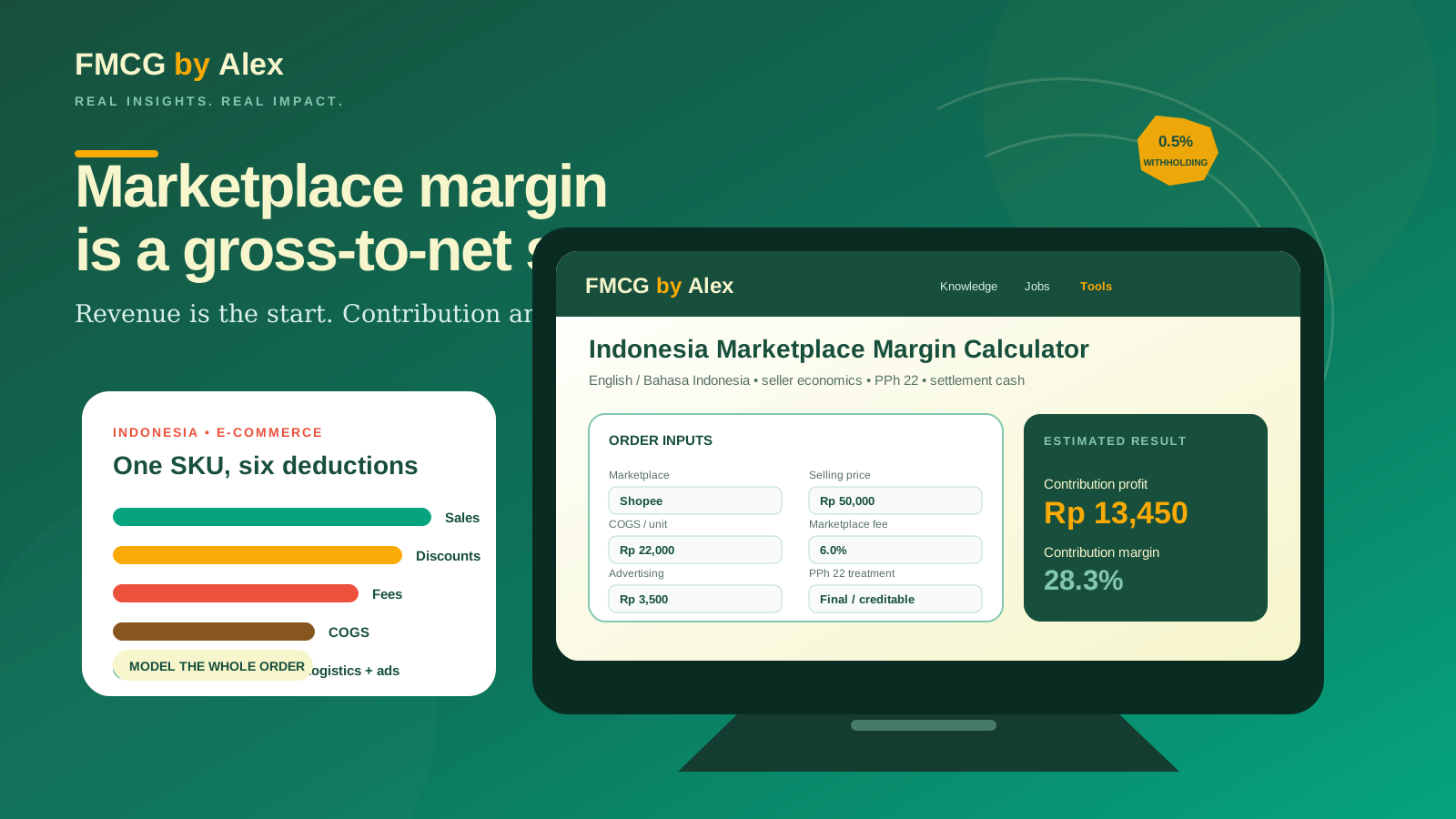
Free FMCG by Alex tool
Put your own SKU numbers into the model.
Use the bilingual online calculator for margin, settlement cash, PPh 22 and break-even pricing, or unlock the QA-verified Windows, macOS and Android apps.
What Indonesia’s Marketplace Tax Collection Actually Does to Your SKU Margin
Indonesia’s new marketplace withholding mechanism is a useful reminder that a small percentage can become a large commercial issue once it lands on a SKU with a thin contribution margin.
The Directorate General of Taxes says the implementation of PPh Article 22 collection under PMK 37/2025 has been postponed through 31 October 2026 and is scheduled to start on 1 November 2026. The policy does not create a new tax; it changes the collection mechanism by requiring designated marketplaces to collect PPh Article 22 from qualifying domestic merchants. The four marketplaces named by DJP are Tokopedia, Shopee, Lazada and Blibli.
The rate is 0.5% of gross turnover, excluding VAT and luxury-goods tax where applicable.
Half of one percent.
It sounds small.
That is exactly why commercial teams should model it properly.
🧮 Calculate your own SKU impact: Open the free Indonesia Marketplace Margin Calculator → to model Tokopedia, Shopee, Lazada, and Blibli fee structures, PPh 22 withholding, settlement cash, and break-even prices.
0.5% of revenue is not 0.5% of profit
Suppose you sell an FMCG product for Rp50,000.
At 0.5%, the marketplace withholding is Rp250.
Look at the revenue line and Rp250 is almost decorative.
Now imagine that after COGS, marketplace charges, seller-funded vouchers, advertising, fulfilment, shipping support and other order costs, the SKU produces Rp2,500 of contribution profit.
That same Rp250 is now equal to 10% of the contribution.
The tax percentage did not change.
The commercial meaning did.
This is why marketplace economics should not be managed by looking at deductions only as percentages of sales. What matters is the relationship between each deduction and the amount of contribution that remains after all the other deductions have already taken their share.
A one-point increase in cost on a SKU earning 35% contribution is irritating.
A one-point increase on a SKU earning 3% contribution is a management meeting.
Do not automatically subtract another 0.5% from every SKU either
There is an equal and opposite mistake.
Someone sees “marketplace collects 0.5%” and adds a new 0.5% cost line to every SKU.
That can also be wrong.
DJP explicitly describes PMK 37/2025 as a change in collection mechanism rather than a new type of tax. Depending on the seller’s tax position, the amount collected may be part of final-tax settlement or may be creditable against annual income tax.
Commercially, that means there are two numbers worth separating:
Economic margin.
And:
Settlement cash.
They are not always the same number.
If the withholding represents final tax for the seller, it belongs in the economic margin calculation.
If it is creditable, it may not be an incremental operating cost in the same way as marketplace commission or fulfilment. But it can still reduce the cash arriving in the settlement now.
That matters.
Cash that arrives later is still cash that cannot be used today to reorder stock, pay suppliers, finance a campaign or support the next production run.
For a large company with abundant working capital, that timing difference may be manageable.
For a fast-growing SME financing inventory from marketplace settlements, it can be much more important.
The Rp500 million threshold needs to be understood correctly
DJP states that qualifying individual taxpayers with annual gross turnover of up to Rp500 million can be outside marketplace collection when the required declaration has been supplied.
There is a detail worth remembering.
The turnover calculation is not simply one Shopee shop or one Tokopedia account.
DJP’s marketplace guidance explains that the threshold looks at the taxpayer’s relevant total turnover, including the broader combination of online and offline business activity.
Opening several marketplace stores does not create several independent Rp500 million limits.
That is another reason commercial teams should avoid building tax assumptions directly into pricing without first checking how the seller is actually classified.
The bigger issue is probably already sitting in your marketplace P&L
The withholding rule is useful because it forces a larger question:
Do you really know what you earn on every marketplace SKU?
Not the selling price.
Not GMV.
Not the dashboard number called sales.
What do you earn after everything?
A marketplace SKU can begin at Rp50,000 and then travel through a surprisingly crowded waterfall.
Seller-funded voucher.
Platform fee.
Service fee.
Affiliate commission.
Campaign participation.
Advertising.
Fulfilment.
Shipping contribution.
Refund.
Return.
Damaged stock.
Another deduction that somebody in finance does not immediately recognise.
And now, where applicable, PPh Article 22 withholding.
Meanwhile the dashboard announces that GMV increased.
Everyone celebrates.
Finance quietly checks the bank account and wonders why it did not share the same enthusiasm.
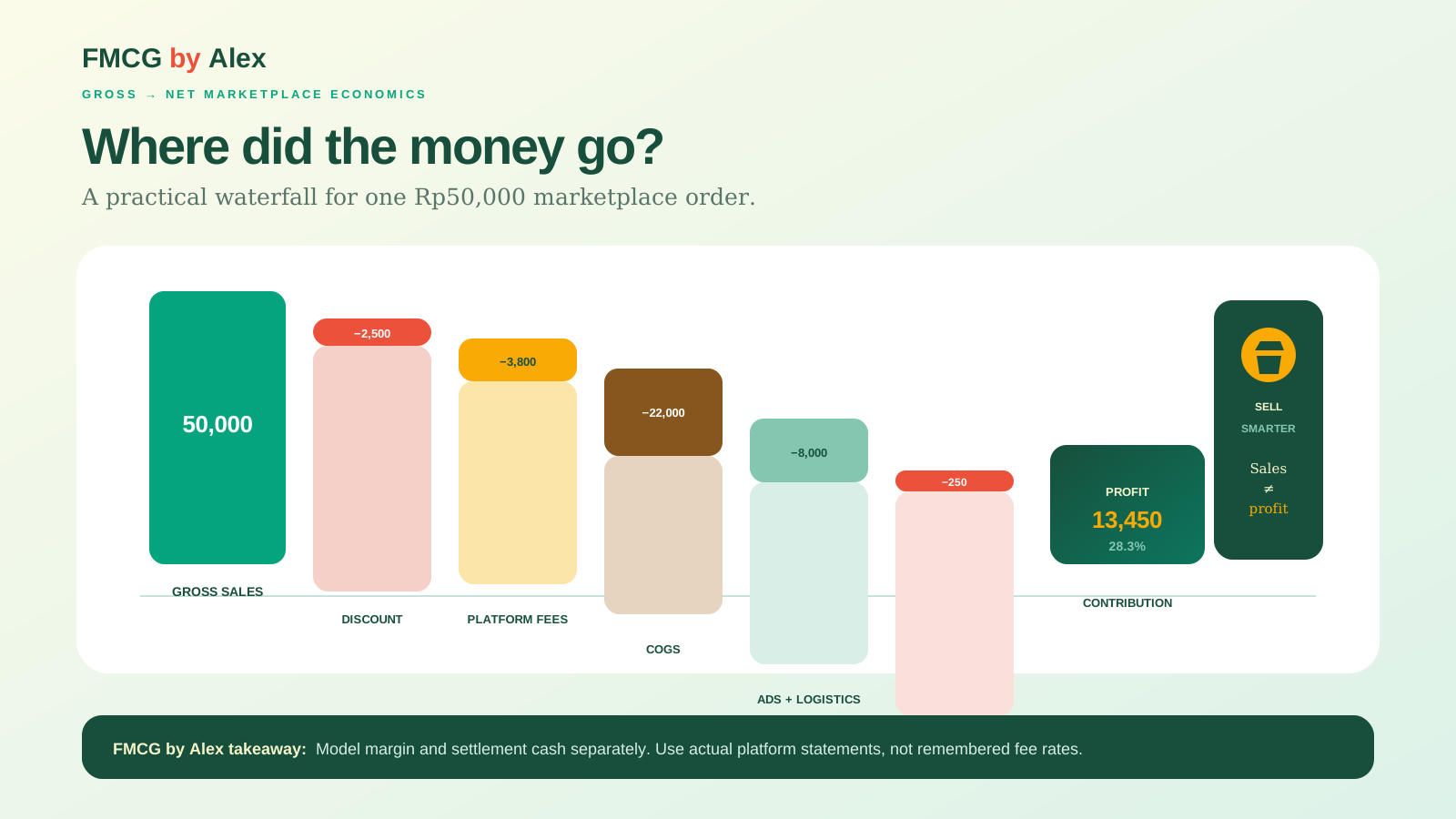
This is the reason I prefer a gross-to-net model.
The consumer pays one number at the top.
The seller receives another number at the bottom.
Everything commercially interesting happens in between.
This is happening inside a very large growth market
Indonesia is not adding this administrative complexity to an insignificant sales channel.
The e-Conomy SEA 2025 report from Google, Temasek and Bain estimated Indonesian e-commerce GMV at roughly US$71 billion in 2025 and projected it to reach around US$140 billion by 2030.
That is roughly a doubling of an already enormous channel.
For FMCG companies, marketplace profitability therefore cannot remain a side spreadsheet owned by one enthusiastic e-commerce manager.
The channel is becoming too large.
The deduction stack is becoming too complicated.
And the difference between GMV and real contribution is too important.
So FMCG by Alex built the calculator
Instead of publishing another article telling sellers to “review their margins,” we built a free Indonesia Marketplace Margin Calculator.
It is available online in English and Bahasa Indonesia. Free Windows, macOS and Android companion apps are being published separately; each download unlocks only after that platform build has passed its release QA checks.
The tool lets you enter:
- selling price;
- units per order;
- COGS;
- seller-funded discounts;
- marketplace fee;
- service or administration charges;
- affiliate commissions;
- advertising cost;
- fulfilment;
- shipping support;
- other order costs;
- taxable gross turnover;
- and the PPh Article 22 treatment.
It then shows:
- net customer revenue;
- estimated settlement cash;
- PPh 22 withheld;
- contribution profit;
- contribution margin;
- and break-even selling price.
Most importantly, the tool separates final-tax treatment from creditable withholding.
That distinction prevents a commercially useful calculator from becoming a very attractive way to calculate the wrong answer.
Open the free Indonesia Marketplace Margin Calculator
Use your real marketplace statement
Do not treat the default example as a benchmark.
Marketplace economics vary by seller status, product category, programme participation and campaign structure.
Use the fees from your own settlement statement.
If the marketplace charges 6.8%, enter 6.8%.
If you are paying an affiliate commission, enter it.
If the brand is supporting shipping, enter it.
If advertising is required to acquire the order, include it.
The calculator should describe your business, not a theoretical seller that exists only in PowerPoint.
One SKU is arithmetic. Ten thousand orders are reconciliation.
This is where the opportunity becomes more interesting.
Doing the calculation for one SKU is easy.
Doing it across hundreds of SKUs, thousands of orders, several marketplaces and constant promotions is not.
That is no longer a calculator problem.
It is a reconciliation problem.
Imagine importing a Shopee, Tokopedia, Lazada or Blibli settlement file and automatically matching every order against:
- customer revenue;
- discounts;
- platform fees;
- campaign deductions;
- affiliate commissions;
- fulfilment;
- shipping support;
- refunds;
- tax collections;
- and the amount that actually reached the bank.
Then imagine the system highlighting exceptions.
A deduction rate changed.
A campaign produces great GMV and terrible contribution.
A best-selling SKU has slipped below the company’s minimum margin.
Expected settlement and actual settlement do not agree.
A tax collection needs to be reconciled to invoices and finance records.
That is the logical next product for Sakura Software Solutions.
Not another dashboard telling you how much you sold.
A marketplace reconciliation layer answering a much more useful question:
We sold Rp100 million. Where did the money go?
The commercial opportunity is larger than the tax event
That is why the current tax change reinforces the opportunity rather than defining it.
The tax rule creates urgency.
The free calculator creates discovery.
The reconciliation product creates a durable software category.
The funnel is straightforward:
FMCG by Alex article → free online calculator → free desktop/mobile app → Sakura Software Solutions marketplace reconciliation.
The tax discussion gets the seller through the door.
Gross-to-net profitability keeps the product useful long after everyone understands the regulation.
What to do before 1 November
Take your top marketplace SKUs.
Use the actual marketplace settlement data.
Model the real commercial stack.
Check both margin and settlement cash.
Identify the SKUs that are already fragile.
And do not wait for the withholding mechanism to expose a profitability problem that was already there.
You may discover that 0.5% barely changes the economics.
You may discover that it creates a working-capital issue.
Or you may discover that the tax is not remotely the biggest problem and that a “hero” SKU has quietly been converting cash into GMV for months.
That third result would make the exercise very worthwhile.
Sources and further reading
- Directorate General of Taxes: Marketplace PPh collection guidance
- Directorate General of Taxes: Postponement through 31 October 2026 and start on 1 November 2026
- Directorate General of Taxes: Implementation of PMK 37/2025 and designated marketplaces
- Google, Temasek and Bain: e-Conomy SEA 2025 Indonesia overview
FAQ
Is the 0.5% marketplace withholding a new tax?
DJP says PMK 37/2025 does not create a new type of tax. It changes the collection mechanism by having designated marketplaces collect PPh Article 22 from qualifying domestic merchants.
When is marketplace PPh Article 22 collection scheduled to begin?
DJP announced that implementation is postponed through 31 October 2026 and is scheduled to begin on 1 November 2026.
Which marketplaces are named by DJP?
The four named marketplaces are Tokopedia, Shopee, Lazada and Blibli.
Is the free calculator available in Bahasa Indonesia?
Yes. The online tool includes both English and Bahasa Indonesia. The Windows, macOS and Android companion apps use the same bilingual calculator and are released only after their platform-specific QA checks pass.
Does FMCG by Alex sell the email addresses collected for app downloads?
No. Download lead details are used only to provide the requested download and to send updates or new FMCG by Alex information that is relevant to the tool or the user’s commercial work. The information is not sold or rented.
Tools for this topic
View shopCommercial Execution Tee
Soft cotton tee celebrating disciplined FMCG execution.
Related content
The Shopper Has Left the Store. Their AI Agent Is Doing the Shopping
What happens to FMCG marketing when AI assistants build grocery baskets and substitute products before a human ever sees the shelf? Explore the rise of agentic commerce and machine-legible brands in Indonesia.
The New FMCG Shelf Is an Algorithm: A Story About Winning Online Visibility Without Becoming a Discount Addict
FMCG brands no longer fight only for supermarket shelf space. They now fight for search ranking, marketplace visibility, reviews, quick-commerce availability and algorithmic attention. Here is how to win the new digital shelf without becoming addicted to discounts.
Hiring Trends in Indonesia's FMCG Sector (2025-2026)
Indonesia's FMCG hiring market in 2025-2026 is shifting from volume hiring toward capability-led recruitment across sales, brand, e-commerce, and supply chain.