
The Cold Drink War: Why Beverage Brands Win or Lose at the Fridge, Not in the Boardroom
In beverage sales, getting your product into a store is only half the battle. Getting it cold, visible, competitively priced and into the consumer's hands is where the real business begins. From Indonesian warungs to modern supermarkets, beverage distribution is a surprisingly complicated game of logistics, psychology, refrigeration and commercial economics.
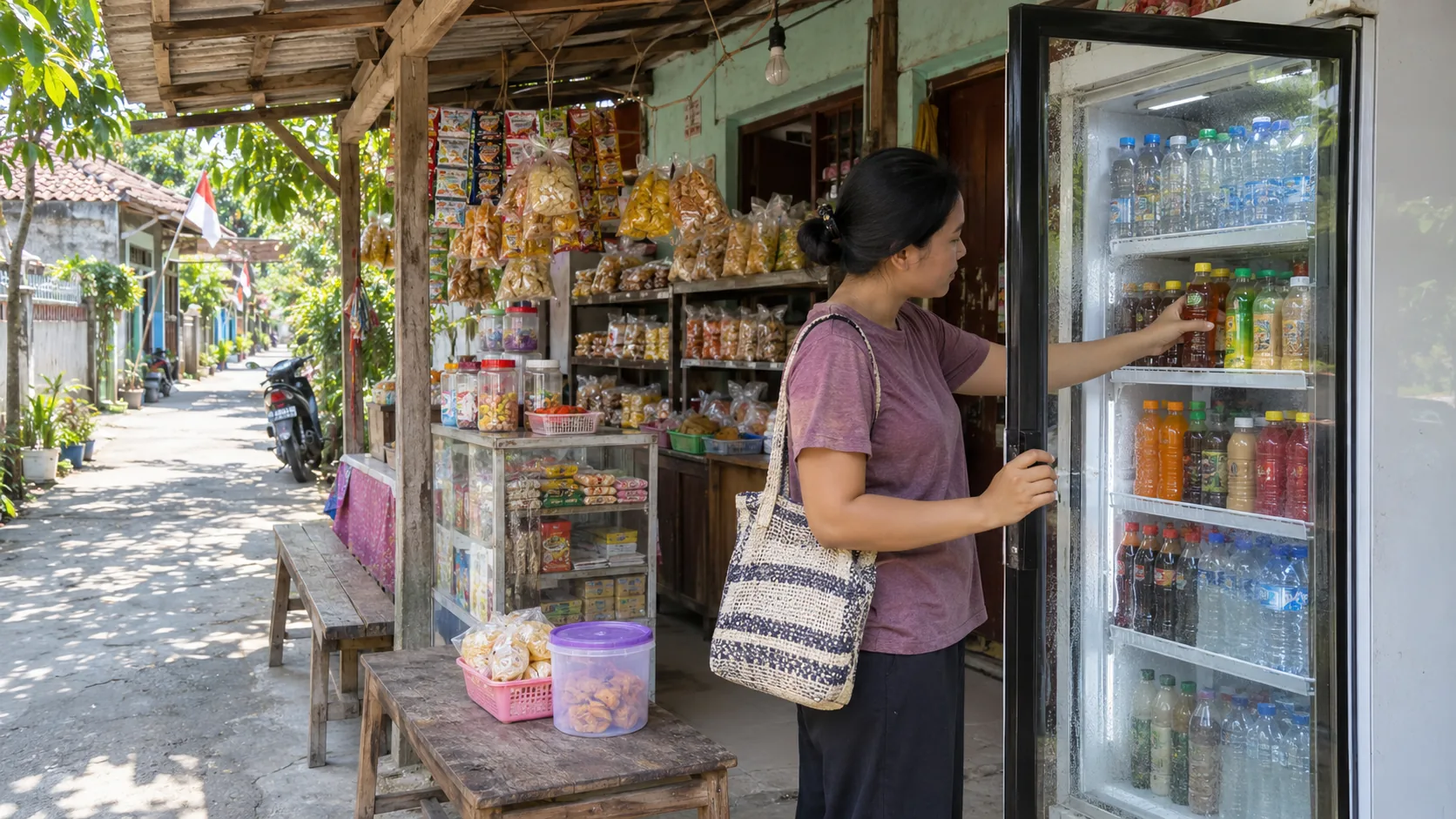
Walk into almost any warung in Indonesia on a hot afternoon and you will find one of the most competitive pieces of retail real estate in the entire FMCG industry. It isn't particularly large, it doesn't come with an impressive rental agreement, and it probably doesn't feature prominently in the company's annual strategic presentation. It is the refrigerator. Behind that glass door, bottled water, ready-to-drink tea, coffee, energy drinks, flavoured beverages and carbonated soft drinks are fighting for a limited amount of space and the attention of customers who are generally not interested in conducting an extensive evaluation of the available brands. They are thirsty, they want something cold, and they would preferably like to get on with their day. A beverage manufacturer may have spent months developing the perfect flavour, millions of rupiah on advertising and considerable effort establishing national distribution, but if its product is sitting on a dusty shelf at room temperature while the competitor's bottle is conveniently waiting in the refrigerator, all that strategic planning may not count for very much.
This is one of the things that makes beverage sales and distribution particularly interesting. Unlike many other FMCG categories, beverages are frequently purchased for immediate consumption, which makes the circumstances surrounding the purchase almost as important as the product itself. A customer buying cooking oil or laundry detergent is usually planning to use it later. Someone buying a cold drink outside a school, at a petrol station, in a minimarket or after finishing work may have an entirely different sense of urgency. The purchase decision can take seconds, and the winning brand is often the one that combines familiarity, price, availability and convenience at precisely the right moment. It doesn't necessarily have to be the cheapest product, or even the consumer's favourite brand under normal circumstances. It simply has to be the most attractive option when the consumer is ready to buy.
For beverage manufacturers, this creates an important distinction between having distribution and having effective distribution. A sales director may proudly announce that the company's products are available in 100,000 retail outlets, but that number tells us remarkably little about the quality of the business being generated. How many of those outlets are actively selling the product? How many reorder regularly? Is the product actually visible to consumers? Is it available cold in outlets where immediate consumption matters? Are the correct flavours and pack sizes present? And perhaps most importantly, is the company making an acceptable profit from all this activity? These are considerably more interesting questions than simply counting the number of stores that accepted an introductory order. Unfortunately, they also require rather more work to answer.
The challenge has become more relevant as Indonesian consumers continue adjusting their purchasing behaviour. Worldpanel by Numerator's Indonesia FMCG Outlook 2026 describes shoppers who are increasingly conscious of value, selective about discretionary spending and willing to move between retail channels to find what they need. Its Q2 2026 market commentary also identifies beverages among the categories facing pressure. Consumers have not suddenly lost the ability to become thirsty, of course, but they are making more deliberate choices about what they purchase and how much they are prepared to pay. This makes the combination of affordability, product availability and point-of-sale execution increasingly important. A brand cannot simply assume that its products will sell because the weather is warm and Indonesia has a large population. The market may offer enormous opportunities, but competitors have generally noticed this as well.
The Refrigerator Is Not Just Equipment. It Is Part of Your Distribution Strategy.
One of the more expensive mistakes beverage companies can make is treating refrigeration as a relatively simple merchandising exercise. Buy a few thousand branded coolers, place them in retail outlets, fill them with products and wait for sales to increase. In an attractive PowerPoint presentation, this looks like a perfectly reasonable strategy. The coolers carry the company logo, the bottles are arranged beautifully, and the sales forecast points in the right direction. The complications usually begin when somebody has to decide which outlets should receive a refrigerator, who will pay for the electricity, how often it needs replenishing, who is responsible for maintenance and what happens when the retailer decides that the competitor's products deserve some space as well.
A refrigerator is fundamentally different from a cardboard display or a promotional poster because it represents a substantial investment in physical equipment. It consumes electricity, requires maintenance, occupies valuable retail space and must be supplied with sufficient inventory to justify its presence. The manufacturer is effectively investing capital in another company's premises, often without knowing precisely how much additional business the equipment will generate. That can be an excellent commercial decision, but only when the outlet has enough sales potential and the retailer is willing to support the arrangement. A refrigerator standing in a busy roadside shop may generate attractive returns, while an identical refrigerator placed in a quiet neighbourhood outlet could spend most of its working life making six bottles of tea comfortably cold.
This is why I would never approach cooler placement as a competition to see which regional sales manager can distribute the greatest number of refrigerators. The objective should be to identify outlets where cold availability can materially increase sales, improve brand visibility or defend an important competitive position. Outlet location matters, but it needs to be considered alongside actual consumer traffic, purchasing occasions, retail prices, existing refrigeration capacity and the retailer's ability to keep the equipment stocked and operating. A shop beside a busy transport terminal might have excellent potential for single-serve beverages during commuting hours, while a neighbourhood store serving mostly household grocery purchases could have a very different sales profile. Similarly, a restaurant that regularly serves cold drinks with meals might justify investment in refrigeration even if its daily customer count is relatively modest, because beverage purchasing is closely connected to the food being consumed.
There is also the question of who controls the refrigerator. Beverage companies naturally prefer prominent placement of their own products, particularly when they have paid for the equipment, but the retailer has a business to operate and customers who may be asking for several competing brands. Any agreement regarding equipment ownership, product allocation, maintenance, branding and commercial obligations should therefore be clearly understood by both parties and comply with the relevant competition rules. A retailer who receives a cooler but doesn't see sufficient sales from the manufacturer's products may gradually fill the empty space with whatever sells fastest. The sales representative can complain about this during the next visit, but it would be more useful to understand why the manufacturer's products aren't moving quickly enough in the first place. Retailers are generally enthusiastic supporters of brands that make them money. Their loyalty becomes somewhat less impressive when the products don't sell.
There is an equally important operational issue that tends to receive less attention: a refrigerator is only useful when the products inside it are actually cold. That sounds painfully obvious, but field execution frequently manages to turn obvious principles into surprisingly complicated problems. Equipment may be switched off overnight to save electricity, overloaded with warm stock immediately before peak trading hours, positioned in direct sunlight or poorly maintained. A cooler can be technically present in the outlet while failing to provide the experience the consumer expects. Temperature performance, door seals, ventilation, power supply and replenishment practices all matter, particularly in a tropical environment. For products requiring a regulated cold chain, such as certain dairy beverages, the standards are more demanding still. Keeping an ambient-stable soft drink pleasantly chilled is not the same thing as maintaining the food-safety requirements of a temperature-sensitive product, and the two should never be confused.
Energy efficiency deserves attention as well. Commercial refrigeration consumes electricity throughout the day, and the difference between efficient and inefficient equipment can become significant across a large installed base. Research published through UNEP and commercial refrigeration efficiency programmes demonstrates how equipment design affects lifetime operating costs. Manufacturers should therefore evaluate not only the initial purchase price of a cooler but also its expected energy consumption, reliability, maintenance requirements and useful life. A cheaper refrigerator may look attractive when the procurement department negotiates the original invoice, but considerably less attractive after several years of electricity expenses and compressor replacements. The lowest purchase price and the lowest cost of ownership are not necessarily the same thing, which is another useful observation that tends to become apparent only after the budget has been approved.
The Economics of Making a Drink Cold
Let's consider a fictional Indonesian beverage manufacturer that wants to expand its presence in general trade. The company sells a ready-to-drink beverage with an average consumer price of Rp10,000 per bottle and is considering placing branded refrigerators in selected outlets. For illustration, assume a refrigerator costs Rp7.5 million, with another Rp500,000 required for transportation, installation and initial setup. The total investment is therefore Rp8 million per outlet. The company expects to support the installation through a monthly combination of maintenance provision, retailer incentives and electricity contributions, amounting to Rp300,000. The actual figures will vary considerably depending on the equipment, the outlet agreement and the region, but they give us a reasonable framework for examining the economics.
Now suppose the company's net contribution from each additional bottle sold is Rp1,200, after manufacturing costs, the relevant trade discounts and variable distribution expenses. This is not the consumer selling price, nor is it the manufacturer's gross profit before distribution expenses. It is the incremental contribution available to support the investment after the costs directly associated with selling the additional product have been deducted. That distinction matters, because calculating a refrigerator's return using the full retail price of the beverage would produce a wonderfully attractive investment proposal and a rather disappointed finance department.
If the presence of the refrigerator genuinely increases sales by an average of 20 bottles per day, the company generates an additional 600 bottles per month, assuming 30 trading days. At Rp1,200 contribution per bottle, this produces Rp720,000 in additional monthly contribution. After deducting the Rp300,000 of ongoing support costs, the company retains Rp420,000 per month towards recovering the original Rp8 million investment. The simple payback period is therefore approximately 19 months, before financing, taxation and other excluded costs.
That could be an attractive investment if the equipment is expected to remain commercially productive for several years. But the calculation changes dramatically when we adjust the sales assumptions. If the refrigerator generates only 10 genuinely additional bottles per day, monthly contribution falls to Rp360,000, leaving just Rp60,000 after support costs. The simple payback period suddenly becomes more than eleven years. Increase incremental sales to 30 bottles per day and the calculation looks considerably healthier: Rp1,080,000 monthly contribution, Rp780,000 after support costs and a payback of roughly ten months. The equipment hasn't changed. The purchase price is identical. What changed is the outlet's ability to generate additional sales.
This is why outlet selection and sales velocity should drive cooler investment decisions. The calculation should also distinguish additional sales from sales that would have happened anyway. If a retailer previously sold 40 bottles per day at room temperature and now sells 50 cold bottles, the incremental volume is ten bottles, not fifty. We should also consider whether those additional sales represent new consumers, switching from competitors, or customers purchasing our products at one outlet instead of another nearby outlet where we already had distribution. Those distinctions become important when calculating the return on a large regional cooler programme. The most reliable evaluation would compare performance before and after installation, ideally against similar outlets that did not receive a refrigerator, while allowing for seasonal demand, promotions and differences in outlet traffic.
The cooler investment itself should be tracked as an asset rather than disappearing into the trade marketing budget after installation. Companies need to know where each refrigerator is located, whether it is operational, who is responsible for it and whether the outlet continues to justify the investment. Poorly performing equipment should be reviewed, with reasonable opportunities to improve sales execution before considering relocation. A refrigerator that generates little additional business in one outlet may be far more productive somewhere else. In fact, relocating existing underperforming coolers can sometimes be a better use of capital than buying another batch simply because the annual equipment budget has money remaining.
Of course, the manufacturer's economics are only half the story. The retailer also needs to benefit. If additional cold-drink sales increase store turnover, improve gross profit and attract repeat visits, the equipment creates commercial value for both parties. But the retailer must also consider electricity, available floor space, inventory investment and the opportunity cost of giving valuable refrigerator capacity to one supplier. A good cooler programme therefore works best when the manufacturer's investment and the retailer's commercial interests point in the same direction. The arrangement should make selling the brand easier and more profitable, rather than turning every refrigerator into an ongoing negotiation between the sales representative and the shop owner.

Distribution Is About More Than Delivering Cases
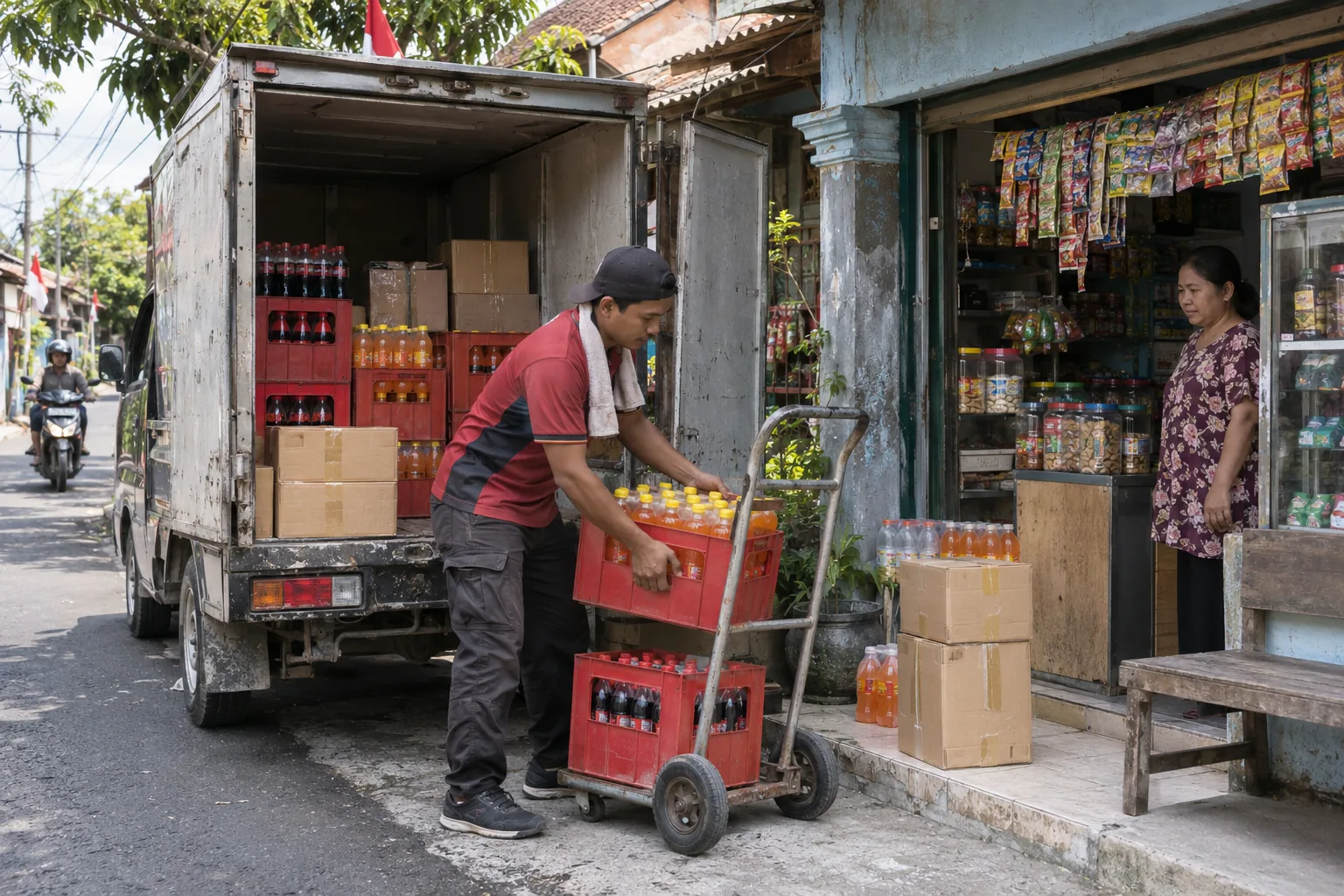
Refrigeration is only one part of the beverage business. The other major challenge is getting the product to thousands of outlets at an economically sensible cost. Beverages are particularly demanding from a distribution perspective because they are relatively heavy and bulky compared with the value of the goods being transported. A carton of bottled water consumes space and vehicle capacity that could potentially accommodate products with considerably higher value per kilogram. This makes delivery density, route planning, vehicle utilisation and order size important determinants of profitability. A beverage company might have excellent manufacturing economics and attractive gross margins, only to discover that an ambitious expansion into low-volume rural outlets consumes much of the available contribution in transportation expenses.
In Indonesia, where traditional retail, modern minimarkets, wholesalers, restaurants and other channels operate alongside one another, there is no single distribution model that works equally well everywhere. Direct-store-delivery operations can provide strong control over availability, merchandising and replenishment, but they also require vehicles, personnel, systems and sufficient outlet density to justify their costs. Independent distributors offer established customer relationships, local knowledge and infrastructure, although manufacturers must still ensure that distributors have both the incentive and the capacity to execute the brand's strategy. Wholesalers can help products reach smaller or more remote retailers economically, but they generally provide less visibility over final outlet-level sales and merchandising conditions. The sensible approach is to choose the route to market according to the economics and commercial requirements of the territory, rather than expecting every province to operate according to an identical national template.
The scale of this challenge is illustrated by Coca-Cola Europacific Partners' published description of its Indonesian operations. The company reported serving more than 450,000 customers across a wide variety of outlet formats, with smaller stores, cafés and restaurants representing the majority of its business at the time of that report. That is a substantial distribution footprint, but the interesting lesson is not simply the number of customers. It is the operational effort required to maintain product availability, assortment and visibility across such a diverse retail network. A nationwide brand does not succeed because its national sales director has a particularly impressive map of Indonesia. It succeeds because thousands of individual outlets receive the right products frequently enough to satisfy actual consumer demand. The map is useful, but unfortunately it doesn't drive the delivery truck.
For a beverage manufacturer working through distributors, I would pay particular attention to the relationship between delivery frequency, order size and outlet productivity. A high-volume warung selling several cases of drinks each week may justify regular direct service, while a small outlet purchasing a few bottles at a time may be more economically supplied through a wholesaler or a shared distribution route. The decision should account for the contribution earned from the products, the cost of visiting and delivering to the outlet, the likelihood of stockouts and the retailer's ability to finance inventory. Simply forcing every outlet onto a weekly delivery schedule can create enormous operational costs without generating corresponding sales. Equally, reducing delivery frequency too aggressively may lead to lost purchases when popular products are unavailable during peak demand periods.
There is also a practical difference between supplying an outlet and keeping its cooler full. A manufacturer can deliver a carton of beverages in perfect condition and still lose sales if the retailer places it in the storeroom while the refrigerator gradually empties. Beverage replenishment requires attention to what is happening at the point of consumption, particularly when products sell rapidly during certain parts of the day. A shop near an office district might experience strong lunchtime demand, while an outlet serving commuters could have peaks in the morning and evening. Restaurants, tourist locations and recreational venues have their own purchasing patterns. The appropriate delivery frequency should therefore reflect actual sales velocity and available storage capacity, while the retailer needs a simple and reliable process for moving products into refrigerated display space before demand peaks. A beautifully stocked refrigerator at nine in the morning offers limited consolation if it is empty by three in the afternoon.
Sales representatives should be trained to recognise these differences rather than treating every store visit as an opportunity to sell another carton. A productive call involves checking inventory, identifying missing products, inspecting the cooler, reviewing the best-selling assortment, understanding the retailer's recent sales and agreeing on an appropriate replenishment quantity. Ideally, field teams should know which outlets have the greatest potential, which products generate the best contribution and where improved execution could produce additional volume. The aim is not to encourage salespeople to spend half an hour inspecting every refrigerator in the country. It is to help them use their time intelligently, with enough information to focus on commercially meaningful opportunities.
Price, Packaging and the Occasion Behind the Purchase
One of the reasons beverage distribution cannot be separated from marketing is that different consumption occasions require different products, packaging formats and price points. A consumer buying a drink for immediate consumption from a warung may be looking for a small, affordable bottle that is easy to carry. Someone shopping for a family gathering may prefer a larger multipack or bottle intended for sharing. A restaurant may want packaging that supports its menu prices and serving style, while a hotel or premium café may consider presentation and brand positioning alongside the liquid itself. These are not merely packaging decisions. They influence retail price, consumer accessibility, distributor margins, production costs, shelf space, refrigeration requirements and the economics of delivering the product.
This is particularly important in a market where many consumers are carefully managing discretionary spending. If a beverage brand positions every product at a premium price, it may struggle to generate sufficient volume in outlets where consumers are highly price-sensitive. Conversely, relying entirely on low-priced packs can make the distribution economics difficult, particularly when packaging and transport costs absorb a substantial proportion of the manufacturer's revenue. The right price-pack architecture provides consumers with sensible choices while protecting the manufacturer's contribution. A smaller bottle can improve affordability at the point of purchase, even when its price per litre is higher, but only if consumers recognise enough value in the proposition. Different pack sizes should serve identifiable needs rather than merely adding complexity to the product catalogue.
Consider a company selling a ready-to-drink tea in several formats. A smaller single-serve pack may be suitable for school canteens and price-sensitive general-trade outlets, a medium bottle for commuters and convenience stores, and a larger format for household consumption. Restaurants may prefer a particular bottle or can that fits their presentation and pricing requirements. The sales team should not necessarily attempt to sell every format into every outlet. Doing so increases inventory complexity and can result in slow-moving products occupying valuable space that should be allocated to the most productive SKUs. The better approach is to develop channel-specific assortments based on consumer demand, retail economics and available display capacity.
This also has consequences for new product introductions. Beverage manufacturers are understandably enthusiastic about launching new flavours, limited editions and innovative product formats. A successful launch can create consumer excitement and generate incremental purchases, but every new SKU also competes for space in the refrigerator, distributor warehouse and delivery vehicle. If a new flavour takes the place of an established bestseller without producing enough incremental demand, the company may have increased its operational complexity while achieving very little additional revenue. Product innovation should therefore be evaluated on its contribution to the total portfolio, taking account of substitution between existing products, rather than simply celebrating the initial shipments of a newly launched SKU.
Seasonality adds another dimension. Ramadan and Lebaran can create important shifts in purchasing patterns for certain beverage categories, while school holidays, tourism, weather conditions, sporting events and local festivities can influence demand by location and occasion. The commercial organisation needs to understand these patterns well enough to adjust distribution, merchandising and stock availability in advance. That requires coordination with Production and Supply Chain, because beverages cannot magically appear in the distributor's warehouse when the sales team discovers that demand is about to increase. If seasonal sales require additional finished-goods inventory, the factory may need to produce earlier, packaging materials may need to be ordered in advance and distributors may require additional working capital. As with most FMCG planning exercises, the commercial opportunity becomes much easier to exploit when somebody has remembered to involve the rest of the company.
The Sales Numbers That Actually Matter
Beverage companies often evaluate sales performance using cases sold, revenue generated, distribution coverage and achievement against monthly targets. These are useful indicators, but they do not provide a complete picture of commercial health. A distributor can achieve its monthly purchase target by taking additional stock into its warehouse without increasing consumer demand. A sales representative can open dozens of outlets that never place a second order. A regional manager can report thousands of refrigerators installed without demonstrating that the equipment is generating attractive returns. None of these activities is necessarily worthless, but they should not be confused with evidence of sustainable growth.
I would begin by separating primary sales, secondary sales and actual retail offtake wherever the available data allows. Primary sales tell us what the manufacturer has shipped to distributors or directly managed customers. Secondary sales show what distributors have sold onward to their customers. Retail offtake tells us what consumers are actually purchasing from outlets. These figures will not always move together, particularly during promotions, seasonal stock-building or distribution expansion. A manufacturer may report excellent primary sales while distributors are struggling to move inventory, just as a temporary reduction in primary sales might reflect distributors consuming previously purchased stock rather than weakening consumer demand. The important thing is to understand the relationship between the different measures and recognise when inventory movements are creating a misleading impression of commercial performance.
At the outlet level, sales velocity is particularly valuable. Rather than reporting only that a brand is available in 10,000 stores, management should examine how many units those stores sell per day or per week, how often they reorder, how many products they carry and whether the business is growing within comparable outlets. For refrigerated beverages, I would add cold availability, cooler utilisation and the proportion of relevant demand periods during which the right products are actually available for immediate consumption. These indicators help distinguish outlets that are merely listed in the company's distribution database from those that are genuinely contributing to profitable sales.
Distributor productivity deserves similar attention. How many outlets does each sales representative visit, and how many of those calls result in productive orders? What is the average order value? How many deliveries can each vehicle complete per day, and what is the delivery cost per case? Are vehicles travelling excessive distances to service low-volume customers? Is the distributor carrying enough inventory to prevent stockouts without tying up unnecessary working capital? What proportion of its customers are placing repeat orders? A distributor with fewer outlets but higher sales velocity and better route density may generate substantially more profit than one with impressive coverage numbers and expensive, unproductive delivery routes.
Another useful measure is the return on trade investment. Beverage manufacturers spend money on refrigerators, signage, promotional displays, retailer incentives, sampling programmes and temporary price reductions. These activities should be evaluated in terms of the additional contribution they generate, not simply the number of promotional materials installed or the volume shipped during the campaign. A promotion that increases sales by 30% might sound successful until we discover that the discount has reduced contribution so sharply that the company earns less money than it would have without the promotion. Similarly, a cooler that generates excellent sales but requires disproportionately high retailer support may be less attractive than another installation producing slightly lower volume at a much better return. Commercial effectiveness is ultimately about balancing growth, consumer demand and profitability, rather than pursuing volume regardless of cost.
Technology can help, although I would avoid assuming that installing another dashboard automatically improves execution. Distributor management systems, route-planning tools, outlet-level sales information, GPS data, equipment registers and field-sales applications can provide useful visibility into the business. The real advantage comes from turning that information into better decisions. If a sales manager can identify which refrigerators are consistently underperforming, which outlets are experiencing frequent stockouts and which distributor routes have poor delivery economics, the company can respond before those problems become embedded in the annual results. On the other hand, collecting an impressive amount of data without changing commercial behaviour simply creates a more expensive way of discovering that sales haven't improved.
From the Fridge Back to the Factory
There is one final connection that beverage companies sometimes underestimate: everything happening at the point of sale eventually affects production planning. Different pack sizes require different packaging materials, production line settings and sometimes different manufacturing equipment. Seasonal demand changes influence production schedules and finished-goods inventory. Promotional activity can create sudden increases in demand that distributors are unable to support unless stock has been prepared in advance. Even a successful refrigerator placement programme can create manufacturing and distribution challenges if the additional sales are concentrated in a few popular SKUs rather than spread evenly across the portfolio.
Suppose a beverage manufacturer decides to place 500 additional refrigerators during the coming year. Management expects each installation to generate an average of 20 genuinely additional bottles per day once fully operational. At full deployment, this would represent approximately 10,000 additional bottles per day, or 300,000 bottles during a 30-day month. That is a meaningful commercial opportunity, but it also creates additional requirements for manufacturing, packaging, warehouse capacity, distribution and working capital. The company should not automatically add 3.6 million bottles to its annual forecast, because the refrigerators will probably be installed gradually, some will take time to reach normal sales productivity and others may underperform. The sensible approach is to forecast the expected installation schedule, apply realistic sales ramp-up assumptions and then translate the resulting demand into monthly product and production requirements.
The same principle applies to the distributor network. Additional retail demand must be supported by adequate delivery capacity and distributor financing. If the manufacturer expects sales to increase materially through a cooler programme, distributors need to understand which outlets will receive the equipment, what additional sales volumes are anticipated, how frequently those stores must be serviced and whether the existing routes can accommodate the increased business. The programme may justify additional sales representatives or vehicles in some territories, while other distributors may be able to absorb the growth through better utilisation of existing resources. These decisions should be evaluated before the equipment is installed, rather than waiting until consumers discover that the beautifully branded refrigerator is empty.
There is also the question of inventory freshness and product rotation. Many ambient-stable beverages have reasonably long shelf lives, but that does not mean companies should ignore expiry dates, storage conditions or slow-moving products. Certain beverages require strict temperature control throughout distribution, while even products that can be stored at ambient temperature may deteriorate if exposed to unsuitable conditions. Distributor stock levels, warehouse rotation and replenishment practices must therefore reflect the characteristics of each product. A company that enthusiastically expands distribution while allowing old inventory to accumulate in slow-moving outlets can create problems that are considerably more expensive than the original sales opportunity.
This is where Sales and Operations Planning becomes genuinely valuable. The commercial team should provide realistic demand forecasts based on outlet expansion, comparable-store growth, promotional plans, seasonal trends and new product introductions. Production should translate those forecasts into achievable manufacturing schedules, Procurement should plan the required materials and Finance should evaluate the implications for cash flow and profitability. The process must also work in reverse, with operational constraints informing commercial decisions. If packaging materials cannot be secured in time, production capacity is already fully committed or distribution costs make a proposed expansion uneconomic, those realities need to be reflected in the plan. It is much better to adjust an ambitious strategy while it is still a spreadsheet than after several million bottles have been manufactured and the company discovers there is nowhere sensible to sell them.
Winning the Beverage Business, One Outlet at a Time
For me, the most interesting part of beverage sales is that the business combines the enormous scale of FMCG manufacturing and distribution with a remarkably simple moment of consumer decision-making. A large beverage producer may operate sophisticated production facilities, manage national advertising campaigns, coordinate dozens of distributors and maintain thousands of retail relationships. Yet the commercial result is ultimately influenced by ordinary decisions made in individual outlets: whether the consumer sees the product, whether it is cold enough, whether the price makes sense and whether the retailer has remembered to replenish the refrigerator.
This is why I would encourage beverage companies to spend as much time understanding outlet-level execution as they spend discussing national distribution targets. Market coverage remains important, of course, because consumers cannot purchase products that are unavailable. But coverage without sales velocity is expensive, refrigeration without sufficient demand is a poor investment, and additional volume without adequate contribution is not necessarily an improvement. Successful beverage distribution requires the company to connect consumer behaviour, retail economics, distributor capabilities, equipment investment and manufacturing capacity into one coherent commercial system.
That doesn't mean every beverage company needs to own thousands of refrigerators or develop an elaborate direct-store-delivery operation. A smaller producer may be more successful by concentrating on selected channels, building strong relationships with a manageable number of distributors and identifying the occasions where its product has a genuine competitive advantage. A premium beverage brand might perform well in cafés, hotels and specialist retail without attempting to compete in every neighbourhood warung. A mass-market ready-to-drink tea producer may need broad general-trade availability, affordable packaging and highly efficient delivery routes to achieve sustainable scale. The objective is not to copy the distribution model of the largest competitor. It is to build a route to market that makes commercial sense for the product, the consumer and the company.
As for the refrigerator, I would regard it as both a sales opportunity and a test of management discipline. Before investing in another thousand coolers, I would want to know which outlets deserve them, what sales uplift we can reasonably expect, how the retailer benefits, how the equipment will be maintained and what the investment is likely to earn. I would also want the regional sales managers and distributors to understand that success will be measured by additional profitable sales rather than the number of refrigerators delivered. Installing equipment is relatively straightforward. Making that equipment commercially productive for several years is where the actual management begins.
The beverage industry will continue producing new flavours, new packaging formats, increasingly sophisticated marketing campaigns and, no doubt, impressive presentations explaining why the next product launch will transform the category. Some of those innovations will be genuinely successful, while others will discover that consumer enthusiasm during market research doesn't always translate into repeat purchases. But the fundamentals of beverage sales are unlikely to change very much. Consumers will continue looking for products that satisfy their needs, retailers will continue favouring brands that generate attractive sales and profits, and distributors will continue worrying about delivery costs, inventory and cash flow.
So the next time somebody proudly announces that their beverage brand has reached another 10,000 retail outlets, I would congratulate them, but I would also be tempted to ask a few additional questions. How many of those outlets are buying repeatedly? How quickly are the products selling? Are the drinks cold when consumers want them? And after paying for the manufacturing, transportation, trade margins, promotional support and refrigerators, how much money is the company actually making?
Because in the end, the most expensive refrigerator in the world is not necessarily the one with the highest purchase price. It is the one that sits in a shop, consumes electricity, carries your company logo and spends the day keeping products cold that nobody wants to buy.
And no amount of additional branding on the glass door is going to fix that.
All financial figures, sales assumptions, cooler investment calculations and commercial examples in this article are illustrative. Actual results depend on product economics, retail conditions, equipment specifications, distribution costs and local market circumstances.
Research and Further Reading
- Worldpanel by Numerator — Indonesia FMCG Outlook 2026. Consumer spending priorities, affordability, retail channel behaviour and the importance of accessible product offerings.
- Worldpanel by Numerator — Indonesia FMCG Monitor Q2 2026. Indonesian FMCG category performance and changing channel dynamics.
- Coca-Cola Europacific Partners — Meet the Markets: Indonesia. Distribution scale, retail outlet diversity and seasonal beverage sales in Indonesia.
- UNEP — Commercial Refrigeration Equipment Guidelines. Commercial refrigeration efficiency, equipment standards and operational considerations.
- U.S. Environmental Protection Agency — ENERGY STAR Commercial Refrigerators and Freezers. Energy-efficient commercial refrigeration and operating-cost considerations.
Continue reading
Recommended reading for this topic
Books and tools our editors link to this article. Purchases are completed on Amazon.com.
Distribution Channels
Julian Dent
A general guide to choosing, structuring and managing routes to market, from direct selling to distributors, retailers and online channels, with a focus on partner management.
Check current price on Amazon
Buy Now on AmazonTransforming Your Go-to-Market Strategy
V. Kasturi Rangan
A Harvard Business School approach to go-to-market strategy that starts from what customers value and asks which channels and partners should deliver it.
Check current price on Amazon
Buy Now on AmazonMarketing Channel Strategy
Robert W. Palmatier, Louis W. Stern
A university-level text on designing and governing marketing channels: channel structure, partner power and conflict, and relationship management between manufacturers and intermediaries.
Check current price on Amazon
Buy Now on Amazon


As an Amazon Associate I earn from qualifying purchases. Purchases are completed on Amazon.com. Affiliate disclosure
Related content
Your Container Has Arrived. Your Customers Haven't: The Real Guide to Entering Indonesia's FMCG Market in 2027
Indonesia is one of the world's most attractive consumer markets, but getting a product into the country is considerably easier than getting consumers to buy it. From navigating BPOM and halal regulations and selecting distributors to understanding retail margins, building nationwide distribution and deciding when local manufacturing makes sense, entering Indonesia in 2027 requires much more than an enthusiastic export manager and a container full of optimism.
Jakarta Isn't Indonesia. So Why Does Your FMCG Growth Strategy Pretend It Is?
The overlooked opportunities, commercial realities and distribution challenges of Indonesia's secondary cities, and why your next major growth opportunity may be somewhere your management team rarely visits.
How to Know Whether a Sales Visit Actually Makes Money Without Sacrificing Your Brand
Improving sales route profitability sounds like an obvious objective for any FMCG company. But aggressive cost-to-serve cuts and minimum order sizes can kill a growing brand. Here is how to evaluate true visit economics, protect developing outlets, and balance route efficiency with long-term brand building in Southeast Asia.
How to Build a Better FMCG Route-to-Market
Designing channel roles, distributor economics, and service levels in one RTM framework.