
Jakarta Isn't Indonesia. So Why Does Your FMCG Growth Strategy Pretend It Is?
The overlooked opportunities, commercial realities and distribution challenges of Indonesia's secondary cities, and why your next major growth opportunity may be somewhere your management team rarely visits.

Jakarta Isn't Indonesia. So Why Does Your FMCG Growth Strategy Pretend It Is?
The overlooked opportunities, commercial realities and distribution challenges of Indonesia's secondary cities, and why your next major growth opportunity may be somewhere your management team rarely visits.
There is a familiar scene that plays out in FMCG boardrooms across Indonesia whenever management begins discussing geographical expansion. Someone puts a map of the country on a presentation slide, circles Jakarta, Bandung, Surabaya and perhaps Bali, and announces that the company has a tremendous opportunity to expand its distribution footprint. The Commercial Director talks enthusiastically about untapped markets, the Sales Director promises to identify additional distributors, and Finance begins calculating what another ten or fifteen percent in geographical coverage might do to next year's revenue.
A few weeks later, the company has a new distributor in another province, a regional sales manager has booked several flights, and a respectable quantity of finished goods is heading towards a warehouse that nobody from headquarters has actually visited. Everyone is pleased. Distribution is expanding, the sales presentation looks considerably more impressive, and management can proudly announce that the brand is now available in another part of Indonesia. Whether consumers in that particular region are interested in buying it, whether the distributor can afford to sell it, and whether the additional sales will produce enough contribution to cover the cost of getting there are questions that occasionally receive rather less attention.
Having spent much of my career working in FMCG, particularly in Indonesia and Southeast Asia, I've always found this approach to geographical expansion slightly amusing. Indonesia is an extraordinarily diverse market, yet many companies still approach it as though it were a rather large version of Greater Jakarta, with a few inconvenient stretches of water separating the different sales territories.
The assumption appears to be that once a product has succeeded in Jakarta, the rest of the country is simply waiting for someone to deliver it. Consumers in another city will presumably appreciate the same packaging, accept approximately the same retail price, shop through a similar combination of outlets, and respond enthusiastically to the same promotional campaigns. The only thing missing is distribution, preferably provided by an enthusiastic local businessman who already owns a warehouse, several delivery vehicles and sufficient working capital to finance the manufacturer's ambitions.
Occasionally this works. More frequently, the reality is considerably more complicated.
Indonesia offers enormous opportunities for consumer goods manufacturers, importers and distributors, but capturing those opportunities requires a better understanding of where consumer demand actually exists, how purchasing behaviour differs between regions, and what it costs to convert geographical coverage into profitable, sustainable sales. In an increasingly competitive FMCG market, simply expanding the number of cities printed on the company's distribution map is no longer a particularly convincing growth strategy.
Key Takeaways
- Secondary Cities Demonstrate Greater Price Resilience: Worldpanel by Numerator's 2026 Outlook shows secondary cities absorbing higher price points better than tier-one metros or remote rural areas, where FMCG volume has contracted.
- Accessible Opportunity Beats Theoretical Market Size: Economic output is not household category spend. A smaller provincial city with active wholesale trade and low route friction can yield far higher contribution than an expensive, hyper-contested tier-one battleground.
- Traditional Trade Commands ~70% of FMCG Value: Despite rapid modern trade and e-commerce penetration, warungs, toko kelontong, and regional wholesalers remain the decisive gatekeepers of volume across provincial Indonesia.
- Distributor Profitability Dictates Shelf Availability: Appointing a distributor with standard percentage margins fails if the sales volume cannot cover dedicated sales calls, extended delivery routes, and local retailer credit.
- Expansion Is an Investment, Not Merely Volume: A model territory generating Rp112 million in monthly revenue can flip from Rp4.4 million in net operating contribution to negative Rp2.32 million if outlet reorder rates drop from 100% to 70%.
The Market Is Changing, and the Interesting Growth Isn't Necessarily Where You Expect It
One of the more interesting findings in the Worldpanel by Numerator Indonesia FMCG Outlook 2026 is that secondary cities have demonstrated greater resilience in their ability to absorb higher prices, while consumers in major cities and rural areas have been reducing FMCG consumption. This is particularly significant because it challenges one of the assumptions that has shaped distribution strategies for decades: that the largest cities, with their greater concentrations of modern retail, higher average incomes and more developed commercial infrastructure, will automatically deliver the most attractive growth opportunities.
The broader market figures help explain why companies should be paying attention. According to Worldpanel data reported by Katadata, Indonesia's FMCG sales value increased by just 2% in 2025, compared with 7% growth in 2024, while physical sales volume actually declined by 0.4%. This distinction matters enormously. A business can report positive revenue growth because consumers are paying more for products while the actual quantity purchased is falling. If management looks only at rupiah sales, it may conclude that the market is growing reasonably well. If it examines volume, purchase frequency and household penetration, a rather different picture begins to emerge.
For manufacturers accustomed to building annual budgets around optimistic assumptions about market expansion, these developments should encourage a more disciplined approach. Growth is still available, but it is becoming less evenly distributed across regions, categories, income groups and retail channels. Companies that understand these differences have an opportunity to gain market share, while those relying on national averages risk making substantial investments in territories where consumer demand is considerably weaker than anticipated.
That doesn't mean Jakarta has suddenly become unimportant. Quite the opposite. Jakarta and its surrounding metropolitan area remain enormously significant for consumer goods businesses, and Java as a whole accounted for 56.93% of Indonesia's economic output in 2025, according to the Indonesian Chamber of Commerce and Industry. The concentration of consumers, purchasing power, commercial infrastructure, headquarters operations and distribution networks makes the island an indispensable part of almost any serious national FMCG strategy.
However, the other side of that statistic is equally interesting. Roughly 43% of Indonesia's economic output was generated outside Java, across a geographical area containing an extraordinary range of cities, industries, consumer groups and commercial conditions. And even within Java, there are substantial differences between the metropolitan areas of Jakarta and Surabaya, the commercial environments of Semarang and Solo, and the consumption patterns found in smaller towns and surrounding districts.
Economic output is not the same as FMCG purchasing power, of course. A region can have substantial industrial activity without that income being distributed evenly among households, while another city may support attractive consumer spending through a combination of services, education, tourism, trade and local entrepreneurship. The relevant question is not simply how wealthy a province appears in the national statistics, but how much money households actually spend on the category you are selling, how frequently they purchase it, where they shop and what proportion of that demand your brand can realistically capture.
For a company planning its 2027 expansion, I would therefore be much more interested in identifying specific cities and surrounding commercial catchment areas where category demand is developing favourably than in blindly following the national population distribution. A city with a smaller population but attractive category consumption, good wholesale infrastructure and manageable delivery costs may produce a considerably better commercial return than a much larger market requiring substantial promotional expenditure and an expensive distribution operation.
The important distinction is between market size and commercially accessible market opportunity. They are related, but they are certainly not the same thing.
A City Is Not a Smaller Version of Jakarta
Consider five potential expansion markets: Semarang, Solo, Malang, Palembang and Makassar. Each represents an interesting commercial environment, but treating them as interchangeable geographical targets would be a mistake. Their economic surroundings, distribution structures, competitive environments, transport connections and consumer catchment areas require separate examination.
For a manufacturer already operating a strong distribution network in Central Java, extending into additional territory around Semarang or Solo might be relatively straightforward, particularly if existing warehouses and sales teams can support the expansion without significant incremental investment. Malang might offer opportunities to a company with established East Java infrastructure, while Palembang would require a different assessment of Sumatra's distribution economics. Makassar presents another strategic question altogether, particularly for businesses considering whether an operation there could eventually support wider distribution across eastern Indonesia.
These are strategic possibilities rather than a ranking of those cities. Without category-level consumption data, actual distributor proposals and local market research, it would be irresponsible to declare one of them the superior opportunity. That is precisely the point: the attractiveness of a city depends on what you are selling, who you intend to sell it to and how efficiently you can deliver the product.
A premium personal-care manufacturer may find that its strongest commercial opportunities are concentrated around specific consumer segments, beauty specialists, pharmacies, selected modern-trade outlets and online purchasing behaviour. A manufacturer of affordable household cleaning products might achieve better results through a dense traditional-trade network supported by local wholesalers. A beverage producer has to think about consumption occasions, visibility, refrigeration, delivery frequency and, depending on the product, the practical economics of transporting a considerable amount of water from one part of the country to another.
Even within the same category, the ideal product assortment may differ substantially between territories. The detergent that sells particularly well in a large urban supermarket may not be the most appropriate format for a neighbourhood shop. An expensive imported snack may enjoy enthusiastic demand among a particular group of consumers while remaining commercially irrelevant to most of the surrounding population. A small sachet may provide the right entry price in one channel, while a larger pack offers better value per use and stronger margins in another.
None of this can be determined reliably by looking at population figures alone.
I would start by examining the economic structure of each prospective market, including the main employment sectors, household expenditure patterns, population development, local retail infrastructure and relevant category consumption. Regional statistics from BPS provide a useful starting point, particularly the data on regional economic output and household expenditure. However, statistical information should be combined with observations from distributors, wholesalers, retailers and consumers, because the most useful commercial details rarely appear in national economic reports.
A manufacturer entering a new city should know which brands dominate its category, what consumers typically pay for competing products, which pack sizes move fastest, which wholesalers supply the local trade and how purchasing patterns change around payday, religious festivities and seasonal events. It should also understand whether the attractive opportunity lies primarily inside the city itself or in the surrounding towns and districts that depend on it for wholesale supply.
This last distinction is frequently overlooked. A regional city may function as a commercial distribution hub for a much larger surrounding area, making its value considerably greater than its municipal population suggests. Equally, a city with a substantial population may already be so intensely contested by established competitors that gaining meaningful market share requires an investment that is difficult to justify.
The objective is to identify the combination of consumer demand, accessibility and competitive opportunity that gives the company the best chance of building a sustainable business. A new geographical territory is not automatically attractive because the sales department has found someone willing to buy the first truckload.
Traditional Trade Is Still Where Much of the Battle Is Won
One of the more persistent misconceptions about Indonesia's retail development is that the growth of modern trade and e-commerce somehow makes traditional distribution less relevant. Modern retail is certainly important, and the expansion of online purchasing has created significant opportunities in categories such as personal care, beauty, household products and selected packaged foods. But the assumption that consumers outside the major cities are simply waiting for a supermarket or an online marketplace to replace their existing shopping habits rather misunderstands how FMCG purchasing works.
According to Worldpanel research reported by Retail Asia in October 2026, traditional trade still represented approximately 70% of Indonesia's FMCG market value in the second quarter of the year. That is a remarkable proportion for a market that also has established modern retail chains, increasingly sophisticated digital marketplaces and rapidly developing specialty channels.
The continuing importance of traditional trade does not mean every manufacturer should pursue the same route-to-market structure. It does mean that any company serious about geographical expansion should understand how local wholesalers, traditional retailers, market traders and neighbourhood shops operate, because these businesses remain essential points of consumer access.
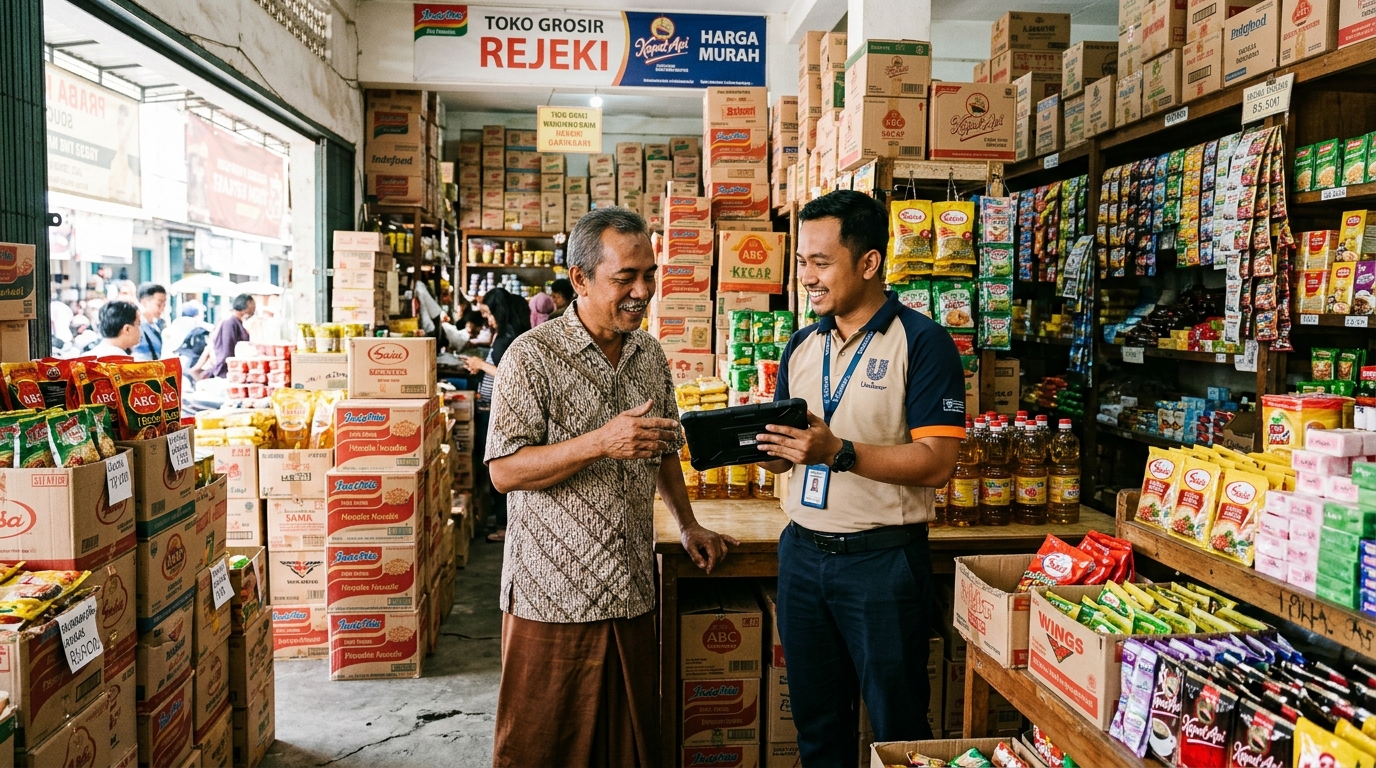
In many traditional outlets, the retailer's decision to stock a product is influenced by considerations that manufacturers sometimes underestimate. The shopkeeper needs confidence that consumers will purchase the product, that the selling price is competitive, that the retailer can earn an acceptable margin and that replacement stock will be available without creating unnecessary financial or operational inconvenience.
Space is limited, working capital is limited, and the retailer has no obligation to provide free storage for a manufacturer's ambitions. A product sitting on a shelf for six weeks may be a minor inconvenience to a large supermarket, but it can represent a meaningful amount of tied-up cash to a small independent shop.
Manufacturers therefore need to think about more than distribution coverage. They need to understand how their products generate cash for the retailers expected to sell them.
An affordable pack with a modest absolute margin but rapid stock turnover can be highly attractive to a traditional retailer. A more expensive product may offer a larger margin per unit but produce less profit over the course of a month because sales are slow. The retailer will usually figure this out considerably faster than the manufacturer's sales department, particularly when the same shopkeeper has to decide which products deserve scarce shelf space and which ones should quietly disappear from the next purchase order.
The same commercial logic applies to wholesalers. A wholesaler is interested in products that generate sufficient gross profit relative to inventory investment, handling requirements, customer demand and the credit extended to smaller retailers. A new brand that requires significant selling effort but offers little margin may struggle to attract attention, regardless of how enthusiastic its marketing materials happen to be.
In a secondary-city expansion strategy, the wholesaler network can be as important as the appointed distributor. Understanding which wholesalers supply particular clusters of outlets, what routes they operate and how frequently they replenish customers is essential. Sometimes it makes commercial sense to build distribution through an established wholesale network. In other cases, the company may need more direct sales coverage to ensure products reach retailers consistently and achieve adequate visibility.
The right answer depends on the economics of the category and the level of control required, but the manufacturer should understand the difference between having stock somewhere in the city and having products available in the outlets where consumers actually shop.
Your Distributor Is a Business Partner, Not a Charity
Geographical expansion also has a habit of exposing weaknesses in distributor economics that remain hidden while sales are concentrated in established territories.
Suppose a manufacturer identifies an attractive opportunity in a provincial city and appoints a distributor that already handles several established consumer goods brands. The distributor has a warehouse, a fleet of delivery vehicles, a reasonably capable sales organisation and a network of existing customers. Everything initially looks promising, especially because the distributor appears willing to add another brand to its portfolio.
The manufacturer agrees on an annual sales target, provides product information and perhaps supports the first few months with promotional materials. The distributor places an opening order, stock arrives, and the new territory is officially launched.
Unfortunately, distributing an additional brand is not quite as simple as placing another collection of cartons in the warehouse.
The salesmen must be trained, retailers must be convinced to stock the products, stock availability must be maintained, credit must be extended where appropriate, deliveries must be organised, and slow-moving inventory must be managed. If the products require dedicated selling attention, additional salespeople or merchandising support may be necessary. If the distributor's existing delivery routes do not reach the intended outlets, the business must either extend those routes or accept additional transport expenses.
All of this costs money, and somebody has to pay for it.
A distributor earning a reasonable percentage margin on a brand can still lose money if the sales volume is insufficient to cover the additional selling and servicing costs. Similarly, a manufacturer can generate perfectly respectable invoiced sales while the distributor struggles to convert that inventory into profitable sales to retailers.
I've always believed that manufacturers should examine distributor profitability much more carefully than they typically do. It is easy to complain that a distributor isn't investing enough effort in the brand, but the first question should be whether the distributor can actually earn an attractive return by doing so.
A company demanding dedicated sales coverage, extensive market development, frequent deliveries, generous retailer credit and ambitious geographical expansion cannot simply assume that its standard distributor margin will finance all those activities. The distributor must earn sufficient contribution to support the operation, otherwise the brand will inevitably become a lower priority than other products offering a better commercial return.
This is particularly important in geographically dispersed markets, where the cost of serving individual outlets may be considerably higher than in densely populated urban areas. A salesman visiting ten productive outlets along a compact city route has a very different cost structure from someone travelling substantial distances between smaller towns, especially if each customer purchases only a limited quantity of stock.
The manufacturer should therefore work with prospective distributors to establish a realistic operating model, including expected monthly sales, gross margin, selling expenses, delivery costs, warehousing requirements, credit exposure, inventory turnover and required investment in additional sales coverage.
If the distributor cannot generate an acceptable return under realistic assumptions, the solution is not to increase the sales target until the spreadsheet becomes profitable. It is to reconsider the commercial model.
That might mean focusing initially on a smaller geographical area, prioritising a narrower product assortment, working through wholesalers, increasing order quantities, adjusting delivery frequency or providing temporary market-development support. What matters is that the economics make sense for both parties.
A distributor that grows profitably alongside the manufacturer can become an extremely valuable long-term partner. One that loses money supporting the manufacturer's expansion strategy will eventually find something more rewarding to do with its working capital.
The Most Profitable Product Mix May Be Different in Every City
Product assortment and pricing deserve equally careful consideration. National FMCG companies understandably prefer standardisation because it simplifies manufacturing, procurement, inventory management, marketing and forecasting. Producing the same assortment for every territory is operationally convenient, and there is considerable value in avoiding unnecessary complexity.
However, standardisation becomes counterproductive when it ignores meaningful differences in consumer purchasing behaviour.
Worldpanel's 2026 research describes Indonesian shoppers as increasingly value-conscious, with some consumers reducing consumption or buying less frequently while others continue to spend selectively on affordable indulgences and premium products. Its first-quarter findings also indicated differences between categories, with food and beverages recovering, personal care facing downtrading pressure and beauty continuing to offer premiumisation opportunities.
The practical implication is that manufacturers should not assume every region needs precisely the same balance of entry-level, mainstream and premium products.
For a household-care manufacturer, the correct assortment might include a small affordable pack for consumers making frequent low-value purchases, a mainstream format providing good value for regular household use and a larger economical pack for consumers who prefer to stock up. The optimal balance will depend on local purchasing power, shopping behaviour, competitor pricing and the channels through which the product is distributed.
The cheapest pack is not necessarily the most economical for the consumer, because smaller packaging formats can carry a higher price per gram or millilitre. Equally, a larger format that offers excellent value per use is not helpful to a consumer who cannot comfortably afford the cash outlay required to purchase it.
This distinction between affordability and value is especially important when developing regional pricing strategies.
A manufacturer may also discover that the retail price needed to maintain its margins becomes uncompetitive after additional freight, distributor handling and retailer margins have been included. The product may have a perfectly sensible price in Jakarta but become substantially more expensive by the time it reaches a retailer in another island or a remote district.
The manufacturer then faces a commercial decision. Should it accept a lower contribution margin to maintain a competitive consumer price, adapt the pack size, improve logistics efficiency, supply through a different network or concentrate on customers who are willing to pay more?
Simply passing every additional cost to the consumer may protect the manufacturer's percentage margin while destroying demand. Absorbing all those costs may protect market share but leave the company selling products at an unattractive contribution.
Neither outcome is particularly useful.
This is why the regional product assortment, recommended retail price, distributor margin and logistics model need to be evaluated together. There is little value in identifying an attractive consumer segment if the company cannot serve that segment at a price consumers will accept and a margin the business can sustain.
Regional adaptation does not necessarily require launching completely different products for every city. In many cases, the best approach is to concentrate on a carefully selected core assortment, using existing SKUs in proportions appropriate to local demand. This can improve sales productivity while keeping manufacturing and supply-chain complexity manageable.
The temptation to launch the entire national product portfolio into every new territory should be resisted until the market has demonstrated that it deserves the additional assortment.
Before You Expand, Calculate What the Opportunity Is Actually Worth
Let's take a practical example. Imagine an Indonesian manufacturer of household cleaning products evaluating expansion into Semarang, Solo, Malang, Palembang and Makassar. The company already has an established product range and wants to identify which locations offer the most attractive opportunities for profitable growth in 2027.
Rather than treating the five cities as equally promising and immediately appointing distributors everywhere, I would begin with a structured commercial assessment. The purpose would be to understand the size of the accessible category market, the existing competitive landscape, the distribution infrastructure required and the economics of entering each territory.
For each city, I would examine the number and type of potentially relevant outlets, estimated category turnover, prevailing consumer prices, competitor presence, existing wholesaler networks and the availability of suitable distributors. I'd then look at the cost of transporting products into the territory, the likely selling expenses, the amount of working capital required and the contribution that could reasonably be generated once the business reaches a sustainable operating level.
The exercise should distinguish between total market potential and the much smaller share the company can realistically capture. A city containing thousands of retail outlets does not automatically represent thousands of customers. Some outlets will be unsuitable for the category, others will already have strong supplier relationships, and a considerable number may not be commercially viable to serve through the proposed distribution structure.
Let's assume that, in one of these markets, the manufacturer expects to establish a productive base of 250 active outlets, with each outlet eventually selling an average of 14 consumer units per week across the selected core assortment. Using a four-week trading period, that produces 14,000 units of monthly consumer sales.
If the manufacturer's net realised revenue averages Rp8,000 per unit, after the normal trade discounts and deductions reflected in the model, those sales would represent approximately Rp112 million in monthly net revenue. Suppose the manufacturer earns a contribution of Rp1,600 per unit after product costs and the normal variable commercial expenses associated with those sales. The resulting monthly contribution would be Rp22.4 million.
At first glance, this looks encouraging.
However, the company must still consider the incremental fixed costs of supporting the new territory. Let's assume these amount to Rp18 million per month, including the manufacturer's additional market-development support, supervision, local selling infrastructure and other costs not already captured in the per-unit contribution. That leaves approximately Rp4.4 million in monthly operating contribution before one-off launch costs, financing expenses, taxes and any other corporate overhead allocation.
That is rather less exciting than the original Rp112 million sales figure, although it may still represent a commercially worthwhile investment if the company has a credible plan to increase sales productivity.
Now suppose the business discovers that only 70% of the outlets included in the forecast consistently reorder, while the remainder fail to maintain the expected purchasing pattern. With everything else unchanged, monthly volume falls to 9,800 units and contribution drops to Rp15.68 million. Against the same Rp18 million of incremental fixed expenses, the territory is now losing approximately Rp2.32 million per month.
The company has entered a new market, gained retail distribution, generated meaningful sales and still managed to create an operation that loses money.
And these are illustrative assumptions, not actual market measurements for any of the five cities. Real results would depend on category velocity, trading margins, geography, route density, logistics, product mix and customer behaviour.
The calculation becomes even more interesting once initial market-development investment is included. If entering the territory requires Rp100 million in one-off costs, including introductory promotions, retailer activation, training and launch activities, recovering that investment from a stable monthly contribution of Rp4.4 million would take roughly 23 months. That simple payback calculation ignores financing costs and future changes in performance, but it is enough to demonstrate why management should examine geographical expansion as an investment rather than merely another source of sales revenue.
Of course, the business may be able to improve profitability by increasing average sales per outlet, improving product assortment, reducing delivery costs, expanding coverage through existing routes or negotiating better commercial terms. Those improvements are precisely what the expansion plan should identify and quantify.
What matters is understanding the economics before committing to a national roll-out, rather than discovering them after several quarters of disappointing results.
The Best Expansion Plans Begin with a Small Number of Real Customers
Once the initial market assessment identifies a promising territory, I would resist the temptation to launch aggressively across the entire city. A more sensible approach is to establish a controlled market-development programme involving a relatively small but representative selection of outlets, wholesalers and potential distribution partners.
For example, the company might begin with 40 or 50 carefully selected retail outlets across different commercial neighbourhoods and channels. These should not simply be the easiest shops to persuade into accepting an opening order. The sample needs to reflect the types of customers the company intends to serve at scale, including the differences between established neighbourhood shops, traditional market retailers, wholesalers and modern or specialty outlets where relevant.
The initial objective is not to maximise the opening order. It is to establish whether consumers actually purchase the products, whether retailers are prepared to reorder them and whether the company can maintain availability at an acceptable cost.
The first few weeks should provide useful information about product acceptance, retail pricing, competitor activity and selling rates. The following weeks are often more revealing, because they show whether the initial enthusiasm translates into repeat purchasing.
I would pay particular attention to the relationship between the number of outlets that initially accept the product and the number that continue purchasing after the first stock has been sold. Distribution figures can look impressive during a launch because sales teams are heavily focused on persuading retailers to take an initial order. A second order is rather more persuasive evidence that something commercially useful is happening.
It is also important to understand what happens inside the outlet. Is the product displayed where consumers can see it? Is the selling price consistent with the recommended positioning? Does the shopkeeper actively recommend the product, or is it gathering dust behind several better-known competitors? Are shoppers rejecting the price, unfamiliar with the brand, or simply unaware that the product is available?
A manufacturer can learn considerably more from an afternoon visiting a representative selection of retailers than from a beautifully formatted spreadsheet reporting that distribution has increased by another 200 outlets.
The objective is to identify a repeatable commercial formula: a suitable product assortment, a competitive consumer price, a workable distributor margin, a realistic outlet servicing model and sufficient consumer demand to generate consistent replenishment.
Once this formula has been demonstrated in a compact geographical area, the company can extend it into neighbouring districts and additional outlet clusters. If it fails, the business has an opportunity to adjust its approach without having committed substantial resources to a larger roll-out.
This is not an argument for timid expansion. It is an argument for using evidence to determine where aggressive expansion makes commercial sense.
Geography Has a Habit of Appearing on the Profit and Loss Statement
One of the reasons FMCG companies sometimes underestimate regional expansion costs is that logistics expenses are frequently considered separately from sales planning. The Commercial Director identifies an attractive market, the sales team negotiates distribution agreements, and the supply-chain department is subsequently asked to explain how the products can be delivered.
Indonesia's geography makes that separation particularly dangerous.
The cost of supplying a distributor depends on more than the distance between the factory and the destination. It can be influenced by shipment size, transport mode, warehousing arrangements, handling requirements, delivery schedules, infrastructure constraints and the reliability of the logistics network. Inter-island movements add complexity, particularly where freight schedules, transhipment or smaller onward deliveries are involved.
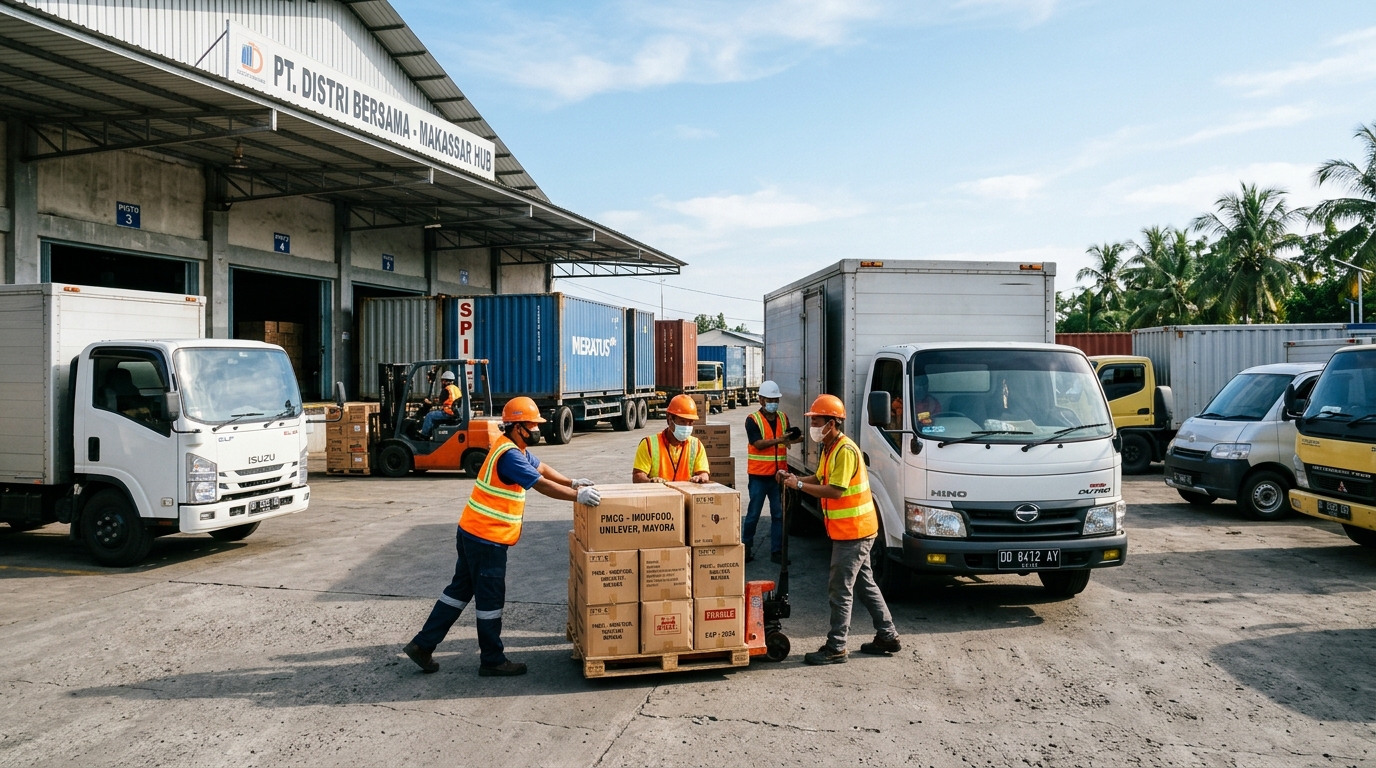
These challenges are not unique to FMCG companies. The World Bank's June 2026 Indonesia Economic Prospects report highlighted the difficulties created by fragmented logistics coordination and the high costs associated with domestic transportation. For manufacturers, the practical lesson is that a theoretically attractive sales opportunity can quickly become less attractive when the complete cost of serving the market is understood.
A company shipping full truckloads to an established distributor along a well-developed transport corridor may achieve reasonable logistics efficiency. The same company sending smaller quantities to a distant market, particularly one requiring additional storage and secondary distribution, could face a much higher cost per consumer unit.
The product itself matters too. A lightweight, relatively high-value personal-care item provides a different logistics proposition from a bulky household product or a low-value beverage. Shelf life, breakage risk, temperature requirements and packaging efficiency can all influence the economics.
The commercial organisation should therefore involve supply chain, finance and production in the territory-selection process from the beginning. It makes little sense to approve expansion based on gross margin and then discover that the company's actual delivered contribution is insufficient to support the operation.
Working capital deserves equal attention. A distributor may need to purchase several weeks of inventory before the products can be sold, while the manufacturer may need to finance production and transportation well before receiving payment. If sales develop more slowly than expected, capital becomes tied up in stock and receivables.
The larger the geographical footprint, the greater the potential complexity of managing that capital efficiently. Unsold products in a distant warehouse are not necessarily an asset worth celebrating, even if somebody has already counted the original shipment towards the monthly sales target.
E-Commerce Changes the Opportunity, but It Doesn't Eliminate Geography
There is another interesting development that companies should incorporate into their regional strategies. Indonesian consumers are increasingly combining traditional retail, modern trade, specialty outlets and online shopping, often using different channels for different categories and purchasing occasions.
Worldpanel's 2026 FMCG outlook reported that Indonesian households typically shop across three or four retail channels in a month, with almost 40% purchasing FMCG products online. During Ramadan 2026, online FMCG spending increased by more than 60% compared with the corresponding festive period in 2025, according to Worldpanel's August report.
These figures suggest that manufacturers should avoid defining regional expansion exclusively in terms of physical distribution.
A consumer in a secondary city may discover a product through social media, compare prices online, purchase it through a marketplace and subsequently buy it from a local retailer. Another shopper may follow the opposite journey, encountering a brand in a physical shop before ordering a larger pack online.
The channels can reinforce one another, but only if the manufacturer understands their respective roles.
For some categories, online sales can provide an attractive way to test consumer interest in a new market before committing to extensive physical distribution. Geographical sales data from marketplaces may help identify where demand is emerging, which products attract attention and how consumers respond to different price points.
However, online orders do not automatically demonstrate that a brand can operate profitably through traditional distribution. Marketplace promotions, platform fees, advertising costs, delivery subsidies and consumer purchasing patterns may produce economics that differ substantially from those of an ordinary retail outlet.
There is also the question of fulfilment. Selling a relatively inexpensive product online to a distant destination can become costly if shipping expenses represent a substantial proportion of the product's value. The availability of local inventory, suitable fulfilment infrastructure and an appropriate product assortment can make a considerable difference.
Manufacturers should therefore examine online demand as one component of their regional market intelligence, rather than assuming e-commerce will solve every distribution challenge.
A well-designed expansion strategy may involve using online channels to establish brand awareness and identify consumer demand, followed by carefully targeted physical distribution in areas where sales potential justifies the investment. In other markets, specialty retail or selected modern-trade outlets may offer the strongest starting point.
The objective should be to make products conveniently available through the channels consumers actually use, while maintaining acceptable economics across the entire route to market.
🧮 Model Your True SKU Contribution: If your secondary-city strategy incorporates marketplace e-commerce, test your actual unit margins with the free Indonesia Marketplace Margin Calculator to evaluate seller discounts, platform fees, logistics subsidies, and PPh 22 withholding.
Your Regional Sales Manager Needs a Business Plan, Not Just a Bigger Target
All of these considerations bring us to another weakness in conventional FMCG expansion planning: the way regional sales targets are established.
A company may identify an attractive opportunity outside its existing distribution footprint and assign the responsible regional manager an ambitious revenue target. The manager is then expected to find distributors, recruit customers, increase sales and somehow ensure that the entire operation becomes profitable.
The problem is that the sales target rarely explains the commercial activities required to achieve it.
If a regional manager is expected to generate Rp10 billion in additional annual sales, I would want to know how much of that growth will come from increasing sales to existing customers, how much from additional distribution and how much from genuinely new geographical territories. I would also want to understand the required investment, expected margins, distributor capacity and operational support.
A properly developed regional expansion plan should connect the market opportunity to specific commercial drivers. How many suitable outlets exist in the territory? How many can realistically be activated? What proportion should reorder? What is the expected average sales velocity per outlet? How frequently must customers be visited? How many salespeople are required, and how many productive calls can each salesperson make during a normal working day?
These are not especially glamorous questions, but they determine whether the revenue target has any chance of being achieved.
The regional manager should also be responsible for improving the productivity of the distribution network, not simply increasing its size. A territory with 1,000 consistently purchasing outlets can be more valuable than one reporting 3,000 outlets that have purchased the product at some point during the past year.
I'd want to see active distribution, repeat purchasing, sales per productive outlet, product availability, distributor inventory turnover and contribution by territory alongside the usual revenue figures. Where reliable sell-out or retailer purchase data are unavailable, the company should distinguish carefully between confirmed consumer demand and the movement of stock through distributors.
That distinction becomes particularly important when expansion creates pressure to deliver short-term sales results. It is remarkably easy to improve the current month's revenue by persuading distributors to purchase additional inventory. Unfortunately, loading stock into warehouses does not create additional consumer demand, and the following month's orders often reveal the difference.
Regional managers should therefore be encouraged to build commercially sustainable territories rather than simply delivering impressive opening shipments.
Their success should be measured by the quality and profitability of the business they develop, not by the enthusiasm with which they colour additional sections of the national distribution map.
Expansion Must Eventually Reach the Factory Floor
Another aspect that deserves attention is the connection between geographical expansion and production planning.
A manufacturer may identify several attractive new markets and develop ambitious plans to grow its customer base. Each regional manager submits a sales forecast, distributors provide estimated order volumes, and Marketing recommends additional products or pack sizes to improve local competitiveness.
Individually, all these plans may appear perfectly reasonable. Collectively, they can create a rather interesting problem for the production department.
Expanding geographically can change the company's demand profile in ways that are not immediately visible in the annual sales budget. Different territories may require different pack sizes, product assortments, replenishment frequencies and promotional calendars. A product that performs well in one region may sell considerably more slowly in another, creating an uneven distribution of inventory across the network.
If the manufacturer responds by producing small quantities of an increasingly fragmented assortment, production efficiency may deteriorate. More frequent changeovers, additional packaging materials, smaller production batches and increased inventory complexity can raise costs.
Alternatively, if production continues to prioritise the existing national assortment, distributors in the new territories may receive products that do not match local demand particularly well.
Neither situation is desirable.
This is where a properly functioning Sales and Operations Planning process becomes essential. Regional expansion assumptions must be translated into SKU-level demand forecasts, with clear distinctions between initial pipeline filling and sustainable replenishment demand.
The factory needs to know not only how much additional volume the commercial organisation expects to sell, but which products will be required, when demand is likely to occur and how confident the company is in those forecasts.
A new territory may require substantial initial inventory to establish retail availability, followed by several weeks of comparatively modest replenishment while consumer demand develops. Treating the initial distributor shipment as a normal monthly demand pattern can easily produce overproduction and excessive stock.
The better approach is to separate launch inventory, expected retail off-take, replenishment cycles and seasonal demand, and then update those assumptions as actual market performance becomes available.
The resulting plan should be shared across Sales, Marketing, Production, Procurement, Logistics and Finance. Otherwise, the company risks creating a situation in which Sales celebrates expanding distribution, Production struggles with increasingly complicated forecasts, and Finance wonders why so much working capital is sitting in warehouses several hundred kilometres from the nearest enthusiastic consumer.
How I Would Approach Indonesia's Secondary Cities in 2027
If I were preparing a geographical expansion strategy for an Indonesian FMCG company today, I would begin by examining the performance of the existing business before rushing into new territories.
Many companies already have significant opportunities to improve sales within their current distribution footprint. Outlets may not be adequately serviced, products may be frequently unavailable, distributors may be carrying the wrong assortment, or substantial potential may remain in smaller towns surrounding existing distribution centres.
Improving those weaknesses can sometimes generate a better return than entering an entirely new market, particularly because the infrastructure and commercial relationships are already in place.
Once the existing network has been properly evaluated, I would identify a manageable selection of potential expansion markets based on category consumption, household purchasing behaviour, competitive conditions and logistical accessibility. The objective would not be to find the largest cities, but to identify those where the company has a credible opportunity to establish a profitable and sustainable market position.
I would then involve local distributors, wholesalers and retailers in validating the assumptions. Their knowledge of consumer behaviour, outlet economics and competitive activity can be extremely valuable, provided it is assessed critically rather than accepted as an unconditional promise of enormous sales potential.
A distributor may genuinely believe a brand will perform extremely well in its territory, but enthusiasm should be supported by evidence about category turnover, achievable retail prices, expected sales volumes and operational requirements.
For the most promising markets, I would establish a limited commercial pilot, measure the results and build an evidence-based expansion model. That model should identify how the territory can grow from an initial group of productive customers to a larger and financially sustainable distribution network.
It should also establish clear conditions for further investment. If consumer acceptance is encouraging, repeat purchasing develops as expected and the economics are attractive, the company can accelerate expansion. If the results are disappointing, it should adjust the approach or reconsider the territory.
Not every opportunity deserves to be pursued, and deciding not to enter a market can be just as commercially intelligent as identifying one worth developing.
I would also resist the temptation to pursue too many markets simultaneously. Opening five territories at once may look ambitious, but opening two successfully and using what has been learned to improve the remaining launches can produce better long-term results.
Geographical expansion should create a stronger business, not merely a larger and more complicated one.
The Next Growth Opportunity May Be Closer Than You Think
Indonesia's secondary cities deserve considerably more attention from FMCG manufacturers than they sometimes receive. The market evidence from 2026 suggests that opportunities are developing unevenly, with purchasing behaviour, price sensitivity and category performance differing across regions.
For companies willing to study these differences carefully, there may be attractive opportunities to build distribution, recruit new consumers and establish stronger competitive positions beyond the country's most obvious commercial centres.
However, the opportunity should not be interpreted as an invitation to start appointing distributors everywhere outside Jakarta.
Secondary cities are not automatically profitable, consumers outside the major metropolitan areas are not a single homogeneous group, and geographical expansion does not become successful simply because the manufacturer has managed to deliver its products to another warehouse.
The strongest opportunities will be those where consumer demand, appropriate product positioning, workable distributor economics, reliable logistics and sustainable retail distribution come together.
That requires commercial discipline. It requires understanding local markets in more detail than national statistics can provide. It requires building realistic forecasts from expected consumer purchases rather than distributor opening orders, and it requires ensuring that the investment produces an acceptable return after all the costs of serving the market have been considered.
It also requires a willingness to challenge some long-established assumptions about where growth should come from.
For decades, many FMCG companies have understandably concentrated their resources on Indonesia's largest cities, where consumers, retailers and commercial infrastructure are easiest to reach. Those markets will remain important, and strong execution within them should continue to be a priority.
But Indonesia is much more than Jakarta, Bandung, Surabaya and a handful of other familiar commercial centres. It is an enormous collection of regional economies, consumer communities, distribution networks and purchasing behaviours, each presenting different opportunities and challenges.
The manufacturers that succeed in 2027 will not necessarily be those that establish distribution in the greatest number of cities. They may be the ones that understand precisely which markets deserve investment, which consumers they intend to reach, and how to build a profitable business once the first truckload of products has arrived.
After all, placing a new city on the sales map is relatively easy. Convincing its consumers to buy your products repeatedly, ensuring that retailers and distributors make money selling them, and generating an acceptable return for the manufacturer is where the real work begins.
And if the company's latest expansion strategy still consists primarily of identifying a city on Google Maps, finding a distributor willing to accept an opening order and assigning the regional manager a heroic sales target, perhaps it is time to ask whether the business is genuinely developing new markets or simply collecting warehouse addresses.
The distinction is rather important, particularly when Finance starts calculating the return on investment.
Research References
- Worldpanel by Numerator — Indonesia FMCG Outlook 2026, June 2026.
- Worldpanel by Numerator — FMCG Monitor Q1 2026, June 2026.
- Worldpanel by Numerator — Indonesia Ramadan 2026, August 2026.
- Worldpanel by Numerator — Indonesia Brand Footprint 2026, October 2026.
- Katadata — Indonesia's FMCG Growth Slumped in 2025, May 2026.
- Retail Asia — Indonesia FMCG Volumes Fall as Shoppers Narrow Spending Priorities, October 2026.
- Kadin Indonesia — Provincial Economic Profile.
- BPS Statistics Indonesia — Regional Economic Data.
- World Bank — Indonesia Economic Prospects, June 2026.
Editorial note: The five cities (Semarang, Solo, Malang, Palembang, Makassar) are illustrative expansion candidates, not a research-based ranking. The household-care financial model uses hypothetical figures to demonstrate territory profitability and should not be interpreted as actual sales, pricing or market performance data.
Recommended reading for this topic
Books and tools our editors link to this article. Purchases are completed on Amazon.com.
The Fortune at the Bottom of the Pyramid
C. K. Prahalad
Prahalad's argument that low-income consumers form a large, underserved market, and that serving them takes new price points, pack formats and access models.
Check current price on Amazon
Buy Now on Amazon

As an Amazon Associate I earn from qualifying purchases. Purchases are completed on Amazon.com. Affiliate disclosure
Related content
Your Container Has Arrived. Your Customers Haven't: The Real Guide to Entering Indonesia's FMCG Market in 2027
Indonesia is one of the world's most attractive consumer markets, but getting a product into the country is considerably easier than getting consumers to buy it. From navigating BPOM and halal regulations and selecting distributors to understanding retail margins, building nationwide distribution and deciding when local manufacturing makes sense, entering Indonesia in 2027 requires much more than an enthusiastic export manager and a container full of optimism.
The Cold Drink War: Why Beverage Brands Win or Lose at the Fridge, Not in the Boardroom
In beverage sales, getting your product into a store is only half the battle. Getting it cold, visible, competitively priced and into the consumer's hands is where the real business begins. From Indonesian warungs to modern supermarkets, beverage distribution is a surprisingly complicated game of logistics, psychology, refrigeration and commercial economics.
How to Know Whether a Sales Visit Actually Makes Money Without Sacrificing Your Brand
Improving sales route profitability sounds like an obvious objective for any FMCG company. But aggressive cost-to-serve cuts and minimum order sizes can kill a growing brand. Here is how to evaluate true visit economics, protect developing outlets, and balance route efficiency with long-term brand building in Southeast Asia.
How to Build a Better FMCG Route-to-Market
Designing channel roles, distributor economics, and service levels in one RTM framework.