Your Product Just Got a School Report
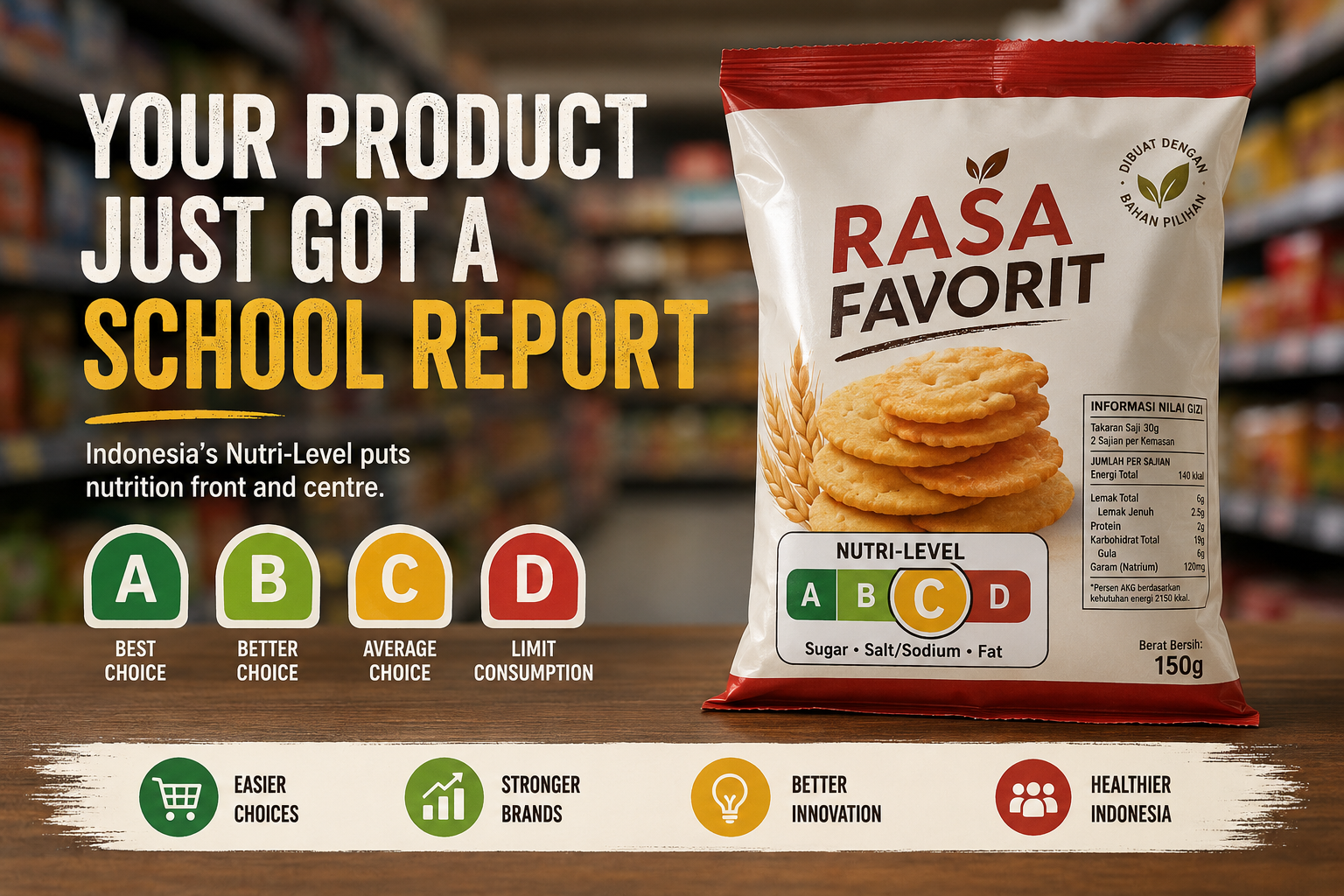
Under BPOM Regulation No. 10 of 2026, Indonesia has introduced front-of-pack Nutri-Level grading. Here is how sugar, salt, and fat grades (A to D) will turn reformulation into brand strategy, category management, and a front-of-pack marketing battle.
Your Product Just Got a School Report
How Indonesia’s Nutri-Level Could Turn Sugar, Salt and Fat Into a Front-of-Pack Marketing Battle
For most of FMCG history, the front of the package has belonged to Marketing.
This has been an unusually comfortable arrangement. Marketing could use the most valuable few square centimetres of cardboard, plastic or aluminium to tell the consumer almost anything it wanted, provided Regulatory eventually stopped objecting. There could be happy families, splashing milk, improbably perfect strawberries, green leaves, mountain streams, athletes emerging from gyms without sweating and words such as natural, active, premium and goodness displayed with the confidence normally associated with constitutional guarantees.
The nutritional information, meanwhile, stayed politely around the back.
This suited almost everybody. Consumers who genuinely wanted to know how many grams of sugar were inside could turn the package over, find the small table and begin doing mathematics in aisle five. Everybody else could focus on the picture of the strawberry.
Indonesia’s new Nutri-Level system changes that relationship in a deceptively simple way.
Under BPOM Regulation No. 10 of 2026, Indonesia has introduced front-of-pack nutritional grading designed to make levels of sugar, salt or sodium, and total fat easier for consumers to understand. The system uses four levels, A through D. The regulation was established on 9 June and promulgated on 17 June 2026, while BPOM told producers and importers that new processed-food registration applications received from 3 August onward should follow the new requirements.
There is something almost comically powerful about putting a letter on the front of a package.
FMCG companies can spend eighteen months developing a positioning, commission an agency to find the perfect emotional territory, shoot a television commercial in three countries and conduct research proving that consumers associate the new pack design with vitality, optimism and contemporary Indonesian family life.
Then the government puts a C next to it.
Suddenly the packaging has acquired a second copywriter.
This is why Nutri-Level is far more interesting commercially than it initially appears. It would be easy to treat it as another labelling regulation to be handled by Regulatory Affairs, Legal and the unfortunate person responsible for artwork changes. The real impact could reach much further. Once nutrition becomes easier to compare at a glance, reformulation becomes part of brand strategy, category management, pricing, innovation and even customer negotiations.
The nutritional table has escaped from the back of the pack.
Marketing should probably introduce itself.
When the consumer no longer needs a calculator
Nutrition labelling has always suffered from one practical problem: consumers are expected to understand it.
A nutritional table may contain calories, carbohydrates, sugars, saturated fats, sodium, protein and several percentages based on serving sizes that occasionally bear only a theoretical relationship to what a normal person actually eats.
A serving of breakfast cereal may be presented as a neat 30 grams. This is presumably consumed by someone using laboratory scales at 7:15 in the morning. The rest of humanity tips cereal into a bowl until it looks approximately right.
The same happens with snacks. A package may contain “2.5 servings”, which is an impressive level of optimism about human self-control.
Front-of-pack grading removes much of that complexity. A shopper does not have to calculate whether 13 grams of sugar in one product is meaningfully different from 9 grams in another while a child is asking whether they can also have biscuits.
She can see a letter.
That convenience is precisely what makes the system commercially powerful.
Imagine two competing drinks sitting beside each other. The brands are similarly priced, both are familiar and both have attractive packaging. One carries a better Nutri-Level than the other. Even if only a proportion of shoppers use the grade as part of the decision, the competitive dynamic changes.
The worse-rated brand now has something visible to explain.
For years, companies could compete through emotional positioning while the nutritional differences remained relatively hidden in small print. That does not mean consumers were being deceived; the information was there. But there is a considerable difference between information being legally available and information being immediately obvious.
A restaurant can technically display its hygiene report somewhere behind the counter.
It feels rather different when the score is printed on the front door.
For manufacturers, this creates a new commercial question. If a product sits at C and a modest reformulation could move it to B, what is that improvement worth?
That is no longer simply a nutritional question. It becomes an investment decision.
R&D will want to know what needs to change. Procurement will want to know what the replacement ingredients cost. Operations will want to know whether the reformulated product still behaves properly in the factory. Marketing will want to know whether consumers notice the taste difference. Sales will want to know whether retailers will give the improved product more support. Finance will want to know whether anybody is actually prepared to pay for all of this.
At some point somebody will suggest reducing the serving size.
Regulatory will look tired.
This is what makes the next phase interesting. Nutri-Level could turn reformulation into something closer to Revenue Growth Management. Companies will begin asking not simply whether a product can be made healthier, but which changes produce the greatest commercial return without damaging taste, affordability or brand equity.
That last part matters enormously in Indonesia.
It is easy to design the theoretically perfect product when price is irrelevant. Unfortunately, price has a habit of remaining relevant.
Indonesia is a market where tiny changes in consumer price can have very real consequences, particularly in mass FMCG categories. A new ingredient that improves the nutritional profile but increases cost substantially may look excellent in the laboratory and much less impressive when it moves the product above an important price point.
A Rp5,000 purchase occasion does not automatically become Rp7,000 because the formulation team has discovered something nutritionally exciting.
FMCG innovation has always been the art of balancing things that refuse to cooperate. Consumers want better nutrition, better taste, better ingredients, convenience, sustainability and affordability. The factory would also appreciate it if the product could run efficiently at high speed and remain stable in tropical conditions for a sensible shelf life.
The perfect formulation is healthy, delicious, affordable, sustainable, easy to manufacture and universally loved.
Unfortunately, it mostly lives in PowerPoint.
Singapore has already shown that labels can change what companies make
Indonesia is not experimenting in isolation. Across Asia, governments are becoming much more willing to use front-of-pack systems to influence both consumer behaviour and product formulation.
Singapore provides perhaps the most useful nearby example because Nutri-Grade has already moved beyond being just a label. Its system initially focused on beverages, grading them A to D based on sugar and saturated fat, with advertising restrictions applying to Grade D drinks. The government says the median sugar level of pre-packaged beverages fell from 7.1% in 2017 to 4.6% in 2023, while average daily sugar intake also declined. Singapore is now extending Nutri-Grade from mid-2027 to pre-packed salt, sauces, seasonings, instant noodles and cooking oils, targeting sodium and saturated fat as well.
That progression is important for FMCG companies in Indonesia because it demonstrates what happens once front-of-pack grading becomes established.
At first the conversation is about labels.
Then it becomes about formulation.
Eventually it can become about advertising, portfolio strategy and category architecture.
Singapore's experience also shows why food companies should avoid thinking about Nutri-Level purely as a compliance deadline. If a government introduces a grading system specifically because it wants companies to reformulate, one should at least consider the possibility that future policy will continue in that direction.
A company that simply redesigns the artwork and carries on as before may comply perfectly well. A competitor that uses the same regulatory change to improve its portfolio could end up in a stronger position.
There is a familiar FMCG lesson here: regulation creates the same rule for everybody, but companies rarely respond equally well.
One business sees an administrative burden.
Another sees a product-development brief.
The regulation is identical. The commercial outcome may not be.
This is particularly relevant in categories where products sit close to grading thresholds. If a relatively small reduction in sugar or sodium improves the front-of-pack result without materially damaging taste, the business case can become attractive. The change may create a better nutritional position, a new advertising message, stronger retailer conversations and possibly better consumer perception at the same time.
That is a much easier investment to defend than reformulation based purely on the sentence “consumers say they would like healthier products.”
Anyone who has worked in consumer research knows that shoppers possess an extraordinary ability to express healthy intentions while standing nowhere near a checkout.
Ask a focus group what they want and they may describe a high-fibre, low-sugar, sustainably sourced product made from natural ingredients.
Then put them in front of the shelf and discount the chocolate biscuits.
FMCG begins again.
A visible grade is different because it is present at the moment of choice.
Indonesia does not need every product to pretend it is broccoli
There is a danger with nutrition discussions that everything becomes moralistic very quickly. Products are divided into good and bad, responsible and irresponsible, healthy and unhealthy, as though every supermarket aisle is a philosophical examination.
That is not particularly useful.
Consumers eat for many reasons. Sometimes they want nutrition. Sometimes they want convenience. Sometimes they want pleasure. Sometimes they want a snack at 10 p.m. while watching television and have absolutely no interest in being educated by the packaging.
An indulgent product does not stop being indulgent because a front-of-pack system exists.
Chocolate is still chocolate.
A sweet biscuit does not need to wake up one morning and decide it has always wanted to be spinach.
The commercial challenge is therefore not necessarily to push every product towards A at any cost. It is to understand the role each product plays and make deliberate choices about the portfolio.
A company might have an indulgent product that carries a weaker grade but has strong brand equity and a clear consumption occasion. That can remain perfectly legitimate. Another product within the portfolio might be reformulated to provide a healthier everyday option.
That creates choice rather than pretending that every eating occasion has the same objective.
The danger comes when brands try to communicate one thing while the nutritional grade visibly communicates another.
Imagine packaging covered in green leaves, words about active living, images of oats and perhaps someone doing yoga at sunrise, while the front-of-pack grade tells a rather less energetic story.
Consumers are not stupid.
And social media has made the gap between branding and reality much easier to expose.
This is perhaps where Nutri-Level could become more powerful than regulators originally intended. The label will not exist only in supermarkets. It will appear in product photographs, marketplace listings, TikTok videos, influencer comparisons and WhatsApp conversations.
Once a nutritional grade becomes visually recognisable, consumers can use it as shorthand.
“This one is B.”
“That one is D.”
The entire nutritional argument has been reduced to something that fits comfortably in a comment section.
For FMCG companies accustomed to controlling the story around their brands, this may require some adjustment.
The internet has made every local formulation an international formulation
India is currently demonstrating another reason companies should pay attention. Debate over front-of-pack warnings has become increasingly heated there, with food manufacturers, regulators, health advocates and the courts all involved. Reuters reported this week on long-running industry resistance to more prominent warning labels for products high in sugar, salt and fat, while social-media scrutiny has increasingly focused on differences between versions of multinational products sold in India and those sold elsewhere.
This matters well beyond India.
Twenty years ago, an Indonesian consumer buying a soft drink had very little reason to know how the formulation compared with the version sold in Britain, Singapore or Australia. Unless she travelled regularly and had an unusual interest in nutritional labels, the comparison probably never happened.
Now someone can put two packages next to each other on TikTok.
The comparison may reach a million people before the regional headquarters has finished deciding which department should respond.
This is a major shift for multinational FMCG companies.
There are perfectly legitimate reasons for products to differ between countries. Consumer tastes vary. Regulations vary. ingredients vary. manufacturing footprints vary. Price points vary. A recipe designed for one market may not be appropriate for another.
All true.
It is also an explanation that can sound remarkably weak on social media when one version appears nutritionally worse than another.
The consumer's question is usually simpler.
“Why do they get less sugar than we do?”
The technically accurate answer might require a twenty-page presentation about market-specific formulation architecture.
TikTok would prefer seventeen seconds.
Indonesia's Nutri-Level therefore arrives in an environment where consumers are already becoming more capable of checking, comparing and challenging product claims. The label itself may accelerate that behaviour by creating a common visual language.
This is not necessarily bad news for manufacturers.
Companies that have invested in reformulation can make that progress much more visible. Products with genuinely strong nutritional profiles gain a simple proof point. New entrants may be able to challenge established brands without requiring huge advertising budgets if their formulation provides a meaningful advantage.
The uncomfortable part is that heritage becomes less useful as a defence against comparison.
A brand can be fifty years old and still contain more sugar.
Marketing is about to discover a new letter in the alphabet
The most obvious response from marketing teams will be to work out what can be said about the grade.
This will produce interesting packaging meetings.
If a product achieves A, Marketing will almost certainly want the consumer to notice.
If it achieves D, Marketing may discover an unexpected appreciation for minimalist design.
Between those extremes sits a huge amount of strategic possibility.
A favourable Nutri-Level could become part of launch communication, digital campaigns and retail activation. It might give Sales a stronger story when speaking to modern-trade customers. Retailers themselves may eventually create healthier-shopping filters, shelf navigation or digital search tools that incorporate nutritional grading.
The e-commerce implications are particularly interesting because comparison is easier online than in physical stores.
Imagine an online category where consumers can filter by price, pack size, rating and eventually Nutri-Level.
That would change the value of reformulation immediately.
A product does not merely carry a better logo. It appears in a different consideration set.
Retailers may also find the grading useful in their own health-positioning strategies. Supermarkets increasingly want to demonstrate that they are helping shoppers make better decisions, especially as governments become more active around non-communicable diseases and nutrition.
A retailer could highlight A and B products, create healthier baskets, recommend substitutions or incorporate nutritional scores into loyalty programmes.
None of that is guaranteed in Indonesia, but the commercial direction elsewhere makes it entirely plausible.
And once retailers begin using nutritional grading in their own algorithms or recommendations, the issue becomes even more important.
The front-of-pack letter would no longer only influence the human shopper.
It could influence the digital shelf as well.
That connects Nutri-Level with another emerging FMCG battle: machine-mediated shopping. If AI assistants increasingly build baskets based on instructions such as “choose healthier options for the family,” a structured nutritional grade becomes an extremely convenient piece of information for the machine.
The same letter that sits quietly on the pack could eventually affect whether an automated shopping assistant selects the product at all.
Marketing may therefore find itself selling to two audiences.
The consumer sees the brand.
The algorithm sees the data.
Both may notice the C.
The price problem will not politely disappear
All of this sounds straightforward until we reach the part that dominates almost every FMCG decision in Indonesia: affordability.
Healthy reformulation discussions in wealthy markets sometimes assume consumers have enough financial flexibility to absorb higher ingredient costs.
Indonesia does not always offer that luxury.
A product can be nutritionally superior, beautifully positioned and entirely irrelevant if it moves outside the price architecture of the category.
Manufacturers therefore have to approach Nutri-Level with commercial realism.
Reformulation cannot be separated from pack-price strategy.
If reducing sugar requires a more expensive ingredient system, perhaps the company needs to look at pack size, manufacturing efficiency or portfolio mix rather than simply passing the cost into retail price.
If a better nutritional grade gives the brand enough differentiation to support a premium, perhaps that works in an urban modern-trade segment but not in a mass traditional-trade SKU.
The answer may differ by channel.
This is where Indonesia becomes more complicated than markets dominated by large supermarket chains.
A consumer shopping at a premium supermarket in Jakarta may respond very differently from someone purchasing a small single-serve pack from a warung in a provincial town.
The same brand may need to operate across both occasions.
Companies that treat Nutri-Level purely as a national branding exercise risk missing this complexity. The commercial value of the grade may differ depending on channel, price point, consumer income, category involvement and purchase occasion.
There is also a risk of overestimating how quickly consumer behaviour changes.
People do not abandon decades of taste preference because a new label appears on Tuesday.
Healthier choice systems need time to become understood.
Some consumers will notice immediately. Others will ignore them. Some will care strongly in categories associated with health and much less when buying an indulgent treat.
The interesting effect may therefore happen gradually.
Companies reformulate.
Retailers begin using the grades.
Digital platforms make them easier to compare.
Consumers become more familiar with what A, B, C and D mean.
Eventually a product sitting at D may find that the commercial environment around it has become slightly less friendly than it was five years earlier.
That is how many important FMCG changes happen.
Not with a dramatic collapse.
With a steady accumulation of disadvantages.
The people who should care are not only in Regulatory Affairs
This is perhaps the biggest management mistake companies could make.
Nutri-Level looks like a regulation, so the instinct will be to give it to Regulatory.
Regulatory will make sure the artwork complies.
That is necessary.
It is not strategy.
The strategic conversation needs Brand, R&D, Sales, Category, Finance, Procurement and Operations in the room because the grading system touches all of them.
A brand team should understand where its products sit relative to competitors and whether the grade changes positioning.
R&D should know which products could realistically improve.
Procurement needs to understand the ingredient economics.
Sales needs to consider how customers might use the system.
Category Management should think about whether nutritional grading changes category segmentation.
Finance needs to assess which reformulation investments actually generate a return.
Operations needs to remind everyone that the factory exists.
This is not a call for another cross-functional committee with a motivational name.
FMCG already has enough committees.
It is simply recognition that a letter on the front of a package can influence far more than packaging.
The most commercially intelligent companies will probably begin by mapping their portfolios. Not because everything graded C or D needs an emergency reformulation, but because management should understand where the vulnerabilities and opportunities sit.
A highly indulgent brand with strong consumer loyalty may decide not to change.
A mass beverage sitting just above a threshold may have a compelling case for reformulation.
A children's product may deserve particular attention because parents are likely to use the grade differently.
A new innovation programme may decide that achieving B or better is a design requirement from the beginning rather than something R&D tries to fix six months before launch.
Those are strategic choices.
The regulation merely makes them harder to postpone.
A surprisingly large amount of FMCG strategy can fit inside one letter
The most interesting thing about Nutri-Level is that it takes something complicated and makes it visible.
Sugar, sodium and fat have always been present in product development discussions. Governments have been worried about them for years. Consumers increasingly care about them. Manufacturers have been reformulating portfolios long before Indonesia introduced this system.
What changes is the location of the conversation.
It moves from the nutrition panel to the front of the package.
That is a small physical distance and a large commercial one.
The front of the package is where brands compete.
It is where consumers make quick judgments.
It is where Marketing has traditionally controlled the hierarchy of information.
Once a nutritional grade enters that territory, nutrition stops being merely a compliance detail and becomes part of competitive positioning.
Some companies will dislike that.
Some will use it brilliantly.
The strongest response is probably neither panic nor virtue signalling. It is the usual FMCG answer: understand the consumer, understand the economics, improve the product where improvement creates value and do not destroy the taste in the process.
Consumers still have to enjoy eating or drinking the thing.
A nutritionally perfect beverage that tastes like diluted cardboard has achieved an impressive regulatory result and a less impressive commercial one.
Likewise, an excellent product that consumers cannot afford is not much use.
The winners will be manufacturers that can balance nutrition, taste, price and brand without treating any one of them as the only objective.
That has always been the job.
Nutri-Level simply puts the score closer to the consumer.
For decades, FMCG companies have spent extraordinary amounts of time worrying about whether consumers can recognise their logo from three metres away, whether the pack blocks well on shelf and whether the hero ingredient looks sufficiently appetising.
They now have another visual element to think about.
It contains no beautiful photography, no brand story and no carefully researched emotional promise.
Just a letter.
And when the front of the package says the brand is wonderful while the Nutri-Level says D, the consumer may decide for herself which part of the packaging she finds more persuasive.
Tools for this topic
View shopFMCG by Alex Notebook
Dot-grid strategy notebook for planning weekly commercial priorities.
The FMCG Pricing Handbook (eBook)
A practical handbook to design profitable price-pack architecture.
Trade Promotion Masterclass
Build higher-ROI trade plans with structured diagnostics and execution control.
Related content
First the Retailer Sold Your Product. Now It Is Selling Your Customer Back to You.
How retail media, shopper data, and digital platforms are transforming FMCG supplier-retailer economics from physical margin negotiations to paid customer access in Indonesia and beyond.
The Shopper Has Left the Store. Their AI Agent Is Doing the Shopping
What happens to FMCG marketing when AI assistants build grocery baskets and substitute products before a human ever sees the shelf? Explore the rise of agentic commerce and machine-legible brands in Indonesia.
The Weather App Has Joined the Sales Meeting
How heatwaves and weather volatility are quietly rewriting FMCG forecasting, demand planning, revenue growth management, pricing, and supply chains.