The Shopper Has Left the Store. Their AI Agent Is Doing the Shopping
What happens to FMCG marketing when AI assistants build grocery baskets and substitute products before a human ever sees the shelf? Explore the rise of agentic commerce and machine-legible brands in Indonesia.
The Shopper Has Left the Store. Their AI Agent Is Doing the Shopping
There is a quiet assumption underneath most FMCG marketing: sooner or later, a human being will actually look at your product.
It may happen in a supermarket aisle, on a retailer website, inside an app or while scrolling through a marketplace. But somewhere in the process, there is supposed to be a person making a choice. Someone notices the pack, recognises the brand, compares the price, remembers the advertising, sees the promotion and decides whether to buy.
That assumption is beginning to wobble.
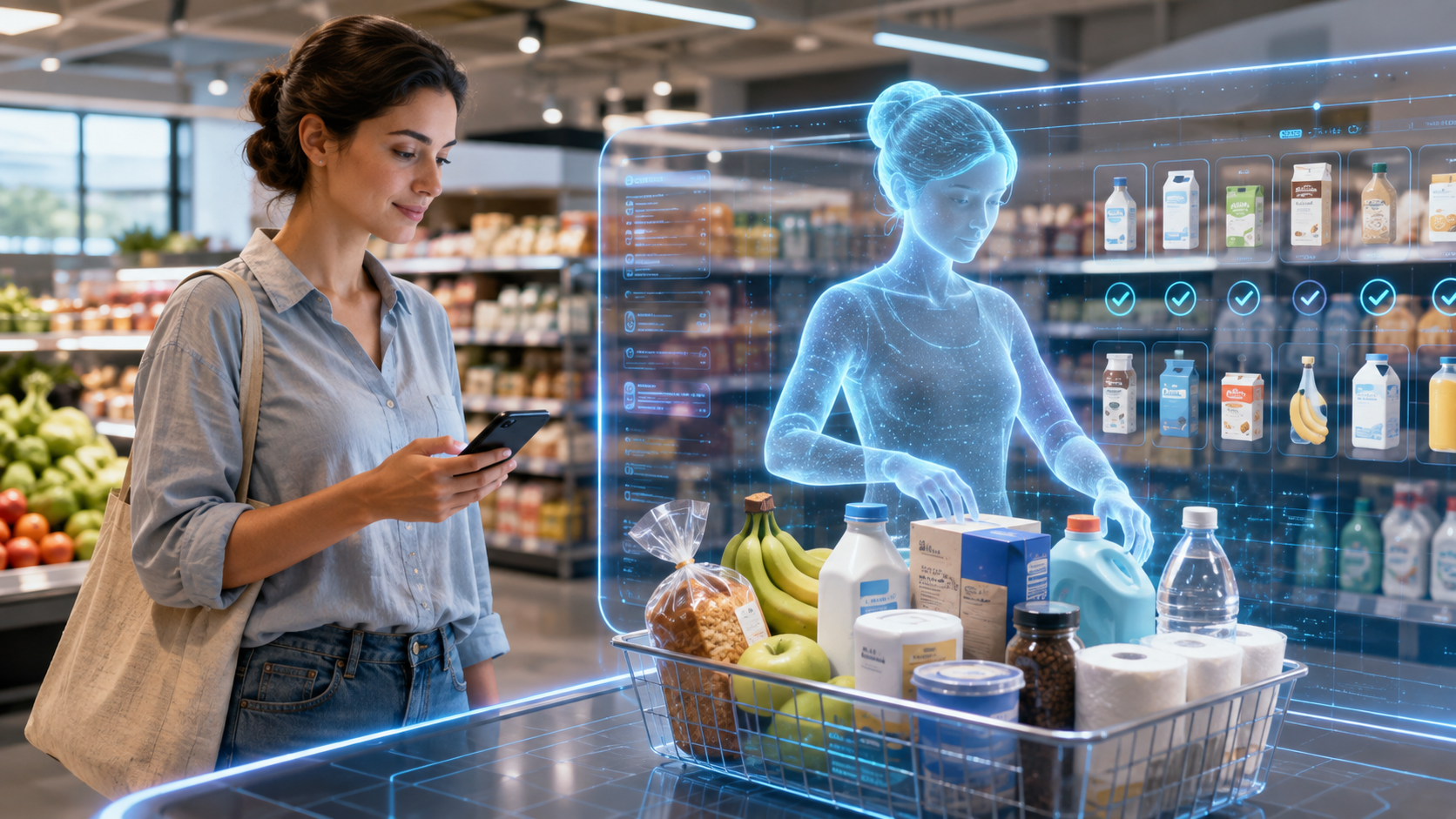
Imagine a consumer who no longer starts with a shopping list and then wanders through the category. Instead, she tells an AI assistant:
“Sort out breakfast for the family for the next five days. Keep it reasonably healthy, make sure there is enough protein, don’t go crazy on sugar and keep the total under €35.”
A few seconds later, a basket appears.
The interesting part is not that software has helped with the shopping. We have been automating bits of grocery retail for years. The interesting part is that the shopper may never have seen the alternatives.
She did not walk past your display.
She did not notice the new packaging.
She did not compare the two cereal boxes.
She did not see the promotional sticker.
She did not even reject your product.
It simply did not make the basket.
That is a very different commercial problem.
For the past hundred years, FMCG has become extremely good at influencing people. Brand building is, at least partly, the art of making a consumer choose one perfectly acceptable product over another perfectly acceptable product and feel good about doing so.
We use colour, packaging, advertising, memory, familiarity, endorsements, price, promotions, distribution and repetition. Ideally, by the time the consumer reaches the shelf, some of the decision has already been made.
AI agents interfere with that little arrangement because they introduce another decision-maker between the brand and the buyer.
And unlike the consumer, the agent does not have a childhood.
It does not remember the cereal its mother used to buy. It does not associate a certain washing powder with home. It does not get excited because the pack has been redesigned in a softer shade of blue after fourteen months of research.
It can simply compare things.
The machine may look at price, nutritional values, ratings, pack size, availability, previous purchases, dietary preferences and whatever else the consumer has asked it to care about. It can do that without getting bored, without a child pulling on its sleeve and without suddenly deciding that it has spent enough time in aisle seven.
For brands that genuinely mean something to consumers, this may not be a disaster at all.
If somebody tells the assistant, “Buy my usual Douwe Egberts,” then the AI has not weakened the brand relationship. It has automated it.
If a parent says, “Always buy the same nappies,” that instruction is about as strong a piece of brand loyalty as you could hope for.
In fact, AI may make real loyalty more visible because the consumer has to express it.
There is quite a difference between recognising a brand and insisting on it.
Aided awareness of 85 percent sounds wonderful in a research presentation.
“Never substitute this brand” sounds even better.
The real danger sits somewhere in the middle, where most FMCG brands live.
The consumer knows the name but does not care enough to insist on it.
She says, “Get me a good high-protein yogurt.”
Now the agent has freedom.
That is where things become uncomfortable.
A brand manager may believe the product has stronger emotional credentials, better packaging and more heritage. The agent may notice that another product has similar ratings, slightly more protein and costs 42 cents less.
Marketing says, “Our brand is about bringing people together.”
The machine says, “That wasn’t in the brief.”
This does not mean emotion is disappearing from FMCG. Human beings will continue to care about taste, trust, habit, identity and familiarity. People are not about to outsource every purchase to a spreadsheet wearing a chatbot costume.
But the more routine the category, the easier it is to delegate.
Nobody needs inspiration every time they buy dishwasher tablets.
Nobody needs a brand film before restocking toilet paper.
Nobody wants to rediscover the perfect cat food every Tuesday.
Routine replenishment is exactly where AI shopping starts to make sense, and routine replenishment happens to be where an enormous amount of FMCG volume lives.
Once consumers hand over that job, the route from “I need this category” to “this product is in the basket” becomes much shorter.
And when the route becomes shorter, some of the traditional marketing opportunities disappear.
The pack still matters when somebody sees it. But what if the machine decides before the pack is ever shown?
That moves a surprising amount of commercial power towards something FMCG companies have historically treated as rather boring: product information.
Nutrition.
Ingredients.
Certifications.
Pack sizes.
Dietary claims.
Ratings.
Availability.
Accurate descriptions.
Current pricing.
All the unglamorous data sitting somewhere between Regulatory, E-commerce and whoever drew the short straw when the retailer asked for a new product-information template.
For years, brands could get away with treating this as administration. The exciting work happened elsewhere. The campaign had music. The packaging had mood boards. Product data had spreadsheets.
AI may make the spreadsheet rather more important.
A machine can only recommend what it can understand.
If one product listing clearly says what the product contains, who it is for, what it costs, what its nutritional profile looks like and whether it is actually in stock, while another listing says “premium healthy lifestyle snack for moments that matter,” one of them is giving the agent significantly more to work with.
“Made with love” is a perfectly nice statement.
It is not a particularly useful product attribute.
This is where some brands may discover that all the effort invested in emotional storytelling does not remove the need to describe the thing being sold.
The strongest brands will probably end up doing both.
They will remain meaningful enough that humans ask for them by name, while being structured and legible enough that machines understand why they belong in the basket.
The ones in trouble will be those that are neither loved nor objectively compelling.
Not cheap enough to win on value.
Not distinctive enough to be requested.
Not better enough to survive comparison.
Just familiar.
Private label will enjoy this development enormously.
One of the great protections enjoyed by national brands has always been that consumers cannot be bothered to evaluate everything.
Standing in front of twenty packs of detergent, most people do not perform a full technical assessment of formulation, price per wash, online reviews and stain-removal performance.
They choose something they know.
That laziness is part of brand equity.
AI does not get tired.
It can compare every option each time, if the consumer allows it.
If the retailer’s own product has similar reviews, a lower price and the same essential functionality, the agent may decide that it is the sensible choice.
This is particularly interesting if the retailer owns the AI assistant as well.
Albert Heijn does not need to persuade customers to abandon Albert Heijn in order to use AI. It can build AI into its own environment.
That is exactly why retailer-controlled assistants matter.
The retailer already owns the shelf, the app, the transaction data and the private label. Add an intelligent assistant and it also starts to own the conversation.
A shopper asks for “a healthy breakfast for four.”
The system decides what healthy means, which products qualify and which ones appear first.
There is a substantial commercial difference between being the supermarket and being the supermarket that answers the question.
Retailers understand this very well because they have spent years trying to prevent the customer journey from starting somewhere else.
They built apps, loyalty programmes, recipe platforms, personalised promotions and retail media networks for exactly this reason. The company that controls the entry point has more influence over everything that follows.
Agentic shopping raises the stakes.
If consumers increasingly start with a general-purpose assistant instead of a retailer app, the supermarket risks becoming the fulfilment layer behind somebody else’s interface.
That is not where retailers want to end up.
Nor, for that matter, is it where brands want to end up.
If a consumer says, “Buy tonight’s dinner,” the crucial commercial question becomes: who gets to interpret the request?
The AI platform?
The supermarket?
The brand?
The consumer’s previous purchase history?
The promotion running that week?
The product paying for sponsored visibility?
These things are not trivial.
A search result can show ten products.
An agent may simply choose one.
Being number four on a search page is disappointing.
Being number four in a system that buys number one is commercially useless.
That is a major difference between ordinary e-commerce and agentic commerce.
Traditional digital retail still assumes the consumer will browse.
Agentic retail increasingly assumes she may not.
This is where some of the current language around “AI shopping” actually undersells what is happening. It sounds like another convenience feature, a slightly cleverer chatbot that helps find pasta.
But once the assistant can assemble baskets, compare products, substitute items and eventually complete payments, it is no longer just helping the shopper.
It is participating in the choice.
And FMCG has always been about influencing choice.
The mechanics of promotions may change too.
Human beings are wonderfully susceptible to a large yellow sign saying “2 FOR €5.”
We see the sign and immediately feel there may be value nearby.
The agent can divide.
It can discover that buying one larger pack elsewhere still costs less. It can notice that the two-for-one offer creates more product than the household normally uses. It can compare the promotional price with the historic price and perhaps conclude that this week’s “spectacular deal” is mainly spectacular typography.
This may force promotional mechanics to become genuinely competitive rather than merely visually persuasive.
At the same time, AI could become extremely good at hunting real promotions.
Tell an agent to “restock the household basics but switch when there is a genuinely better deal” and suddenly every manufacturer is negotiating with a consumer who effectively has a procurement department.
Brands may find that the shopper has become strangely good at Revenue Growth Management.
There is also a fascinating question around substitution.
Today, a shopper who cannot find her regular cereal may physically see what she chooses instead. She notices the switch.
An agent can make that substitution quietly.
The preferred brand is out of stock, so the assistant selects another product. The groceries arrive. Breakfast happens. Nobody holds a ceremony for the brand that disappeared.
If the substitute performs perfectly well, the next instruction may simply become, “That one is fine.”
Brand switching becomes almost invisible.
That is not a small issue for FMCG companies that have spent decades monitoring switching behaviour through panels and research.
An AI agent could create switching without the consumer even experiencing it as switching.
This makes availability even more important.
Being out of stock has always been expensive. In an agentic environment, it may also teach the machine a replacement.
The brand loses the transaction and possibly helps establish the alternative.
Not ideal.
Indonesia makes this especially interesting because conversational commerce is already normal.
Consumers are comfortable asking sellers questions through WhatsApp, sending photos, requesting recommendations and completing transactions through chat-driven journeys. Moving from “Can you recommend something?” to “Please sort this out for me” is not an enormous behavioural leap.
A shopper may eventually type:
“Groceries for five days, family of four, Rp500,000 budget, simple breakfasts, school snacks and nothing too spicy for the youngest.”
That request contains far more commercial information than most search bars ever receive.
The assistant can interpret the need, build a basket and perhaps choose between modern retail, marketplaces, quick commerce and other connected channels.
For smaller FMCG brands, that could be either extremely good news or extremely bad news.
A local product no longer necessarily needs premium physical shelf space if the system can discover it because it fits the brief better.
But the product needs to be discoverable in the first place.
A wonderful Indonesian SME product with incomplete online information may lose to an average multinational product whose data is immaculate.
This is why the next digital divide in FMCG may not be between brands that are online and brands that are offline.
It may be between products machines can understand and products they cannot.
That becomes a very practical issue.
Plenty of smaller manufacturers still have online product descriptions that amount to a photograph, a name and some enthusiastic adjectives.
“Delicious premium healthy quality.”
Fine.
Healthy how?
How much protein?
How much sugar?
What allergens?
What pack size?
Halal certified?
Suitable for children?
Shelf stable?
The human seller may know all of this.
The machine does not know anything that has not been made available to it.
That will matter more as shopping becomes conversational.
There is a temptation, of course, to treat all this as the death of branding.
That would be silly.
People are still people.
They will still discover products in stores. They will still care about packaging. They will still see advertising, follow creators, notice trends, taste products at friends’ houses and develop preferences that make absolutely no economic sense.
Thank goodness.
FMCG would be a very dull industry if people behaved rationally.
But consumer behaviour does not need to change completely to alter category economics.
If even part of routine replenishment becomes delegated, that is meaningful.
The boring repeat purchases are enormous businesses.
Coffee.
Laundry detergent.
Pet food.
Nappies.
Breakfast cereal.
Water.
Household cleaning.
Basic personal care.
These categories depend heavily on habit.
Agentic shopping is basically habit with software attached.
The winners will be the brands that can get themselves written into the habit.
“Always buy this.”
“Never substitute that.”
“Use our usual one.”
Those may become some of the most valuable sentences in consumer goods.
The challenge is getting there.
That still requires everything brands have always needed: product performance, trust, relevance, availability and a reason for the consumer to care.
AI does not remove the need for brand building.
If anything, it may expose the difference between brands consumers genuinely care about and brands they merely recognise.
The recognised brand enters the comparison.
The loved brand enters the instruction.
That is the distinction worth paying attention to.
For years, FMCG companies have fought for a place in the consumer’s mind.
They have paid for awareness, shelf position, search visibility and increasingly retail media.
The next battle may be stranger.
Brands will need to remain memorable to humans while becoming legible to machines.
They will still need the packaging that catches the eye.
But they may also need the data that answers the request.
They will still want emotional loyalty.
But they will also want to become a default.
And they may have to learn that the next shopper entering the category will not always walk through the aisle, compare the packs or even consciously choose between them.
She may simply say:
“Get the usual groceries.”
Then go and do something more interesting.
The AI will take it from there.
For FMCG brands, the important question is whether it takes you with it.
Tools for this topic
View shopCommercial Execution Tee
Soft cotton tee celebrating disciplined FMCG execution.
Related content
What Indonesia’s Marketplace Tax Collection Actually Does to Your SKU Margin
Indonesia’s marketplace PPh 22 collection is scheduled to begin on 1 November 2026. Here is what the 0.5% actually means for SKU margin, settlement cash, pricing and marketplace reconciliation.
The New FMCG Shelf Is an Algorithm: A Story About Winning Online Visibility Without Becoming a Discount Addict
FMCG brands no longer fight only for supermarket shelf space. They now fight for search ranking, marketplace visibility, reviews, quick-commerce availability and algorithmic attention. Here is how to win the new digital shelf without becoming addicted to discounts.
Hiring Trends in Indonesia's FMCG Sector (2025-2026)
Indonesia's FMCG hiring market in 2025-2026 is shifting from volume hiring toward capability-led recruitment across sales, brand, e-commerce, and supply chain.