First the Retailer Sold Your Product. Now It Is Selling Your Customer Back to You.
How retail media, shopper data, and digital platforms are transforming FMCG supplier-retailer economics from physical margin negotiations to paid customer access in Indonesia and beyond.
First the Retailer Sold Your Product. Now It Is Selling Your Customer Back to You.
There was a time when the economics of supermarket retail were fairly easy to explain. A manufacturer made something, a retailer bought it, put it on a shelf and sold it for more than it had paid. The annual negotiation was essentially a long and occasionally theatrical argument over how much of the difference each side deserved. The supplier would arrive with charts showing higher costs for raw materials, packaging, labour, fuel and transport. The buyer would counter that consumers were under pressure, competitors were becoming more aggressive and the category was not growing quickly enough. Somewhere in the middle of all this, the manufacturer would ask for a price increase, the retailer would ask for more promotional support, and after several rounds both sides would agree to something neither had originally proposed. Everyone would then describe the result as a partnership.
That basic model has not disappeared, but it has become considerably more complicated because retailers have realised that there is another valuable asset inside the store: the customer herself. More precisely, there is value in knowing what she buys, when she buys it, whether she switches brands when prices rise, which products she only purchases on promotion, whether she has children, what else is in her basket and whether she comes back to the same product two weeks later. Once that behaviour becomes visible through loyalty programmes, apps, marketplaces, digital payments and online shopping, the retailer has something that is valuable not just for running stores but for selling advertising.
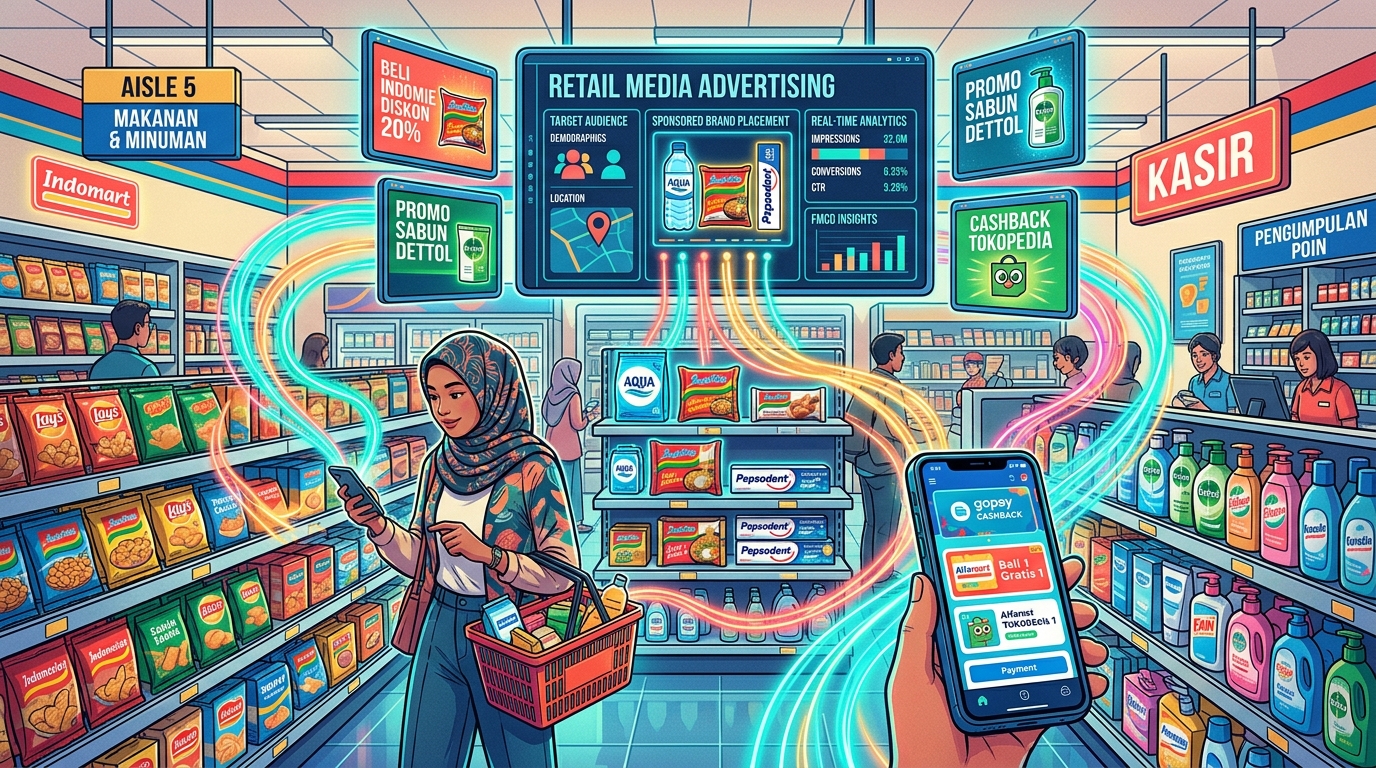
That is where the modern FMCG relationship becomes rather elegant. The supplier develops the product, invests in brand building, pays for distribution and persuades people to buy. Those purchases generate shopper data inside the retailer's ecosystem. The retailer then takes that data, builds a media proposition around it and offers the supplier the opportunity to pay for access to the very people buying the supplier's products.
It is difficult not to admire the circularity.
Why Retailers Love Selling Attention Instead of Moving Pallets
This is already happening at scale around the world, and the direction is becoming increasingly relevant in Indonesia and Southeast Asia. Walmart is the obvious global example because its advertising business has been growing far faster than mature retail sales and because the margin profile of advertising is so attractive compared with moving physical goods through stores. A pallet of beverages has to be manufactured, shipped, stored, unloaded, replenished and occasionally dealt with after someone drops it in aisle seven. A sponsored placement has none of these operational inconveniences. It does not expire, leak, require refrigeration or arrive with six crushed cartons.
For a retailer accustomed to grocery margins, media can look almost indecently attractive.
The important point, however, is not that supermarkets are becoming advertising agencies and forgetting how to sell groceries. It is that retail creates the audience that makes the advertising valuable. The stores, apps and online platforms generate millions of transactions, and those transactions reveal what people actually buy. That gives retailers something traditional media companies have always struggled to obtain: a direct connection between advertising exposure and purchase behaviour.
A broadcaster can tell a detergent company how many people probably saw its commercial. A retailer can potentially say that a household saw an offer on Monday, bought the product on Wednesday, purchased it again three weeks later and switched to a competitor when the promotion ended. The first tells you something about attention. The second gets much closer to telling you what happened to the money.
For FMCG marketers, that is enormously attractive.
It is also where the relationship with the retailer begins to change.
From Shelf Space to Digital Rent: Defending Visibility
For years, suppliers paid for physical visibility. Gondola ends, leaflets, displays and promotional spaces were all part of doing business. Today, the same commercial logic is moving into digital environments. A product can be listed online but still be almost invisible if it appears far down in search results. A competitor can buy sponsored placement above it. The brand can respond by buying its own sponsored placement, at which point both suppliers are effectively bidding against each other for visibility inside the retailer's digital store.
There is nothing inherently wrong with this. If a sponsored position brings genuinely new shoppers into the brand, it can be excellent marketing. The awkward question is what happens when a company starts paying simply to recover visibility it previously received organically.
Suppose your coffee brand has historically appeared near the top of a retailer's search results because it sells well. Competitors begin buying sponsored placements, pushing you lower. You respond by spending on sponsored search, recover your position and see sales improve. The dashboard will quite reasonably show that the campaign worked. But commercially there is a difference between creating new demand and paying to defend an existing position. One is growth; the other is starting to look a little like rent.
The Indonesian Context: Minimarkets, Grab, Alfamart, and Occasions
That distinction will matter more as retail media expands in Asia, because the ecosystem here is not limited to large supermarket chains. In Indonesia, commerce is spread across minimarkets, supermarkets, marketplaces, delivery apps, loyalty programmes and traditional trade, with consumers moving between them without caring very much which internal company department owns which channel. A household might see a product on TikTok, order it through GrabMart, pick it up at Alfamart later in the week and then buy it from a neighbourhood warung the next time. To the consumer it is one brand. To the manufacturer it can look like four unrelated lines in four different reports.
This is exactly why Indonesia is such an interesting market for the next stage of retail media. The country combines enormous FMCG frequency with high mobile engagement, sophisticated marketplaces, very dense modern trade networks and a traditional trade channel that remains commercially critical. It is not simply a smaller version of the United States. The way people discover, order and buy products is more fragmented, more mobile and often more conversational.
Alfamart is a good example of how the retailer relationship is already broadening. To the consumer, it remains a convenient place to buy drinks, snacks, toiletries and household essentials. Commercially, however, the ecosystem around Alfamart now includes Alfagift, loyalty data, digital activation and increasingly sophisticated consumer engagement. The retailer is no longer limited to selling the supplier a place on a physical shelf. It can help the brand reach members digitally, activate shoppers through loyalty and connect activity much more closely to transaction behaviour.
That is a much more valuable proposition than a cardboard display near the cashier, although FMCG being FMCG, the cardboard display will probably survive as well.
Grab takes the logic in another direction. It sits across mobility, food delivery, grocery delivery and digital advertising, which means it can understand consumer occasions in ways that a traditional supermarket cannot. In Indonesia, that becomes particularly powerful around moments such as Ramadan and mudik, when travel, eating patterns and purchasing behaviour all change dramatically at the same time. A brand can potentially reach people during a relevant occasion and move them directly towards a purchase inside the same ecosystem.
The older advertising model was more hopeful. Put a billboard beside the road, show a cold beverage, and trust that the consumer would remember it at the next minimarket. The newer model can be much closer to the transaction. The platform understands the context, serves the message and may provide the route to purchase immediately.
That starts to blur the traditional boundary between marketing and route to market.
For Indonesian FMCG businesses, that is especially important because beautiful digital execution still cannot rescue poor physical availability. A brand can run an extraordinarily sophisticated campaign aimed at consumers in Surabaya, Medan or Makassar, but if the product is sitting in the wrong warehouse, all the targeting in the world merely creates disappointed demand more efficiently. The advertisement can move at internet speed. The carton cannot.
The Internal Silo Problem: Paying the Same Customer Four Times
This is why retail media should not be treated as a standalone media discipline in Asia. It needs to sit much closer to commercial planning, distribution and customer strategy.
The difficulty is that most FMCG organisations were not designed that way. Sales manages customer terms and promotions. Marketing manages brand budgets. E-commerce often has its own activation money. Trade Marketing funds in-store activity. Category Management may buy data and Shopper Marketing sits somewhere in the middle trying to connect all of them.
The retailer, meanwhile, may be receiving money from all of these departments.
This creates one of the less glamorous but more important questions in modern FMCG: does anyone actually know how much the company is spending with one customer?
A Key Account Manager can look at the trade terms and conclude that the account is profitable. Marketing can point to a strong return on retail-media spend. E-commerce can show improving conversion. Trade Marketing can demonstrate promotional uplift. Each result may be entirely correct. Then Finance combines the numbers and discovers that everyone has been paying the same retailer from different pockets.
This is not because anybody has done anything wrong. It is because the organisation was built around a world in which media spending and customer spending were clearly separate. Retail media has quietly made that separation much less useful.
If a company spends IDR 5 billion on trade support and another IDR 3 billion on media sold by the same retailer, it may still be perfectly sensible to spend all IDR 8 billion. But management should at least know that it is spending eight rather than five.
The same applies to marketplaces. In Southeast Asia, a brand can generate very impressive sales through Shopee, Lazada or TikTok Shop while simultaneously funding vouchers, commissions, ads, free shipping, affiliates and promotional participation. The topline can grow beautifully while contribution margin becomes increasingly shy.
This is one reason GMV is such a pleasant metric. It rarely ruins the mood.
The harder question is what remains after all the costs of creating that GMV have been paid.
Incrementality vs. Attribution: Did the Ad Create the Sale?
Retail media has the same challenge. Campaign dashboards naturally focus on what happened after people saw the advertising. That is useful, but it does not automatically tell us what would have happened without the advertising. A consumer who has bought the same coffee every week for five years may still buy it after seeing a sponsored placement. The platform can attribute the purchase to the campaign, but it would be ambitious to suggest that the campaign created the entire sale.
This is where incrementality becomes more important than attribution.
The relevant question is not simply whether sales occurred after an ad was shown. It is whether additional profitable sales occurred because the ad was shown. Did the brand recruit new households? Did existing buyers purchase more frequently? Did shoppers switch from a competitor? Did they repeat after the promotion disappeared? Did the campaign grow the category, or did it merely move familiar buyers through the same transaction with another media cost attached?
These are old commercial questions wearing new digital clothes.
When Your Customer Becomes Your Competitor and Your Media Vendor
They also matter because retailers increasingly own competing products. Private label has always made the supplier-retailer relationship slightly unusual, but retail media makes it more so. The retailer can now control the shelf, the online search environment, much of the customer data and a growing advertising business, while also selling its own alternatives to national brands.
That does not mean retailers are secretly conspiring against suppliers. Strong national brands remain highly valuable because they generate traffic, innovation, excitement and consumer demand. But the structure of the relationship is worth understanding. A manufacturer may find itself buying advertising from its customer in order to compete more effectively against its customer's own brand.
There are not many industries where that sentence sounds normal.
In FMCG, it does.
The strategic response should not be to resist retail media. That would be pointless. The underlying economics are too attractive for retailers, and the targeting and measurement opportunities are too useful for brands. Retail media will continue to grow because there is real value in connecting shopper attention more closely to purchase behaviour.
The better response is to become much more disciplined about how it is bought.
For manufacturers in Indonesia and across Asia, that means looking at the retailer as a complete commercial ecosystem rather than as a collection of separate budget lines. Trade terms, promotions, digital media, loyalty activation, marketplace investment and shopper data should not necessarily be merged into one undifferentiated number, but they should be visible together.
Otherwise, a company can optimise each individual programme while making the total relationship steadily more expensive.
The Future: AI Assistants and the Modern Key Account Negotiation
This becomes even more important as AI begins to enter commerce. Retailers and platforms are starting to experiment with assistants that can help shoppers plan meals, create lists and select products. If that becomes normal, the role of retail media may gradually move beyond influencing what consumers see towards influencing what systems recommend.
For a brand manager, that is a very different problem.
The old question was whether the product had enough facings.
Then it became whether the product appeared high enough in search.
The next question may be whether the retailer's assistant thinks the product is the best answer when somebody asks, “What should I buy for dinner?”
The supermarket has travelled quite a long way from stacking cans.
Yet the core commercial relationship remains surprisingly familiar. Retailers need good products, strong brands and suppliers who can grow categories. Manufacturers need distribution, access to shoppers and customers capable of bringing their products to market efficiently. Neither side is about to disappear.
What has changed is that retailers have discovered many more ways to make money around the transaction.
They can earn margin on the product, sell advertising around the product, use loyalty data to improve targeting, create paid visibility in search, monetise audiences outside their own stores and increasingly build digital services around the shopper relationship.
For FMCG suppliers, the consequence is not that the retailer has somehow become the enemy. It is that the customer has become commercially more sophisticated, and the supplier needs to do the same.
The old annual negotiation was about price, promotions and volume. The new one is gradually becoming a conversation about the entire economics of access to the shopper.
That may include distribution, visibility, data, media and eventually recommendation.
Which is why the modern Key Account Manager may reach the end of a long annual negotiation, finally close the pricing spreadsheet and believe the difficult part is over. Price has been agreed. Promotions have been agreed. Volume targets are in place. Everyone has shaken hands.
Then someone from the retailer's media team opens another laptop and says, very cheerfully, “Great. Shall we discuss your activation budget?”
At that point, the supplier may reasonably wonder whether the shelf comes with curtains.
Tools for this topic
View shopTrade Promotion Masterclass
Build higher-ROI trade plans with structured diagnostics and execution control.
Related content
The New FMCG Shelf Is an Algorithm: A Story About Winning Online Visibility Without Becoming a Discount Addict
FMCG brands no longer fight only for supermarket shelf space. They now fight for search ranking, marketplace visibility, reviews, quick-commerce availability and algorithmic attention. Here is how to win the new digital shelf without becoming addicted to discounts.
Beauty on the Shelf: A Story About Selling Personal Care and Cosmetics in Indonesian Modern Trade Without Losing Your Mind
A humorous, story-driven guide to personal care and cosmetics sales strategy in Indonesian modern trade, covering listing, shelf execution, beauty advisors, promotions, testers, compliance, online pricing and repeat purchase.
The Shopper Has Left the Store. Their AI Agent Is Doing the Shopping
What happens to FMCG marketing when AI assistants build grocery baskets and substitute products before a human ever sees the shelf? Explore the rise of agentic commerce and machine-legible brands in Indonesia.
Trade Promotion ROI Dashboard Walkthrough
A practical dashboard design for tracking promo effectiveness by retailer and mechanic.