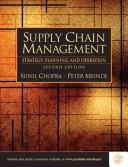
Strategic Supply Chain Management
by Shoshanah Cohen, Joseph Roussel
An executive-level view of supply chain as a source of competitive advantage, showing how strategy, planning, sourcing and execution fit together and connect to business results.
Why does it matter in FMCG?
Supply chain is often discussed in FMCG as a cost line: freight rates, warehouse rent, factory efficiency. This book argues for a wider view in which supply chain design follows from the competitive position the company wants and is judged by how well it supports that position and contributes to business results. A commercial leader deciding whether to pay for faster replenishment, wider coverage or a more flexible range gets a vocabulary for making that case to finance and operations.
The authors write for managers rather than specialists, so the book moves between strategy and practice with little mathematics. It is structured around a set of core capabilities that a company has to build and keep aligned, instead of a single technique. Read after a technical text on inventory or forecasting, it helps put those tools in their strategic place and shows why excellence in one area can be wasted if another lags behind.
The book's frame of reference is the large, multi-site company, so it transfers more easily to a multinational FMCG head office than to a regional brand working through distributors. What carries over is the discipline of linking supply decisions to strategy and to financial measures; what does not is any detail on retailer service agreements, trade promotion or traditional-trade distribution.
Where you can apply it
- Prepare the supply chain section of a three-year plan that explains how service, cost and flexibility choices support the chosen customer and channel positions.
- Frame a conversation between commercial and supply chain leaders about which customers or channels justify faster, costlier service.
- Assess whether planning, sourcing and operations capabilities are developed evenly or whether one is holding back the others.
- Structure a review of supply chain organisation and metrics ahead of expansion into a new market or channel.
What you should take away
- Explain how supply chain strategy should follow from business strategy and the customer promise.
- Describe the main capabilities a company must develop and align to run a supply chain well.
- Relate supply chain decisions to business results such as cost, service and growth.
- Frame supply chain trade-offs in terms an executive team or board can discuss.
Who benefits most?
Commercial directors, general managers and supply chain leaders who need to connect operations to strategy, and managers preparing for a head-of-supply-chain or country-lead role.
Limitations to keep in mind
The book is aimed at senior managers and stays at the level of principles and frameworks, so it will not teach you how to set safety stock or design a network. The 2013 edition does not address quick commerce, marketplace fulfilment or retail media, and its examples are not specific to packaged goods.
The edition verified for this listing is from 2013. Newer editions may exist; the Amazon page links to them.
Put it to work: related FMCG by Alex guidance
- Forecasting & Supply Chain for FMCG: The S&OP-Lite System That Keeps You AliveFMCG is a business of replenishment. If you can't replenish reliably, you can't scale reliably. Here is the S&OP-lite system to keep your brand alive.
- International Expansion in FMCG: How to Go Abroad Without a Logistics NightmareInternational expansion is seductive, but it's not just 'selling somewhere else.' It's building a mini version of your business in a new market with new rules.
Book details
- Author
- Shoshanah Cohen, Joseph Roussel
- Publisher
- McGraw Hill Education
- Edition year
- 2013
- Pages
- 316
- Format
- Hardcover
- ISBN-13
- 9780071813082
- ISBN-10
- 007181308X
- Amazon ASIN
- 007181308X
- Category
- Supply Chain & Operations
- Business functions
- Supply chain & operations, Strategy & growth
About this recommendation
Written by the FMCG by Alex editorial team. This is an editorial assessment of how the book applies to commercial work in consumer goods; it is not a hands-on test or a claim of personal endorsement. Bibliographic details come from Open Library, and the Amazon.com listing for ASIN 007181308X was checked on November 6, 2026. Editorial text last updated November 7, 2026.