Pricing Strategy
Setting Price Levels, Managing Price Discounts and Establishing Price Structures
by Tim J. Smith
A structured text on pricing as three linked decisions: price levels, price structures, and the discounts and policies around them, built on value, cost and competition.
Why does it matter in FMCG?
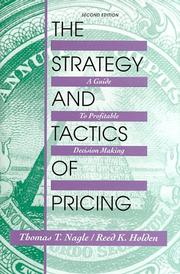
Most FMCG pricing arguments are really arguments about structure rather than a single shelf price: how the ladder runs from small to large packs, how each channel and customer type is priced against list, and how much of that list survives promotions and trade terms. Tim Smith's book organises pricing around those questions, treating price level, price structure and discount management as separate decisions that have to fit together.
The supporting analysis draws on customer value, costs and competitor positions to decide where a price should sit, and it ties price changes to profit rather than to volume alone. For a commercial manager preparing a price-pack architecture review or a list-price increase, that suggests a disciplined sequence: define what the price is meant to achieve, check it against cost and value, then decide how far discounts will be allowed to erode it.
The book was written for a general business audience, with examples from many industries rather than packaged goods. Its structure transfers well to FMCG, but the retailer's control of shelf price and the share of volume sold on promotion mean the discount and policy sections need translating into trade-terms language. Do not expect rules of thumb calibrated to low-unit-price products or to the way grocery buyers negotiate.
Where you can apply it
- Structure a price ladder across small, medium and family packs so that each step has a clear role and the per-unit gap between sizes is deliberate.
- Set rules for how much discount a key account, distributor or channel can receive off list price before the request is escalated.
- Prepare a list-price change by checking it against shopper value, cost movements and competitor price positions.
- Review a year of promotional discounting to see which discounts changed shopper behaviour and which simply reduced realised price.
What you should take away
- Distinguish price level, price structure and discount policy as separate decisions and explain how they interact.
- Describe how value, cost and competitor prices set the range within which a price should sit.
- Draft discount rules that protect realised price and are simple for sales teams to follow.
- Explain a price change to finance and sales colleagues in terms of its effect on profit.
Who benefits most?
Commercial managers, pricing and revenue growth analysts, and sales directors who set or defend price structures and want one organised reference rather than a collection of anecdotes.
Limitations to keep in mind
Published in 2011 for a general business readership, so there is little on retailer-controlled shelf pricing, trade-spend accounting or promotion mechanics in packaged goods. Readers will need to translate the structure and discount material into their own trade-terms vocabulary.
The edition verified for this listing is from 2011. Newer editions may exist; the Amazon page links to them.
Put it to work: related FMCG by Alex guidance
- When the Shopper Says 'Too Expensive': How Price-Pack Architecture Can Save Your FMCG Brand in IndonesiaA practical and witty guide to price-pack architecture in Indonesia, showing how FMCG brands can stay affordable, protect margins and keep shoppers buying when demand is under pressure.
- Pricing Power Playbook for FMCG BrandsA practical framework for improving margin without sacrificing volume in competitive FMCG categories.
Book details
- Author
- Tim J. Smith
- Publisher
- Cengage South-Western
- Edition year
- 2011
- Pages
- 344
- Format
- Book
- ISBN-13
- 9780538480888
- ISBN-10
- 0538480882
- Amazon ASIN
- 0538480882
- Category
- Pricing & Revenue Growth
- Business functions
- Pricing & revenue growth
About this recommendation
Written by the FMCG by Alex editorial team. This is an editorial assessment of how the book applies to commercial work in consumer goods; it is not a hands-on test or a claim of personal endorsement. Bibliographic details come from Open Library, and the Amazon.com listing for ASIN 0538480882 was checked on November 6, 2026. Editorial text last updated November 7, 2026.